
Health & Wellness
NAFDAC alerts Nigerians on substandard, contaminated syrup


The National Agency for Food and Drug Administration and Control (NAFDAC)
has notified the public about five contaminated syrups allegedly going around in World Health Organisation (WHO) regions.

The notification is contained in a public alert No. 037/2023, signed by the Director-General of the agency, Prof. Mojisola Adeyeye, a copy of which was obtained by thecolumn.ng Abuja on Monday (today).
The agency listed the WHO regions to include: America, Eastern Mediterranean, South-East Asia and Western Pacific.
It stated that the five oral liquid dosage forms (syrup and suspension) were also detected in the Maldives and Pakistan and that some of the affected products have also been detected in Belize, Fiji and Lao People’s Democratic Republic.
The agency listed the sysrups as: ALERGO Syrup, EMIDONE Suspension, MUCORID Syrup, ULCOFIN Suspension and ZINCELL Syrup, adding that “a total of 23 batches of the products are affected and the stated manufacturer is
PHARMIX LABORATORIES (PVT.) LTD (Pakistan).
“In November 2023, samples of five different batches of ALERGO syrup were screened for non-compliance by the quality control laboratory of the Maldives Food and Drug Authority (MFDA).
“This is in accordance with the Thin Layer Chromatography (TLC) test for Diethylene Glycol and Ethylene Glycol for inclusion in the International Pharmacopoeia.
“The routine screening detected potentially unacceptable amounts of diethylene glycol and ethylene glycol as contaminants.
“Laboratory testing conducted by the Therapeutic Goods Administration of Australia (TGA) confirmed that all five batches were contaminated with ethylene glycol at levels ranging from 0.62 to 0.82 per cent w/w relative to the accepted limit of not more than 0.10% w/w.
“A follow-on inspection of PHARMIX LABORATORIES (PVT.) LTD was conducted by the Drug Regulatory Authority of Pakistan (DRAP).
“The DRAP review of the manufacturing facility and manufacturing records suggested that diethylene glycol/ethylene glycol as contaminants may be present in other products and batches manufactured by PHARMIX LABORATORIES (PVT.) LTD.
The NAFDAC boss said that as a precautionary measure, DRAP had instructed PHARMIX LABORATORIES to stop production of all oral liquid dosage medicines and issued
a Recall Alert for the five different oral dosages manufactured by the company.
She disclosed that Diethylene Glycol and Ethylene Glycol are toxic to humans when consumed and can prove fatal.
According to her, toxic effects can include abdominal pain, vomiting, diarrhoea, inability to pass urine, headache, altered mental state, and acute kidney injury which may lead to death.
The NAFDAC boss stated that manufacturers of liquid dosage forms, especially syrups that contain excipients, are at risk of contamination with EG/DEG such as glycol, sorbitol, and/or glycerin/glycerol.
Adeyeye added that the substandard products referenced in the alert are unsafe and that their use, especially in children, may result to serious injury or death.
She stated that although the products are not registered by NAFDAC, they may have been distributed through formal and informal markets to other countries or regions, including Nigeria.
She implored importers, distributors, retailers and consumers to exercise caution and increase vigilance within the supply chain to avoid the importation, distribution, sale and use of substandard cough syrups.
She said all medical products must be obtained from authorised/licensed suppliers, adding that products’ authenticity and physical condition should be carefully checked when buying.
The director-general advised the public, who have the listed products not to sell or use the products, but submit stock to the nearest NAFDAC office.
She urged those who may have used the products to seek immediate medical advice from qualified healthcare professionals.
She also advised healthcare professionals and consumers to report any suspicion of adverse drug reactions, or substandard and falsified medicines to the nearest NAFDAC office on 0800-162-3322 or via email: [email protected].
She encouraged healthcare professionals and patients to report adverse or side effects related to the use of the medicinal product to the nearest NAFDAC office, or through the use of E-reporting platforms available on the NAFDAC website www.nafdac.gov.ng or via the Med- safety application available for download and IOS stores or via e-mail on




The Economic and Financial Crimes Commission (EFCC), on Monday, disclosed that more than 40 of its personnel have been dismissed in the past two and a half years.
The commission revealed that they were sacked over their involvement in alleged corruption and financial malfeasance that could tarnish the image of the agency.
The EFCC Chairman, Ola Olukoyede, who disclosed this in Abuja when he met with media executives and other journalists in Abuja, said more than five of them are currently facing prosecution.
According to him, the case files of others involved that are yet to face the wrath of the law were being prepared for prosecution.
He stressed that these were part of the efforts to ensure that personnel of the anti-graft agency maintained the highest standards of integrity while investigating and prosecuting corruption cases.
“In the past two and a half years or three years of my service, I have asked them to dismiss over 40 staff on account of corruption and financial malpractice.
“More than five of them are being prosecuted at the moment. You can follow those cases in court; they are public knowledge,” the anti-graft agency boss told journalists.
The EFCC chairman said the commission had also introduced measures to strengthen accountability among its personnel, including a gift policy designed to regulate the acceptance and declaration of gifts by staff.
According to him, personnel would be required to declare assets valued above a specified threshold, including gifts received from relatives abroad.
He said the commission would determine the categories and value of gifts that its personnel could accept, stressing that the policy was aimed at ensuring that staff could account for their means of livelihood and standard of living.
Olukoyede warned that EFCC personnel could not effectively fight corruption while engaging in corrupt practices themselves.
He also disclosed that the commission had renamed its former Department of Internal Affairs as the Department of Ethics and Integrity, as part of efforts to strengthen internal accountability.
Olukoyede said the commission’s anti-corruption activities had also contributed significantly to revenue mobilisation, with federal and state tax recoveries amounting to approximately N288.1 billion during the period under review.
He said the figure comprised about N173.2 billion in federal tax recoveries and N114.9 billion attributed to state internal revenue services.
“This is fiscal value recovered through enforcement of existing obligations, not through the imposition of new taxes,” he said.
The EFCC chairman further disclosed that approximately N257.2 billion in naira recoveries were recorded for federal ministries, departments and agencies.
‘N1.23tn recovered in 3 years’
Olukoyede said the commission recovered N1.23tn, $684.48m, £373,905.78 and €9.34m between October 1, 2023, and June 30, 2026.
He explained that about N397.26 billion, representing 33 per cent of the naira recoveries, constituted direct recoveries for the Federal Government, while N836.34 billion, or 67 per cent, represented indirect recoveries made on behalf of ministries, departments and agencies, state revenue services, companies, individuals and foreign victims.
On the utilisation of recovered funds, Olukoyede said N661.32 billion and $492.37 million had been released to beneficiaries during the period.
He said the naira releases included about N325.35 billion paid directly to individuals and corporate bodies, while N335.97 billion was released to various MDAs, the Nigerian Revenue Service and state internal revenue services, among other beneficiaries.

Conference of the West African College of Physicians, WACP, has urged government at all levels to strengthen the health system or risk worsening the ongoing migration of skilled medical professionals, declining service delivery, and deepening pressures on already overstretched hospitals.
The position was made at a press conference held at the Theophilus Ogunlesi Hall, University of Ibadan on Monday, to formally announce activities marking the 50th Annual General and Scientific Conference of the West African College of Physicians, WACP, Nigeria Chapter.
WACP also highlighted systemic gaps in governance, funding, workforce retention, and healthcare delivery, while emphasising the need for reforms anchored on collaboration, innovation, and patient-centred care.
Speaking at the briefing, the Chairman of the Nigeria Chapter of WACP and Vice President of the College, Prof. Benjamin Uzochukwu, said Nigeria’s health system challenges cannot be solved by restrictive policies but by making local practice more attractive, functional, and sustainable.
Prof. Uzochukwu noted that while artificial intelligence is increasingly useful in modern medicine, especially in diagnosis, it cannot replace the empathy and judgment required in patient care.
He said: “For us and for me in particular, we should not rely solely on artificial intelligence. We must combine it with human intelligence.
“In our clinical practice, we have found that artificial intelligence is very helpful, particularly in diagnosis. However, when it comes to management, the human element is missing.
“Artificial intelligence will not say, ‘I’m sorry.’ However, a clinician’s empathy can help address the social aspects of a patient’s problem by saying, ‘I’m sorry. How are you doing?’ and so on.”
He, however, expressed concern over the continued migration of health workers abroad, warning that brain drain is weakening Nigeria’s healthcare system.
“Brain drain continues to strip our hospitals of experienced specialists,” he said, adding that inflation has further reduced the real value of healthcare workers’ earnings.
On past efforts to curb brain drain, he criticised restrictive measures that limited doctors’ access to international training opportunities, arguing that such policies were counterproductive.
“At one point, the Federal Government introduced a policy that indirectly prevented some doctors from travelling abroad to undertake specialist training. However, we do not believe that this is the appropriate approach.
“To curb brain drain, we must ensure that what we have within the country is sufficient, of high quality, and offers appropriate remuneration to sustain the health system.
“If we strengthen our health system, then anyone who visits a health facility will receive appropriate treatment and quality healthcare services.”
On how Nigeria’s health sector can be revitalised, he said: “We must allocate at least the agreed 15% of the national budget to health. At present, spending is below 6 percent.”
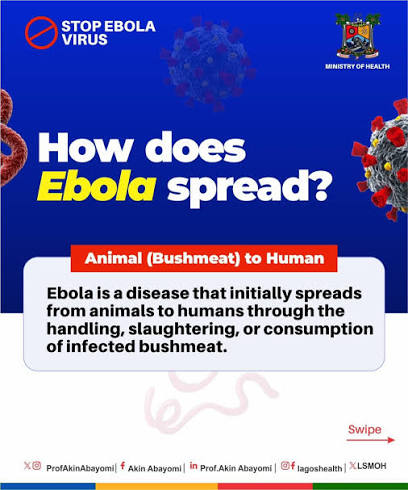
The Lagos State Government has urged residents of Eti-Osa, Ibeju-Lekki and Epe to remain alert and adopt preventive measures against Ebola Virus Disease, EVD, as part of efforts to safeguard public health.
A statement issued by the Lagos state government quoted the Permanent Secretary of Health District III, Dr. Monsurat Adeleke, as saying residents should remain vigilant and adopt preventive measures against Ebola Virus Disease.
According to Adeleke, Ebola Virus Disease is caused by Ebola viruses and can result in severe illness and death if not detected and managed promptly.
She explained that Health District III has intensified community sensitisation programmes aimed at reducing the risk of infection and protecting residents across the affected areas.
The Permanent Secretary noted that the disease spreads mainly through direct contact with the blood, saliva, vomit and other bodily fluids of infected persons or animals.
To prevent transmission, she advised residents to avoid contact with sick persons, dead bodies and wild animals such as bats and monkeys. She also urged members of the public to maintain proper personal hygiene, make regular use of hand sanitisers and avoid eating undercooked meat.
Adeleke stressed the importance of public awareness and adherence to safety measures, noting that prevention remains the most effective way to curb the spread of the disease.
“Although there is no confirmed Ebola outbreak in Nigeria at this time, vigilance, prompt reporting, adherence to infection prevention measures, and community awareness remain essential to protecting lives and preventing the spread of the disease. As such, Health District III is working with relevant agencies to strengthen surveillance, public awareness, and emergency preparedness across Eti-Osa, Ibeju-Lekki, and Epe,” she said.
-
 Health & Wellness1 year ago
President Tinubu Directs Cut in Dialysis Cost from ₦50,000 to ₦12,000
-
 News1 year ago
PICTURE: In Lagos Couple Sentenced to 22½ Years for Cannabis Trafficking
-

 Business5 months ago
Dangote Refinery Reduces Petrol Gantry Price To ₦1,200 Per Litre
-
 Trending News1 year ago
NELFUND Disburses ₦86bn To 449,000 Beneficiaries
-
 Business2 years ago
Heritage Bank Customers’ Path to Securing ₦5m Insured Funds: A Step-By-Step Guide by NDIC”
-
Business2 years ago
Dangote; We Did Not Fix ₦600/Litre Petrol Price
-

 International News5 months ago
Indian Police Arrest Nigerian Over ₦290m Drug Haul
-

 Business5 months ago
After Plea Bargain, Court Discharges Stella Oduah of ₦2.5bn Fraud