
Uncategorized
Defence Headquarters Plans Deployment of 800 Special Forces to Insecure Regions

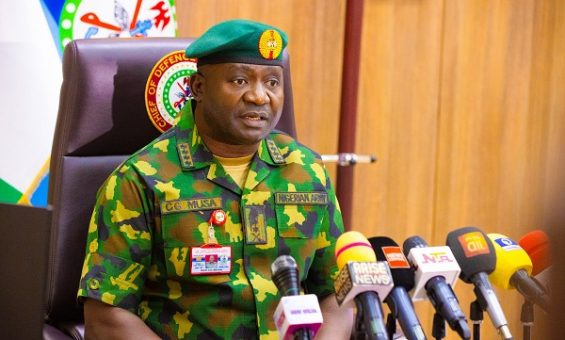
The Defence Headquarters has announced plans to deploy over 800 special forces to troubled states such as Benue, Plateau, and Borno, in a bid to support existing troops in addressing ongoing security challenges.
Chief of Defence Staff Gen. Christopher Musa made this known shortly before Army spokesperson Lt.-Col. Appolonia Anele, announced the death of 17 soldiers during a gun battle with bandits in Niger State.
Ten other soldiers were injured by the bandits during the incident in Bangi, Mariga Local Government Area. The number of bandits neutralised by troops was, however, not given by Lt.-Col. Anele.
At a DHQ training seminar in Abuja yesterday, Gen. Musa revealed that members of the special force are currently undergoing a comprehensive training on how to tackle the rising threats to the nation’s security.
He said: “Sometime next week, we will be graduating the first 800 special forces team trained to face the challenges we are undergoing. The training is very comprehensive.
“We have realised that deploying them in pieces also creates that weakness that we see. We will be deploying them together, a force that stays together, that will understand each other. Because from experience, a fighting force must be able to understand itself.”
The CDS explained that the conference on Performance-Oriented Training and Trends in Contemporary Operating Environment,” was organised as a critical part of a shared commitment to building a professional and combat-ready force equipped to navigate the evolving operational landscape.
“Our mission also aims to create a unified training system that is adaptable, technology-driven, economical, and mission-driven.
“This entails expanding joint training programmes and doctrinal reviews as well as performance simulation and work-giving, among other innovations that will enhance professional operational ability.
“Furthermore, this training will enhance collaboration, cooperation, and ‘jointness’ among the services of other relevant security agencies.”
According to him, an effective response to the country’s complex security threats requires inter-service collaboration, cooperation and rapid integration of artificial intelligence, autonomous systems, advanced surveillance technology and sophisticated electronic cyber warfare.
He emphasised the need for the military to understand the enemy it is dealing with in order to prepare for emerging challenges.
Defence Minister Mohammed Badaru urged the military to ensure that troops’ training aligns with national security objectives.
He said that addressing the country’s security threats required the military to adopt forward-looking strategies based on rigorous training, inter-agency coordination, and real-time adaptation to emerging doctrines and technologies.
Badaru reaffirmed Federal Government’s commitment to supporting the military in overcoming the nation’s security threats.
He said: “As part of our strategic vision, we are working closely with the Services to review and enhance our defence training architecture, with a clear focus on: Aligning training programmes with strategic defence objectives; upgrading facilities and infrastructure in our training institutions, expanding partnership with regional and international military academies and think tanks; Promoting training exercise that reflect both local and global threats and encouraging innovation in training methodology, doctrine development and simulation tools.”
Also in Abuja, Army Spokesperson Lt.-Col. Anele said bandits, numbering 300 on Tuesday morning, launched an attack on Bangi community, prompting a swift land and air component response by troops in Kwanar Dutse Forest.
She said: “The criminals had attempted a night-time transit towards Kwatankoro Forest, where they were reportedly planning coordinated attacks on surrounding communities or looking for a haven to evade the pressure from our operations in Zamfara State.
“However, their movement and actions were effectively disrupted by troops who engaged them in a fierce fire-fight that lasted over three hours.
“Sequel to the ground engagement by the Nigerian Army troops, the Nigerian Air Force conducted precision airstrikes on the terrorists’ withdrawal routes, delivering accurate heavy bombardments on identified terrorists’ locations.”
‘’Although the exact number of casualties could not be ascertained, multiple blood trails along their escape routes indicated significant enemy losses.
“Regrettably, 17 brave and gallant soldiers paid the supreme price during the encounter. Ten others, who sustained varying degrees of injury, were evacuated to a military medical facility, where they are receiving treatment. They are in stable condition.”
She urged the public to continue to support the ongoing counter-terrorism efforts by providing timely information to security agencies “by any means possible.”
The Nation gathered that the bandits had first invaded Kwana Duse, where they engaged soldiers in a gun battle.
According to the Mariga LGA Chairman, Abbas Adam, when residents heard the gunshots, they alerted the military command in Kontagora, which sent a reinforcement team.
Adamu said bad roads made it difficult for the team to arrive at the communities on time, causing the bandits to continue their attack.
The Head of a vigilante group in the area, Mallam Abubakar Sani, also confirmed that some of the bandits were killed during the gun battle.
We are under siege, Niger Assembly laments
Speaker of the state House of Assembly, Abdulmalik Sarkindaji, described the killing of the soldiers as ‘’barbaric, wicked and inhuman.’’
He said: “This is a serious catastrophe that has befallen not only the military but the people of my constituency and the state in general.
‘’I received the news of the killing of these promising young officers who have kept my constituency safe for a long time now with a heavy heart. This is a wicked, barbaric and inhuman act.
“This singular attack is a big setback for the entire farming Mariga Local Government. My entire Constituency is under siege.”
National Assembly wants Benue massacre probed
The National Assembly called for a thorough and transparent investigation into the Yelewata, Benue State massacre.
The call followed the adoption of motions by Senator Titus Zam and Rep. Dickson Tarkighir during plenaries by the Senate and House of Representatives.
In the Senate, where members declared the Benue State killings an act of terrorism, a minute’s silence was observed for the deceased.
The members, who also lauded President Bola Ahmed Tinubu for his response to the tragedy, called on the Federal Government to deploy more military personnel in the troubled state, particularly in Yelewata and other known flashpoints.
Besides, they urged the Federal Government to provide compensation to the families of the deceased and begin the reconstruction of properties destroyed during the attacks.
The Senators agreed to send a delegation to Yelewata as a show of solidarity and to conduct legislative oversight on the humanitarian and security response on the ground.
They also called for comprehensive reforms in Nigeria’s national security strategy, including the adoption of community-based policing models better suited to protecting vulnerable populations.
Before Senate President Godswill Akpabio concluded the session, members also expressed outrage over the killing of 12 wedding-bound travellers from Kaduna State in Mangu Local Government Area of Plateau State on June 21.
“What we are witnessing is state failure, and outside this chamber, there is a final judgment before God,” said Akpabio.
In the House of Representatives, the members charged security agencies to intensify efforts at restoring peace in Yelwata and other affected communities.
They called on the Federal Government to build a Forward Operation Base (FOB) for the Army in Yelwata, to forestall further attacks on the border community.
The House asked its Committee on Interior and Security to immediately visit Yelwata and other communities affected by the attacks.
It also asked the Ministry of Humanitarian Affairs, Disaster Management and Social Development and the National Emergency Management Agency (NEMA) to urgently provide adequate relief materials and medical assistance to the displaced persons.
Abuja to host Africa Chiefs of Defence Staff summit
President Bola Ahmed Tinubu has approved the hosting of the African Chiefs of Defence Staff summit in Abuja.
The three-day summit, aimed at proffering home-grown solutions to the continent’s security challenges, will begin on August 25.
Chairman of the planning committee Air Vice- Marshal Precious Amadi told reporters that 53 Defence chiefs including those of Burkina Faso, Niger and Mali, have indicated interest to attend the summit.
“In the light of current realities, it has become imperative to seek African solutions to African problems. And it is in recognition of this, President Bola Ahmed Tinubu approved the Defence Headquarters to host the maiden African Chiefs of Defence Staff Summit,” he said.






The Borno State Police Command has arrested and arraigned five men in Maiduguri for allegedly printing and wearing T-shirts bearing the inscription “Tinubu Must Go.”
According to a First Information Report (FIR) issued by the State Criminal Investigation Department (SCID) and verified through court officials, the suspects are Baba Aji Gremami (44), Mustapha Abba Yemen (28), Abbacha Mohammed Ali (32), Adam Umar Gubio (21), and Abdulhamid Mohammed (21)
The document, dated September 29, 2026, stated that the incident occurred on September 25 at around 11:00 a.m. around the West End Roundabout community in the Borno State capital.
The police charged the defendants with criminal conspiracy, inciting disturbance, disturbance of public peace, and thuggery—offences the prosecution argues run contrary to Sections 60, 78, 79, and 392 of the Borno State Penal Code.
When the case was brought before the Chief Magistrate Court I in Maiduguri, all five defendants pleaded not guilty. Their legal counsel subsequently moved a bail application.
The presiding judge adjourned the matter to October 6, 2026, for a ruling on bail, while the substantive trial has been slated for October 26, 2026.
The arrest and prosecution of the five men for wearing politically themed T-shirts has sparked widespread outrage, drawing severe condemnation from social media commentators and human rights giant Amnesty International.
A report said the police action has fueled allegations from critics accusing a prominent state politician of orchestrating the detentions to stifle political opposition.
Meanwhile, in a strongly worded statement, Amnesty International has slammed the charges against the men as bizarre, labeling their detention as an act of arbitrary arrest.
The organization emphasized that expressing peaceful political dissent through clothing is a fundamental human right, not a criminal offense.
“Clearly, the intention of this reign of repression in Borno State appears to be selective injustice to curtail the opposition in the political space.
“It is sadly creating a toxic climate of fear that is contrary to the democratic principles of freedom and justice,” the statement read.
Amnesty International demanded the immediate and unconditional release of the detainees, a development it termed “sham trial based on bogus charges.”
The organization reiterated that the right to peacefully express political opinions must be protected rather than stifled in a democratic society.
The arrests have similarly ignited fierce debate online, with social media users condemning the police action as an abuse of power and a blow to free speech.

The Rule of Law and Accountability Advocacy Centre (RULAAC) has petitioned the Anambra State Commissioner of Police over the alleged unlawful arrest and four-day detention of a woman by operatives of the Rapid Response Squad (RRS), Awkuzu, formerly known as the Special Anti-Robbery Squad (SARS).
RULAAC, in a letter signed by its Executive Director, Okechukwu Nwanguma, dated September 5, alleged that Ms. Nwosu Chikamso Jennifer was arrested on August 31, 2026, not over an offence linked to her but in connection with the police search for her brother, who is reportedly wanted over an alleged murder case.
According to the organisation, Nwosu alleged that she was detained for four days and was expected to produce her brother despite not being accused of complicity in the alleged offence.
The organisation said Nwosu further alleged that she was released on September 3 after ₦600,000 was paid, with the payment allegedly described as being for “administrative bail.”
RULAAC said no receipt or acknowledgement was reportedly issued for the payment.
The complainant also alleged that her mobile phone was seized by the police and retained without a seizure form or property receipt.
The organisation identified the investigating officer in the matter as Mr Odoh Kingsley of RRS Awkuzu.
RULAAC said Nwosu had been directed to report again on Monday, September 7, 2026, but was apprehensive that she could face renewed detention or further demands for money.
The rights group therefore called on the Commissioner of Police to urgently intervene and verify the allegations before Nwosu’s scheduled appearance at the police facility.
RULAAC described the alleged arrest and detention of Nwosu over her brother’s alleged offence as a possible case of “arrest by proxy” or “arrest in lieu.”
The organisation argued that arresting a person merely to compel the surrender of a relative raises serious constitutional and human-rights concerns.
“If the claims are substantially correct, the actions complained of would raise grave legal and human-rights concerns,” the organisation said.
“Arresting and detaining a person merely to compel the surrender of a relative amounts to arrest by proxy or arrest in lieu, a practice expressly prohibited by Nigerian law.”
RULAAC also raised concerns about the alleged four-day detention, saying that holding a person beyond the constitutionally permissible period without taking the individual before a court could violate legal safeguards on arrest and detention.
It further described the alleged ₦600,000 payment as “particularly disturbing,” stressing that police bail is free.
The organisation said the allegations were particularly concerning because they involved the Awkuzu facility, which became notorious for alleged human rights abuses during the era of SARS.
RULAAC said the transition from SARS to RRS should have represented more than a change of name.
“These allegations, if established, inevitably evoke the ugly memories of the abuses historically associated with the former SARS facility at Awkuzu,” the organisation said.
“The transition from SARS to RRS ought to signify more than a change of name; it should represent a decisive institutional break from arbitrary detention, arrest by proxy, extortion and other practices that brought the former unit into disrepute.”
RULAAC said the alleged conduct, if established, would be inconsistent with safeguards contained in the Nigerian Constitution, the Police Act 2020 and applicable criminal justice legislation.
In its requests to the Commissioner of Police, RULAAC asked the police authorities to establish the circumstances and legal basis for Nwosu’s arrest and four-day detention.
It also demanded an investigation into the alleged ₦600,000 payment, including determining who allegedly demanded or received the money.
The organisation requested that the money be refunded if it was found to have been unlawfully collected.
RULAAC further asked the police to establish the legal basis for the seizure and continued retention of Nwosu’s phone and ensure that any property retained for investigative purposes is properly documented.
It also urged the police to ensure that Nwosu’s scheduled appearance on September 7 would not result in further arbitrary detention, intimidation or unlawful financial demands.
The organisation asked the police to ensure that Nwosu was not held responsible for producing her brother or punished for his alleged conduct without evidence establishing her own involvement in an offence.
It also called for disciplinary or other appropriate action against any police officer found to have acted unlawfully.
The rights organisation stressed that it recognised the responsibility of the police to investigate serious crimes, including murder allegations.
It said its intervention was not intended to obstruct the investigation into Nwosu’s brother.
“Nothing in this intervention is intended to obstruct any lawful investigation,” RULAAC said.
“Our concern is simply that the investigation must be conducted within the bounds of the law and that no citizen should be deprived of liberty or subjected to financial demands merely because the Police are seeking a relative.”
The organisation urged the police command to respond to the complaint and disclose the steps taken to address the allegations.
International News
Maguire: Tuchel Told Me By Video Call I Was Out And I Said I Was Very Disappointed
On “The Rest is Football” podcast, Manchester United center-back Maguire discussed how Tuchel informed him via video call that he had not been selected for the World Cup squad.
Maguire revealed: “He (Tuchel) video-called everyone. It was quite an awkward call. I first received a message asking if he could talk to me around 4 PM. It was quite a unique approach, and certainly difficult, because he could see everyone’s reactions.
“I said directly that I was really very disappointed. I felt I had done well enough to deserve to be in the squad, and I felt I could have helped the team, playing a role on and off the pitch. He said he couldn’t give me any excuses, but he chose the four players who had helped him through a difficult period last autumn.
“It was hard to accept. After being called up by him for the first time in the March training camp, I did think I would be in the squad. I performed well in both games and then returned to Manchester United, finishing the season with a very strong performance.”
Tuchel ultimately chose to take Stones, Guehi, Konsa, Quansah, and Dan Burn to the World Cup.
No Plans to Retire from England Duty
Furthermore, even with Tuchel’s contract extending to Euro 2028, Maguire is unwilling to close the door on playing for England.
He added: “I don’t think I’ll retire from England duty. I still feel I can shine. Sooner or later there will be a time and a point where I no longer deserve to be selected for England, but even then, I most likely won’t proactively step out and announce my retirement. If I can play for England one more time, it will all be worth it.”
Maguire will use the off-season to fully recover and prepare for Manchester United’s return to the Champions League in the 2026-27 season. While his England teammates face the immense pressure of a major international tournament, the experienced defender will strive to maintain his excellent club form. If he is to earn a recall to the England squad later this year, proving his endurance in the Premier League remains crucial.
-
 Health & Wellness1 year ago
President Tinubu Directs Cut in Dialysis Cost from ₦50,000 to ₦12,000
-
News2 years ago
CBN Debunks Fake Circular on New ₦5,000 and ₦10,000 Notes
-
 Business7 months ago
Dangote Refinery Reduces Petrol Gantry Price To ₦1,200 Per Litre
-
 International News7 months ago
Indian Police Arrest Nigerian Over ₦290m Drug Haul
-
 Business7 months ago
After Plea Bargain, Court Discharges Stella Oduah of ₦2.5bn Fraud
-
Business2 years ago
Dangote; We Did Not Fix ₦600/Litre Petrol Price
-
 Trending News1 year ago
NELFUND Disburses ₦86bn To 449,000 Beneficiaries
-
 Opinion2 years ago
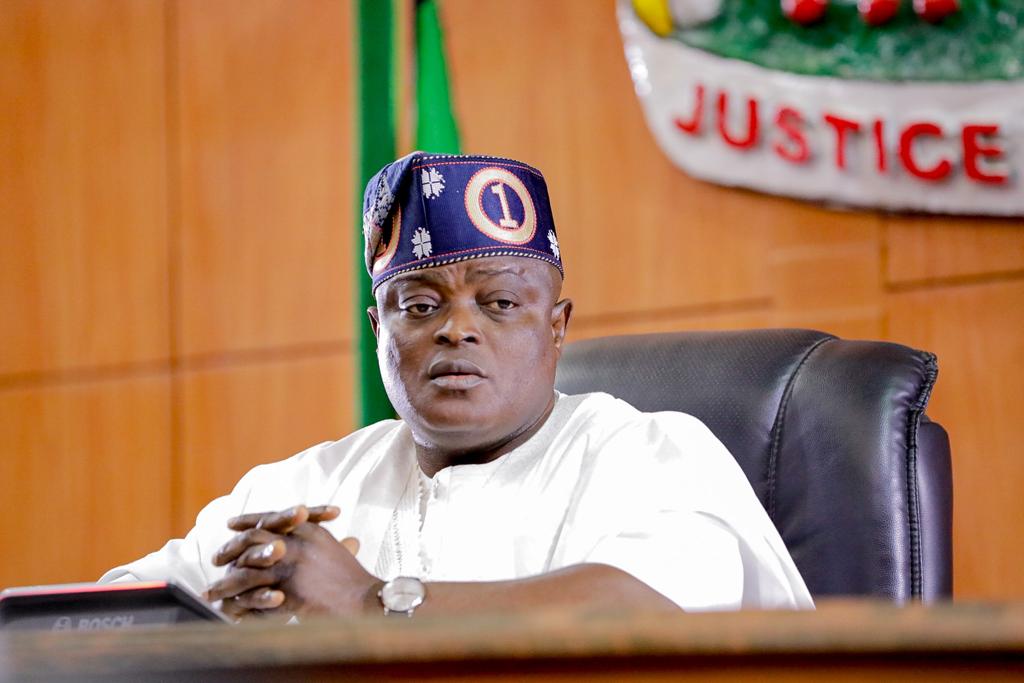
Championing the People’s Voice: Obasa’s Dedication to Grassroots Representation By Dave Agboola⁰