Connect with us

International News

Israel Kills Another Top Hezbollah Official In Lebanon Strike

Published

on

Spread the love

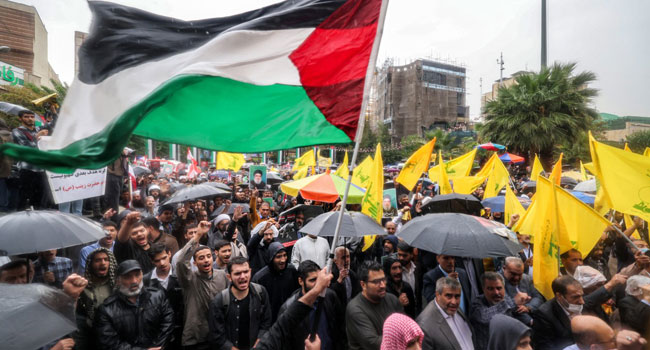
A demonstrator waves a Palestinian flag while gathering with others in the rain for an anti-Israel protest in Tehran’s Palestine Square on September 28, 2024, after the Iran-backed Lebanese Hezbollah group confirmed reports of the killing of its leader Hassan Nasrallah in an Israeli air strike in Beirut the previous day. (Photo by ATTA KENARE / AFP)


Israel said Sunday it killed another senior Hezbollah official in an air strike on the Lebanese capital after dealing the Iran-backed group a seismic blow by assassinating its leader, Hassan Nasrallah.

Israel announced the killing of Nabil Qaouq, a member of Hezbollah’s central council in a strike Saturday, adding that its air force continued to hit “dozens” more targets around Lebanon on Sunday.

Israeli strikes have in recent months decimated Hezbollah’s senior command structure, with Nasrallah’s right-hand man Fuad Shukr, head of the elite Radwan Force Ibrahim Aqil and others among the dead.

The past week’s waves of strikes on Hezbollah strongholds around Lebanon have also plunged the tiny Mediterranean country and the wider region into fear of even more violence to come.

Hezbollah launched low-intensity cross-border strikes on Israeli troops after its Palestinian ally Hamas staged its unprecedented attack on Israel on October 7, sparking the war in the Gaza Strip.

Nearly a year later, Israel announced a shift in its focus to battling Hezbollah on its northern front.

Hezbollah confirmed Nasrallah’s killing in a massive strike on Friday on the group’s main bastion in south Beirut.

“We all started crying,” Maha Karit told AFP in Beirut after Nasrallah’s death.

With Lebanon already mired in political and economic crisis, the escalation has pushed it to the brink, as the bombardment has killed over 700 people in a week, according to health ministry figures.

The Israeli military said on Sunday its air force had struck “dozens of Hezbollah terror targets” after carrying out “hundreds” of strikes on Friday and Saturday.

It then announced that Qaouq was “struck and eliminated” in a strike on south Beirut on Saturday.

Hezbollah has yet to officially announce Qaouq’s death but a source close to the group said he had been killed.

Lebanon’s National News Agency reported a string of raids in and around the city of Baalbek in the east.

At least six people were killed in a strike on a house in the northeastern Hermel region, the agency reported, while an emergency response group affiliated with Hezbollah ally the Amal movement said five of its rescuers were killed in the south.

Hezbollah said its fighters launched “a volley of Fadi-1” rockets at an Israeli base in the Golan Heights early Sunday. The Israeli military reported “approximately eight” launches from Lebanon that fell in unpopulated areas near the Israeli-annexed territory.

Cult status

Nasrallah was the face of Hezbollah, enjoying cult status among his supporters.

Prime Minister Benjamin Netanyahu said Israel had “settled the score” with Nasrallah’s killing, while Israeli military spokesman Daniel Hagari said the world was “a safer place” without him.

US President Joe Biden — whose government is Israel’s top arms supplier — said it was a “measure of justice for his many victims”.

Analysts told AFP that Nasrallah’s death leaves bruised Hezbollah under pressure to respond.

“Either we see an unprecedented reaction by Hezbollah… or this is total defeat,” said Heiko Wimmen of the International Crisis Group think tank.

The assassination also showcased Israel’s military and intelligence prowess.

“It demonstrates… just how deeply Israel has penetrated Hezbollah,” said James Dorsey of Singapore’s S. Rajaratnam School of International Studies.

Hezbollah backer Iran has condemned Nasrallah’s assassination, with First Vice President Mohammad Reza Aref threatening it would bring about Israel’s “destruction”.

On Sunday, Iran’s Foreign Minister Abbas Araghchi also vowed that the killing of its Revolutionary Guards general Abbas Nilforoushan alongside Nasrallah would “not go unanswered”.

Hamas condemned Nasrallah’s killing as a “cowardly terrorist act”, while Lebanon, Iraq, Iran and Syria all declared public mourning.

Allied armed groups across the region like Yemen’s Huthi rebels, already drawn into the Gaza war, have vowed action against Israel.

An “unmanned aerial target” approaching Israel over the Red Sea — where the Iran-backed Huthis have launched attacks before — was intercepted on Sunday, the Israeli military said. There was no immediate claim of responsibility.

 ‘Breaking point’

Most of the deaths in Lebanon came on Monday, the deadliest day of violence since the country’s 1975-1990 civil war.

UN refugee chief Filippo Grandi said “well over 200,000 people are displaced inside Lebanon” and more than 50,000 have fled to neighbouring Syria.

Lebanese Prime Minister Najib Mikati however warned the figure could be much higher, saying up to one million people may have been forced from their homes.

It was potentially the “largest displacement movement” in the country’s history, he said.

The World Food Programme said it had launched an emergency operation to provide meals and support for “up to one million people” affected by the escalation.

“Lebanon is at a breaking point and cannot endure another war,” said WFP regional director Corinne Fleischer.

Diplomats have said efforts to end the war in Gaza were key to halting the fighting in Lebanon and bringing the region back from the brink.

In Gaza, AFP correspondents reported several air strikes during the night and shelling from a navy boat.

Civil defence spokesman Mahmud Bassal said an Israeli strike killed at least three Palestinians in a house in Gaza City, with three more killed in two separate strikes in the territory’s north and centre.

Hamas’s October 7 attack on Israel resulted in the deaths of 1,205 people, mostly civilians, according to an AFP tally based on Israeli official figures that include hostages killed in captivity.

Of the 251 hostages seized by militants, 97 are still held in Gaza, including 33 the Israeli military says are dead.

Israel’s retaliatory military offensive has killed at least 41,595 people in Gaza, most of them civilians, according to figures provided by the Hamas-run territory’s health ministry. The UN has described the figures as reliable.


AFP

International News

US, Iran in counter threats over Strait of Hormuz

Published

on

Spread the love

As the stand-off over the Strait of Hormuz continued, following its effective blockade by Iran, the US and the gulf state are trading threats of further destruction of energy and oil infrastructure across the Middle East with US President, Donald Trump, saying Tehran would face possible obliteration of its energy facilities if it failed to reopen the channel within 48 hours.


In a swift response, Iran threatened to irreversibly destroy US-linked energy sites across the Middle East if its power plants were targeted.

The 48 hours deadline expires today.

Trump’s ultimatum came hours after two Iranian missiles struck southern Israeli towns of Arad and Dimona, injuring more than 160 people in the most destructive attack since the war began.

This, the Israeli Prime Minister, Benjamin Netanyahu, vowed to retaliate “on all fronts”.

Iran had blocked the vital waterway, which carries a fifth of global crude oil trade in peacetime, as its key leverage in the war.

The standoff has sent crude oil prices soaring, with North Sea Brent crude now trading above $105 a barrel, as long-term consequences for the global economy become an acute concern.

The ultimatum, made just a day after the US president said he was considering winding down military operations after three weeks of war, came as the key oil passage remained effectively closed and thousands more US Marines headed to the Middle East.

Iran’s foreign minister, Abbas Araghchi, said Tehran had imposed restrictions only on vessels from countries involved in attacks against Iran, and would assist others that stayed out of the conflict.

Meanwhile, issuing the threat via  his Truth Social, Trump said that the US would “hit and obliterate various Iran power plants starting with the biggest one first if Tehran did not fully reopen the strait within 48 hours.”

Reinforcing Trump’s threat, US Treasury Secretary, Scott Bessent, said the US may need to “escalate” its attacks against Iran to be able to wind down the war.

Asked on NBC’s “Meet the Press” if Trump was winding down or escalating the war, Bessent said: “They’re not mutually exclusive. Sometimes you have to escalate to de-escalate.”

“This is the only language the Iranians understand,” he argued.

Iran threatens US-linked Gulf energy sites after

In response to Trump’s threat, Iran’s army said it would target energy and desalination infrastructure belonging to the US and the regime in the region, according to the Fars news agency.

In a post on X, speaker of the Iranian parliament, Mohammad-Bagher Ghalibaf,

said that vital infrastructure, energy and oil facilities throughout the region will be considered “legitimate targets” and would be destroyed in an irreversible manner.

“Immediately after the power plants and infrastructure in our country are targeted, the critical infrastructure, energy infrastructure, and oil facilities throughout the region will be considered legitimate targets and will be destroyed in an irreversible manner, and the price of oil will remain high for a long time,” Ghalibaf said.

Similarly, Iran’s Islamic Revolutionary Guard Corps (IRGC) intelligence unit in a post on X published by the IRGC affiliated Fars News Agency, said that it is thinking “beyond just the region”.

The post explained that this referred to a “red target bank” of technological and political targets in response to threats against power plants, suggesting that action could be taken “in less than 48 hours”.

The post also lists several achievements the IRGC claimed to have made during the war, including what it described as the “consolidation of power in the Strait,” and “control of global energy.”

To completely shut down the strait

Besides the threats of targeting energy infrastructure across the region,  Iran’s military also threatened to completely shut down the strategic Strait of Hormuz if Trump acts on threats to target the country’s power plants.

“If the United States’ threats regarding Iran’s power plants are carried out… the Strait of Hormuz will be completely closed, and it will not be reopened until our destroyed power plants are rebuilt,” the military’s operational command, Khatam Al-Anbiya, said in a statement carried by state TV.

The military said it would also strike Israel’s “power plants, energy, and information and communications technology (ICT) infrastructure”, along with power plants in regional countries hosting US bases and companies with US shareholders.

It added that the measures will be taken “to defend our country and the interests of our nation”.

Iran charges $2m from ships passing through Strait of Hormuz – Iranian MP

BBC quoted Iranian Member of Parliament, Alaeddin Boroujrrdi, as saying on state TV that some of the ships that pass through the Strait of Hormuz were being charged “ a $2 (£1.5) million fee” by Iran.

He said that a “new governing regime” was being imposed in the Strait claiming that “war has costs”. According to him, the closure of the Strait shows the “authority and right that the Islamic Republic of Iran possesses”.

Iran’s deadly strikes on southern Israel injures 160

Meanwhile, retaliating against Israel’s strike on its Natanz nuclear facility, Iran struck southern Israel towns of Arad and Dimona, injuring more than 160 people in the most destructive attack since the war began. The Israel prime minister, Benjamin Netanyahu, vowed to retaliate “on all fronts”

The strikes, which slipped through Israel’s missile defence systems, tore open the facades of residential buildings and carved craters into the ground.

First responders said 84 people were injured in the town of Arad, 10 of them seriously. Hours earlier, 33 were wounded in nearby Dimona, where AFPTV footage showed a large hole gouged into the ground next to piles of rubble and twisted metal.

Dimona hosts a facility widely believed to be the site of the Middle East’s only nuclear arsenal, although Israel has never admitted to possessing nuclear weapons.

The Israeli army told Agence France-Presse there had been a direct missile hit on a building in Dimona, with casualties reported at multiple sites, including a 10-year-old boy in serious condition with shrapnel wounds.

Iran said the targeting of Dimona was retaliation for Israeli strikes on its Natanz nuclear facility, with the IRGC saying forces also targeted other southern Israeli towns as well as military sites in Kuwait and the UAE.

After the Natanz attack, the UN nuclear watchdog chief, Rafael Grossi, reiterated his call for “military restraint to avoid any risk of a nuclear accident”.

The Natanz facility hosts underground centrifuges used to enrich uranium for Iran’s disputed nuclear programme; it sustained damage in the June 2025 war.

The Israeli military denied it was behind the Natanz strike, but said it had struck a facility at a Tehran university that it claimed was being used to develop nuclear weapon components for Iran’s ballistic missile programme.

Attacks on nuclear sites create escalating threat to public health, WHO chief warns

The Iran war has reached a “perilous stage” as both sides target nuclear facilities, the Director-General of the World Health Organisation, Tedros Adhanom Ghebreyesus, has warned.

Ghebreyesus cited reports about Israel striking the Natanz enrichment complex in Iran, and retaliatory Iranian attacks on the Israeli city of Dimona, where a nuclear facility is located.

Ghebreyesus said the International Atomic Energy Agency was looking into both attacks.

“No indications of abnormal or increased off-site radiation levels have been reported,” he said in a post on X.

But he added: “Attacks targeting nuclear sites create an escalating threat to public health and environmental safety.

“Since the outbreak of hostilities, WHO has provided critical training to its own staff and UN personnel across 13 countries to help them respond effectively to public health threats in the event of a nuclear incident.

“I urgently call on all parties to exercise maximum military restraint and avoid any actions that could trigger nuclear incidents.

“Peace is the best medicine.”

Continue Reading

International News

Peru Congress Impeaches Interim President After Four Months In Office

Published

on

Spread the love

Peru’s Congress on Tuesday impeached interim president Jose Jeri, the Latin American country’s seventh head of state in 10 years and only the latest to be toppled over graft claims.

Jeri, 39, was accused of the irregular hiring of several women in his government and of suspected graft involving a Chinese businessman.

In office since last October, Jeri took over from unpopular leader Dina Boluarte, who was also impeached amid protests against corruption and a wave of violence linked to organised crime.

Prosecutors last week opened an investigation into “whether the head of state exercised undue influence” in government appointments.

Jeri has protested his innocence.

Jeri — at the time the head of Peru’s unicameral parliament — was appointed last year to serve out the remainder of Boluarte’s term, which runs until July, when a new president will take over following elections on April 12.

He is constitutionally barred from seeking election.

Jeri has found himself in the spotlight over claims revealed by investigative TV program Cuarto Poder that five women were improperly given jobs in the president’s office and the environment ministry after meeting with Jeri.

Prosecutors said there were in fact nine women.

Jeri is also under investigation for alleged “illegal sponsorship of interests” following a secret meeting with a Chinese businessman with commercial ties with the government.

Institutional Crisis 

Some observers have pointed to possible politicking in the censure of Jeri just weeks before elections for which over 30 candidates — a record — have tossed their hats into the ring.

The candidate from the right-wing Popular Renewal party, Rafael Lopez Aliaga, who leads in opinion polls, has been among the most vocal in calling for Jeri’s ouster.

Congress is now set to elect its own new leader on Wednesday to replace a caretaker in the post. The new parliament president will automatically take over as Peru’s interim president until July.

“It will be difficult to find a replacement with political legitimacy in the current Congress, with evidence of mediocrity and strong suspicion of widespread corruption,” political analyst Augusto Alvarez told AFP ahead of Tuesday’s vote.

Peru has now burned through seven presidents since 2016, several of them impeached, investigated or convicted of wrongdoing.

The South American country is also gripped by a wave of extortion that has claimed dozens of lives, particularly of bus drivers — some shot at the wheel if their companies refuse to pay protection money.

In two years, the number of extortion cases reported in Peru jumped more than tenfold — from 2,396 to over 25,000 in 2025.

Continue Reading

International News

Social Media Suspended In Gabon ‘Until Further Notice’

Published

on

Spread the love

Gabon’s media regulator on Tuesday announced the suspension of social media platforms “until further notice”, blaming content posted online for stoking conflict and division in society.


The High Authority for Communication imposed “the immediate suspension of social media platforms in Gabon”, its spokesman Jean-Claude Mendome said in a televised statement.

He said “inappropriate, defamatory, hateful, and insulting content” was undermining “human dignity, public morality, the honour of citizens, social cohesion, the stability of the Republic’s institutions, and national security”.

The communications body spokesman also cited the “spread of false information”, “cyberbullying” and “unauthorised disclosure of personal data” as reasons for the decision.

“These actions are likely, in the case of Gabon, to generate social conflict, destabilise the institutions of the Republic, and seriously jeopardise national unity, democratic progress, and achievements,” he added.

The regulator did not specify any social media platforms that would be included in the ban.

However, the regulator said “freedom of expression, including freedom of comment and criticism,” remained “a fundamental right enshrined in Gabon”.

Less than a year after being elected, Gabonese President Brice Oligui Nguema has faced his first wave of social unrest, with teachers on strike and other civil servants threatening to down tools.

School teachers began striking over pay and conditions in December and protests over similar demands have since spread to other public sectors — health, higher education, and broadcasting.


AFP

Continue Reading

Trending

Copyright © 2026 TheColumn NG