
International News
Thailand, Cambodia Clash With Jets, Rockets In Deadly Border Row


Thailand launched air strikes on Cambodian military targets on Thursday as Cambodia fired rockets and artillery, killing at least 11 civilians, in a dramatic escalation of a long-running border row between the two neighbours.
The neighbours are locked in a bitter spat over an area known as the Emerald Triangle, where the borders of both countries and Laos meet, and which is home to several ancient temples.

The squabble has dragged on for decades, flaring into bloody military clashes more than 15 years ago and again in May, when a Cambodian soldier was killed in a firefight.
The conflict blazed up on Thursday, with Cambodia firing rockets and artillery shells into Thailand and the Thai military scrambling F-16 jets to carry out air strikes.

The Thai Ministry of Public Health said at least 11 civilians had been killed, most of them in a rocket strike near a petrol station in Sisaket province.
Footage from the scene showed smoke pouring from the roof of a convenience store attached to the petrol station.
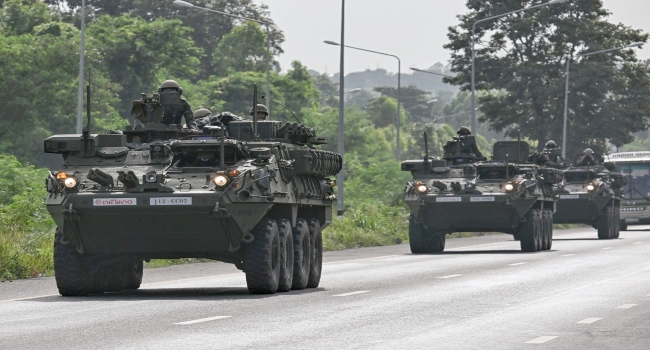 Royal Thai Army soldiers are pictured on armoured vehicles on a road in Chachoengsao province on July 24, 2025. (Photo by Lillian SUWANRUMPHA / AFP)
Provincial officials said most of the dead were students inside the shop when the attack happened.
Six Thai air force jets were deployed from Ubon Ratchathani province, hitting two “Cambodian military targets on the ground,” according to Thai military deputy spokesperson Ritcha Suksuwanon.
Both sides blamed the other for starting the fighting, which erupted near two temples on the border between the Thai province of Surin and Cambodia’s Oddar Meanchey.
Cambodian defence ministry spokeswoman Maly Socheata said in a statement that Thai troops launched an “armed assault on Cambodian forces”.
“In response, the Cambodian armed forces exercised their legitimate right to self-defence, in full accordance with international law, to repel the Thai incursion and protect Cambodia’s sovereignty and territorial integrity,” she said.
Cambodian Prime Minister Hun Manet requested an urgent meeting of the UN Security Council to address what his foreign ministry labelled “unprovoked military aggression”.
Thailand’s government spokesman, meanwhile, accused Cambodia of being “inhumane, brutal and war-hungry,” and Bangkok’s foreign ministry said all border crossings had been shut and nearby residents evacuated.
The Thai military blamed Cambodian soldiers for firing first, and later accused them of a “targeted attack on civilians,” saying two BM-21 rockets had hit a community in Surin’s Kap Choeng district, wounding three people.
According to the Thai military, the clashes began around 7:35 am (0035 GMT) when a unit guarding Ta Muen temple heard a Cambodian drone overhead.
Later, six armed Cambodian soldiers, including one carrying a rocket-propelled grenade launcher, approached a barbed-wired fence in front of the Thai post, the army said.
Around 8:20 am, Cambodian forces opened fire toward the eastern side of the temple, about 200 metres from the Thai base.
Thailand’s acting Prime Minister Phumtham Wechayachai said “the situation requires careful handling” in accordance with international law.
“We will do our best to protect our sovereignty,” he said.
In a Facebook post, Thailand’s embassy in Phnom Penh urged its nationals to leave Cambodia “as soon as possible” unless they had urgent reasons to remain.
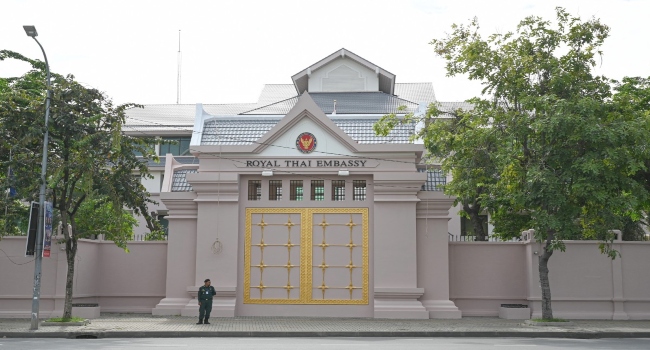
China, a close ally of Cambodia, said it was “deeply concerned” about the clashes, calling for dialogue — while also urging its citizens in Cambodia to avoid the country’s frontier with Thailand.
Long-Running Row
The violence came hours after Thailand expelled the Cambodian ambassador and recalled its own envoy in protest after five members of a Thai military patrol were wounded by a landmine.

On Thursday morning, Cambodia announced it was downgrading ties to “the lowest level,” pulling out all but one of its diplomats and expelling their Thai equivalents from Phnom Penh.
Recent weeks have seen a series of tit-for-tat swipes by both sides, with Thailand restricting border crossings and Cambodia halting certain imports.
The border row also kicked off a domestic political crisis in Thailand, where Prime Minister Paetongtarn Shinawatra has been suspended from office pending an ethics probe over her conduct.
A diplomatic call between Paetongtarn and Hun Sen, Cambodia’s former longtime ruler and father of Hun Manet, was leaked from the Cambodian side, sparking a judicial investigation.
Malaysian Prime Minister Anwar Ibrahim called on both sides to “stand down” and start talks.
Malaysia currently chairs the Association of Southeast Asian Nations (ASEAN), of which both Thailand and Cambodia are members.
AFP


A Nigerian man and registered sex offender, Babatunde Odutola, has been sentenced to prison in the UK after exposing himself and masturbating in front of a woman on a train heading to Manchester.
Odutola, 36, who has no fixed address, was sentenced to 44 weeks in prison at Manchester Magistrates’ Court on Monday, September 14, after pleading guilty to outraging public decency and violating a suspended sentence order.
The incident took place around 7 p.m. on Friday, September 11, on a train traveling through Cheshire towards Manchester Piccadilly railway station.
According to the British Transport Police, Odutola approached a woman on the train, looked her up and down, and became aggressive when she refused to engage with him.
He then exposed himself while sitting in a wheelchair and began masturbating while staring at the woman and telling her to “come over.”
A fellow passenger intervened and helped escort the distressed woman from the carriage. Police reports indicate that CCTV footage showed Odutola continuing to masturbate as other passengers walked through the carriage.
British Transport Police officers arrested him after the train arrived at Manchester Piccadilly. He was prosecuted and jailed within 72 hours of the incident.
Detective Constable Leonidas Christoforou of the British Transport Police stated that Odutola’s behavior was “terrifying” for the victim, whom he allegedly targeted while she was traveling alone.

The National Hajj Commission of Nigeria (NAHCON) has announced that the Kingdom of Saudi Arabia has declined Nigeria’s request for an upward review of its 2027 Hajj allocation, leaving the country’s quota unchanged despite growing demand from intending pilgrims nationwide.
The Commission disclosed that it had formally engaged the Saudi Ministry of Hajj and Umrah, seeking additional pilgrimage slots to accommodate the increasing number of Nigerian Muslims desirous of undertaking the sacred journey and to address appeals from several state pilgrims’ welfare boards for enhanced allocations.
However, Saudi authorities communicated their inability to grant additional slots, citing capacity limitations, structural constraints within the holy sites, and the Kingdom’s policy of strict adherence to approved country quotas under the current operational framework.
Consequently, Nigeria’s allocation for the 2027 Hajj exercise remains fixed at 35,000 slots for government pilgrims and 15,000 slots for licensed tour operators, bringing the country’s total approved allocation to 50,000 pilgrims.
Commenting on the development, the Chairman and Chief Executive Officer of NAHCON, Ambassador Ismail Abba Yusuf, said the Commission fully understands the disappointment the decision may cause many aspiring pilgrims and state pilgrim boards that had hoped for additional allocations.
According to him, the Commission explored all available diplomatic and operational channels in pursuit of an increased quota but respects the final decision of the Saudi authorities.
“We appreciate the deep spiritual desire of many Nigerian Muslims to perform Hajj and understand the expectations of states and stakeholders seeking additional slots. While every effort was made to secure an upward review, the Saudi authorities have communicated their final position based on operational realities and capacity considerations,” Ambassador Yusuf stated.
The NAHCON Chairman urged state pilgrims’ welfare boards, agencies and licensed tour operators to make judicious and transparent use of their approved allocations while ensuring strict compliance with all timelines established by the Commission and the Saudi Nusuk platform.
He emphasized that the deadline for uploading the data of all prospective pilgrims for the 2027 Hajj exercise remains September 26, 2026, warning that no extensions would be granted under any circumstance.
“Kindly note that the deadline for uploading prospective pilgrims’ data remains September 26, 2026. We urge all partners, state pilgrim boards, tour operators and representatives to ensure that all required information is submitted before this date, as no extensions will be granted,” he said.
Ambassador Yusuf further advised intending pilgrims who may be unable to secure a slot under the approved 2027 allocation not to lose hope, revealing that preparations for the subsequent pilgrimage season have already commenced.
“Individuals who were unable to secure a slot for the upcoming Hajj are encouraged to register for the 2028 Hajj. The Commission has officially opened the registration portal for this period, and applications are now being accepted,” he added.

South African police have arrested five suspects after rescuing a 25-year-old e-hailing driver who was allegedly kidnapped, raped and held for ransom in Cape Town.
The South African Police Service (SAPS) said in a statement on Sunday that Steenberg police rescued the driver after he was allegedly raped by two female suspects and held at ransom by the group.
Police were alerted by the victim’s brother after the suspects contacted him and demanded R4,000 in cash for the driver’s release.
According to SAPS, the police used the victim’s vehicle tracker to locate him at Southampton Road in Heathfield, where he was rescued.
“Steenberg police rescued a 25-year-old e-hailing driver after he was raped and held at ransom by two female suspects and three males yesterday,” the police said.
The victim had reportedly met one of the female suspects the previous week through his e-hailing business.
According to police, the two exchanged telephone numbers and communicated throughout the week before arranging to meet.
“When he went to meet her, he was kidnapped by the suspects and the females raped him,” SAPS said.
Police subsequently arrested the two female suspects, aged 23 and 34, as well as three male suspects aged 16, 42 and 48.
The five suspects are expected to appear before the Wynberg Magistrate’s Court on Monday, September 14, 2026.
SAPS said they would face charges relating to the alleged kidnapping and rape.
-
 Health & Wellness1 year ago
President Tinubu Directs Cut in Dialysis Cost from ₦50,000 to ₦12,000
-
 News1 year ago
PICTURE: In Lagos Couple Sentenced to 22½ Years for Cannabis Trafficking
-
 Business6 months ago
Dangote Refinery Reduces Petrol Gantry Price To ₦1,200 Per Litre
-
Business2 years ago
Dangote; We Did Not Fix ₦600/Litre Petrol Price
-
 Business2 years ago
Heritage Bank Customers’ Path to Securing ₦5m Insured Funds: A Step-By-Step Guide by NDIC”
-

 International News6 months ago
Indian Police Arrest Nigerian Over ₦290m Drug Haul
-
 Trending News1 year ago
NELFUND Disburses ₦86bn To 449,000 Beneficiaries
-

 Business6 months ago
After Plea Bargain, Court Discharges Stella Oduah of ₦2.5bn Fraud