
Health & Wellness
Nigeria-Britain Association, LiveWell Initiative Champion Preventive Healthcare at 2026 Health Fair

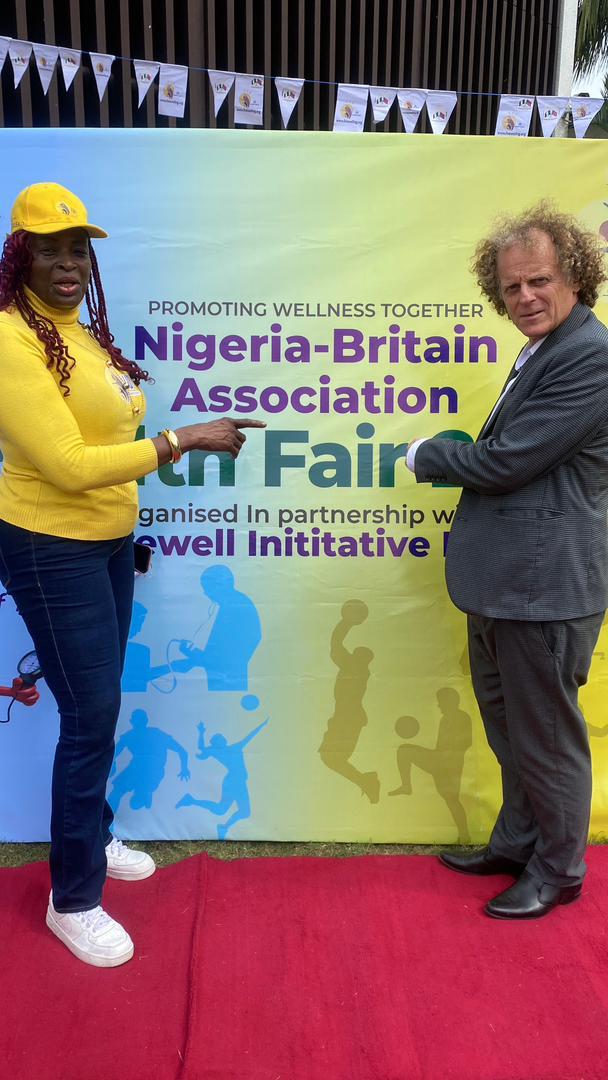
The Nigeria-Britain Association (N-BA), in partnership with the LiveWell Initiative (LWI), successfully hosted the 2026 Health Fair on Saturday, March 28, 2026, at the British Council, Ikoyi, Lagos, reinforcing their shared commitment to advancing preventive healthcare, wellness, and community health awareness.
Themed “Attaining Boisterous Health and Wellbeing amidst a Fast World,” the health fair was convened by the LiveWell Initiative LWI using a team of dedicated healthcare professionals, wellness advocates, and participants of diverse health backgrounds including emotional health physicians, dentists, pharmacists, nurses, public health practitioners for a day dedicated to integrated health services, education, and engagement.
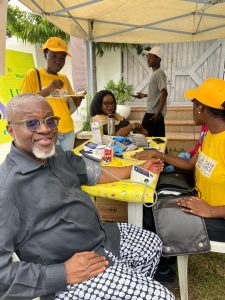
Mr Sola Oyetayo President N-BA having his BP checked
The programme opened with an insightful health talk delivered by Dr Bisi Bright, CEO of LiveWell Initiative LWI, and Council member, N-BA, who emphasized the importance of adopting proactive health behaviours in response to the increasing pressures of modern living.
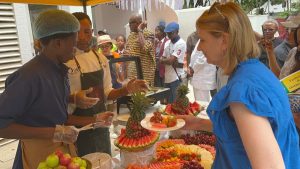
File Photo: Fruits and Salads at the Nutrion Stand
Dr Bright further emphasized that “ individuals must take responsibility for their wellbeing by making informed choices, embracing early diagnosis, practicing basic hygiene, managing emotions, and staying consistently hydrated.”
Her session explored critical areas such as lifestyle management, stress, nutrition, resilience, and the prevention of non-communicable diseases, while advocating a more holistic approach to healthcare.
Speaking at the event, Sola Oyetayo, President of the Nigeria-Britain Association, described the health fair as part of the NBA’s broader sustainability agenda focused on promoting healthier communities and enhancing quality of life for N-BA members and Nigerians, but also to members of the Commonwealth community in Nigeria, He emphatically added that “Health is Wealth.”
Similarly, Funmilola Orokale, Council Member of the N-BA, stated that “the initiative reflects our commitment to ensuring greater health awareness, early detection of underlying conditions through accessible and respectful screening processes.”
With a team of over 50 healthcare professionals all from the LiveWell Initiative LWI, the health fair provided attendees with comprehensive and accessible medical services in a well-coordinated environment.
Participants benefited from a wide spectrum of free health screenings and consultations, ranging from cardiovascular and metabolic checks such as blood pressure and blood sugar testing, to infectious disease screenings including hepatitis, HIV, and malaria.
Specialized services such as prostate screening, breast examinations, eye assessments, dental and dermatological checks were also made available, alongside nutrition counselling, mental wellness support, and neurological assessments.
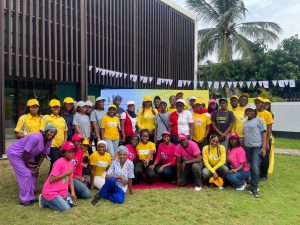
The LWI Team
In addition, a fully equipped pharmacy stand ensured access to free medications and professional guidance, while participants who require visual support received recommended eyeglasses at no cost.
There were free condoms available only for adults, with Counselling on responsible sexual behavior.
Beyond clinical services, the event delivered a holistic wellness experience featuring structured fitness sessions, recreational activities, and healthy nutrition offerings including fruit trees and various salads, smoothies and juices all aimed at promoting sustainable lifestyle changes. The engaging and impactful atmosphere enabled participants to not only assess their health status but also take practical steps toward improved wellbeing. The event recorded strong participation, with over 100 registered attendees alongside additional walk-in participants, many of whom expressed deep appreciation for the initiative, particularly the convenience of accessing multiple healthcare services in one location and gaining greater awareness to make informed health decisions.
About the Nigerian Britain Association (NBA)
The Nigeria-Britain Association is committed to fostering socio-cultural, educational, and developmental ties between Nigeria and the United Kingdom, while promoting initiatives that enhance the wellbeing of its members and the wider community.
About LiveWell Initiative (LWI)
LiveWell Initiative LWI is a health-focused nonprofit organization dedicated to promoting preventive healthcare, wellness education, and access to quality health services through community-driven programmes and strategic partnerships.
The National Association of Resident Doctors (NARD) has given the Federal Government a two-week ultimatum to resolve outstanding welfare and professional issues affecting its members or face possible industrial action.
NARD issued the ultimatum on Sunday at its 46th annual general meeting in Calabar, Cross River State, where it expressed concern over the slow implementation of agreements reached with the Federal Government.
The association said prolonged delays in addressing the issues had become unacceptable, demanding urgent action on remuneration, career progression, professional allowances, excessive workload, manpower shortages and the general welfare of resident doctors.
In resolutions read by NARD National President, Ogar Emmanuel Idoko, the doctors demanded “the immediate implementation of agreements reached with the federal government, particularly those relating to improved conditions of service and professional development”.
The association said the Federal Government had concluded a review of existing remuneration and professional salary structures for doctors, noting that the current framework no longer adequately reflected prevailing economic realities.
NARD also demanded appropriate compensation for resident doctors working beyond their normal responsibilities because of manpower shortages in hospitals.
It called for standardised templates for compensating doctors for excess workload, as well as reliable data to justify payments to those performing additional duties.
The doctors also raised concern over attacks on health workers, urging the government to fully implement existing policies and anti-assault measures designed to protect medical personnel in hospitals.
NARD further expressed concern over the continued migration of doctors and other health professionals from Nigeria.
It urged the Federal Ministry of Health and Social Welfare to urgently address the factors driving the exodus of medical professionals from the country.
The association also called on state governments to prioritise the welfare of doctors and other health workers in their institutions and ensure the implementation of relevant welfare policies.
The National Agency for Food and Drug Administration and Control (NAFDAC) has reported that 48 people have died after consuming suspected locally prepared alcoholic and herbal concoctions in parts of Ondo State, with preliminary laboratory findings indicating high concentrations of toxic methanol in samples of the suspected drinks.
The agency, in an update signed by its Director-General, Prof. Mojisola Adeyeye yesterday said a total of 182 cases had been recorded, with five victims who are now totally blind and two others partially blind.
The incident, which was initially reported in early September, affected residents of Odigbo Town, Araromi-Obu, New Town, Odole, Okele, Orita Odigbo and Oniparaga in Odigbo Local Government Area. The report also listed Irele Local Government Area among the affected locations.
According to NAFDAC, the number of reported deaths initially stood at 31, comprising 20 in Odigbo Town and 11 in Araromi-Obu, but increased as investigations and surveillance progressed.
The agency said 90 affected persons had been admitted and subsequently discharged, while six remained hospitalised. Another 31 were treated as outpatients, while the remaining cases involved varying degrees of illness and complications.
NAFDAC said the clinical features reported among affected persons included headaches, generalised body weakness and pain, visual disturbances, difficulty in breathing and altered consciousness, with some cases deteriorating rapidly.
The agency disclosed that 15 people had so far been arrested in connection with the suspected production, sale and distribution of the implicated locally produced alcoholic and herbal beverages.
As part of its investigation, NAFDAC said samples of the suspected concoctions had undergone laboratory examination and toxicological studies to determine their chemical composition and identify potentially toxic substances, adulterants, contaminants or undeclared ingredients.
It said toxicological, microbiological and chemical screening was conducted on 15 unlabeled samples, while acute oral toxicity tests were performed on laboratory mice in accordance with its standard operating procedures and OECD guidelines.
The preliminary findings showed that all the samples caused critical illness in the test animals, while approximately 50 per cent mortality was recorded in six of the 15 samples analysed.
NAFDAC said the critically ill mice recovered after 24 hours of administration, but noted that there was a possibility that they could die if exposed to a second dose.
The agency further disclosed that chemical screening detected Cannabis indicated in 11 samples, while gas chromatography confirmed the presence of high concentrations of methanol.
It explained that methanol was a highly toxic substance capable of causing severe health complications, including blindness, organ failure and death.
According to NAFDAC, the combination of high mortality recorded during animal testing and the confirmed presence of methanol strongly suggested that the samples posed a serious public health risk.
However, it stressed that the findings remained preliminary and required further confirmatory analyses.
The agency said additional testing was ongoing to quantify the methanol concentration and identify other possible toxic agents in the suspected drinks.
NAFDAC said surveillance, case management, investigation and risk-control measures were ongoing, while the reported figures remained subject to verification as investigations continued.
The Economic and Financial Crimes Commission (EFCC), on Monday, disclosed that more than 40 of its personnel have been dismissed in the past two and a half years.
The commission revealed that they were sacked over their involvement in alleged corruption and financial malfeasance that could tarnish the image of the agency.
The EFCC Chairman, Ola Olukoyede, who disclosed this in Abuja when he met with media executives and other journalists in Abuja, said more than five of them are currently facing prosecution.
According to him, the case files of others involved that are yet to face the wrath of the law were being prepared for prosecution.
He stressed that these were part of the efforts to ensure that personnel of the anti-graft agency maintained the highest standards of integrity while investigating and prosecuting corruption cases.
“In the past two and a half years or three years of my service, I have asked them to dismiss over 40 staff on account of corruption and financial malpractice.
“More than five of them are being prosecuted at the moment. You can follow those cases in court; they are public knowledge,” the anti-graft agency boss told journalists.
The EFCC chairman said the commission had also introduced measures to strengthen accountability among its personnel, including a gift policy designed to regulate the acceptance and declaration of gifts by staff.
According to him, personnel would be required to declare assets valued above a specified threshold, including gifts received from relatives abroad.
He said the commission would determine the categories and value of gifts that its personnel could accept, stressing that the policy was aimed at ensuring that staff could account for their means of livelihood and standard of living.
Olukoyede warned that EFCC personnel could not effectively fight corruption while engaging in corrupt practices themselves.
He also disclosed that the commission had renamed its former Department of Internal Affairs as the Department of Ethics and Integrity, as part of efforts to strengthen internal accountability.
Olukoyede said the commission’s anti-corruption activities had also contributed significantly to revenue mobilisation, with federal and state tax recoveries amounting to approximately N288.1 billion during the period under review.
He said the figure comprised about N173.2 billion in federal tax recoveries and N114.9 billion attributed to state internal revenue services.
“This is fiscal value recovered through enforcement of existing obligations, not through the imposition of new taxes,” he said.
The EFCC chairman further disclosed that approximately N257.2 billion in naira recoveries were recorded for federal ministries, departments and agencies.
‘N1.23tn recovered in 3 years’
Olukoyede said the commission recovered N1.23tn, $684.48m, £373,905.78 and €9.34m between October 1, 2023, and June 30, 2026.
He explained that about N397.26 billion, representing 33 per cent of the naira recoveries, constituted direct recoveries for the Federal Government, while N836.34 billion, or 67 per cent, represented indirect recoveries made on behalf of ministries, departments and agencies, state revenue services, companies, individuals and foreign victims.
On the utilisation of recovered funds, Olukoyede said N661.32 billion and $492.37 million had been released to beneficiaries during the period.
He said the naira releases included about N325.35 billion paid directly to individuals and corporate bodies, while N335.97 billion was released to various MDAs, the Nigerian Revenue Service and state internal revenue services, among other beneficiaries.
-
 Health & Wellness1 year ago
President Tinubu Directs Cut in Dialysis Cost from ₦50,000 to ₦12,000
-
News2 years ago
CBN Debunks Fake Circular on New ₦5,000 and ₦10,000 Notes
-
 International News6 months ago
Indian Police Arrest Nigerian Over ₦290m Drug Haul
-
 Business7 months ago
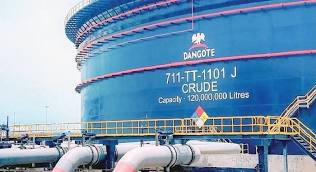
Dangote Refinery Reduces Petrol Gantry Price To ₦1,200 Per Litre
-

 Business7 months ago
After Plea Bargain, Court Discharges Stella Oduah of ₦2.5bn Fraud
-
Business2 years ago
Dangote; We Did Not Fix ₦600/Litre Petrol Price
-
 Trending News1 year ago
NELFUND Disburses ₦86bn To 449,000 Beneficiaries
-
 Opinion2 years ago
Championing the People’s Voice: Obasa’s Dedication to Grassroots Representation By Dave Agboola⁰