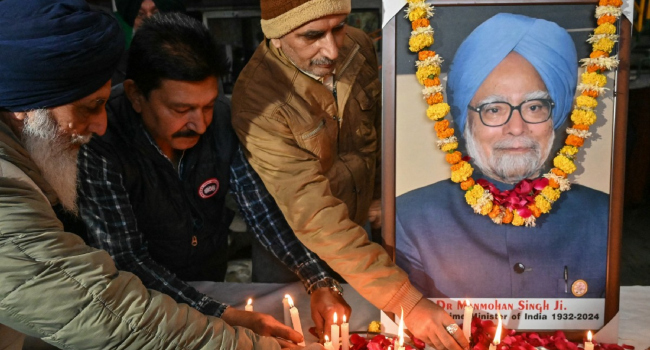
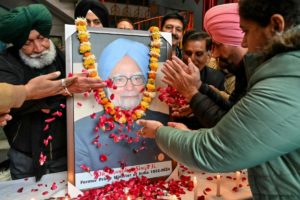
Members of Congress party light candles as they pay homage to late India’s former Prime Minister Manmohan Singh in Amritsar on December 27, 2024. (Photo by Narinder NANU / AFP)
Mourners in India’s capital gathered Saturday to pay their respects to former prime minister Manmohan Singh ahead of a state funeral for the man key to the country’s economic liberalisation.
Singh, who held office from 2004 to 2014, died at the age of 92 on Thursday, after which seven days of state mourning were declared.
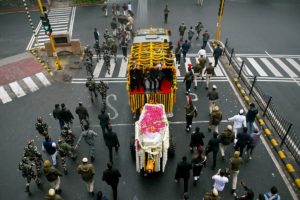
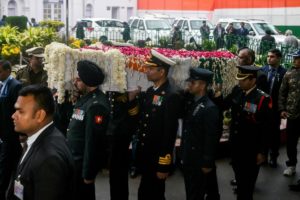
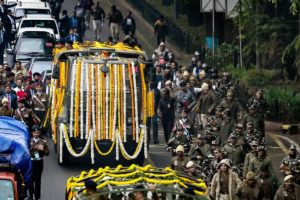
Officers lead the coffin of India’s late former Prime Minister Manmohan Singh, for a state funeral ceremony in New Delhi on December 28, 2024. – Mourners in India’s capital gathered on December 28, to pay their respects to former prime minister Manmohan Singh ahead of a state funeral for the man key to the country’s economic liberalisation. (Photo by Arun SANKAR / AFP)
His coffin, draped in garlands of flowers, was flanked by a guard of honour and carried to his Congress Party headquarters in New Delhi.
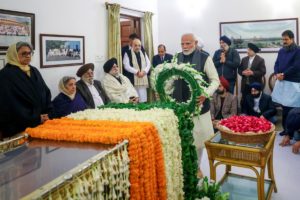
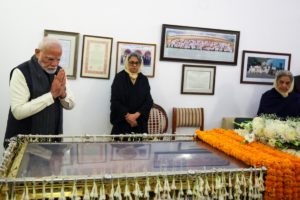
In this handout photograph taken on December 27, 2024 and released by the Indian Press Information Bureau (PIB), India’s Prime Minister Narendra Modi (C) lays a wreath as he pays last respects to former Indian Prime Minister Dr. Manmohan Singh at his residence in New Delhi. – India announced seven days of state mourning on December 27 after the death of former prime minister Manmohan Singh, one of the architects of the country’s economic liberalisation in the early 1990s. (Photo by PIB / AFP) / XGTY / RESTRICTED TO EDITORIAL USE – MANDATORY CREDIT “AFP PHOTO/INDIAN PRESS INFORMATION BUREAU (PIB)” – NO MARKETING NO ADVERTISING CAMPAIGNS – DISTRIBUTED AS A SERVICE TO CLIENTS
It will later be taken through the capital to be cremated, accompanied by guards of soldiers and accorded full state honours.
Indian National Congress (INC) party leader Rahul Gandhi (Centre R) is pictured during procession as the coffin of India’s late former Prime Minister Manmohan Singh is taken for a state funeral ceremony in New Delhi on December 28, 2024. Mourners in India’s capital gathered on December 28, to pay their respects to former prime minister Manmohan Singh ahead of a state funeral for the man key to the country’s economic liberalisation. (Photo by Arun SANKAR / AFP)
Prime Minister Narendra Modi, who along with other leaders is expected to attend the funeral, called Singh one of India’s “most distinguished leaders”.
Opposition Congress leader Rahul Gandhi said he had lost “a mentor and guide”, adding that Singh had “led India with immense wisdom and integrity”.
Officers lead the coffin of India’s late former Prime Minister Manmohan Singh, for a state funeral ceremony in New Delhi on December 28, 2024. – Mourners in India’s capital gathered on December 28, to pay their respects to former prime minister Manmohan Singh ahead of a state funeral for the man key to the country’s economic liberalisation. (Photo by Arun SANKAR / AFP)
US President Joe Biden called Singh a “true statesman”, saying that he “charted pathbreaking progress that will continue to strengthen our nations — and the world — for generations to come”.
The former prime minister was an understated technocrat who was hailed for overseeing an economic boom in his first term.
Officers lead the coffin of India’s late former Prime Minister Manmohan Singh, for a state funeral ceremony in New Delhi on December 28, 2024. – Mourners in India’s capital gathered on December 28, to pay their respects to former prime minister Manmohan Singh ahead of a state funeral for the man key to the country’s economic liberalisation. (Photo by Arun SANKAR / AFP)
Singh’s second stint ended with a series of major corruption scandals, slowing growth and high inflation.
Singh’s unpopularity in his second term, and lacklustre leadership by Nehru-Gandhi scion Rahul Gandhi, the current opposition leader in the lower house, led to Modi’s first landslide victory in 2014.
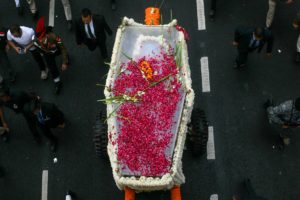
Officers carry the mortal remains of India’s late former Prime Minister Manmohan Singh, at the All India Congress Committee (AICC) headquarters in New Delhi on December 28, 2024. – Mourners in India’s capital gathered on December 28, to pay their respects to former prime minister Manmohan Singh ahead of a state funeral for the man key to the country’s economic liberalisation. (Photo by Arun SANKAR / AFP)
– ‘Service to the nation’ –
Born in 1932 in the mud-house village of Gah in what is now Pakistan and was then British-ruled India, Singh studied economics to find a way to eradicate poverty in the vast nation.
In this handout photograph taken on December 27, 2024 and released by the Indian Press Information Bureau (PIB), India’s Prime Minister Narendra Modi (L) pays last respects to former Indian Prime Minister Dr. Manmohan Singh at his residence in New Delhi. – India announced seven days of state mourning on December 27 after the death of former prime minister Manmohan Singh, one of the architects of the country’s economic liberalisation in the early 1990s. (Photo by PIB / AFP) / XGTY / RESTRICTED TO EDITORIAL USE – MANDATORY CREDIT “AFP PHOTO/INDIAN PRESS INFORMATION BUREAU (PIB)” – NO MARKETING NO ADVERTISING CAMPAIGNS – DISTRIBUTED AS A SERVICE TO CLIENTS
He won scholarships to attend both Cambridge, where he obtained a first in economics, and Oxford, where he completed his doctorate.
Members of Congress party pay their homage to late India’s former Prime Minister Manmohan Singh in Amritsar on December 27, 2024. – India announced seven days of state mourning on December 27 after the death of former prime minister Manmohan Singh, one of the architects of the country’s economic liberalisation in the early 1990s. (Photo by Narinder NANU / AFP)
Singh worked in a string of senior civil service posts, served as a central bank governor and also held various jobs with global agencies including the United Nations.
He was tapped in 1991 by then Congress prime minister P.V. Narasimha Rao to serve as finance minister and reel India back from the worst financial crisis in its modern history.
Members of Congress party light candles as they pay homage to late India’s former Prime Minister Manmohan Singh in Amritsar on December 27, 2024. (Photo by Narinder NANU / AFP)
Though he had never held an elected post, he was declared the National Congress’s candidate for the highest office in 2004.
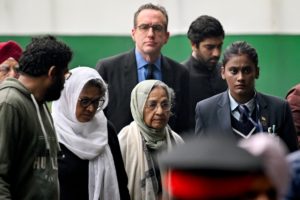
Gursharan Kaur (C), wife of India’s late former Prime Minister Manmohan Singh, arrives for the state funeral ceremony at All India Congress Committee (AICC) headquarters in New Delhi on December 28, 2024. – Mourners in India’s capital gathered on December 28, to pay their respects to former prime minister Manmohan Singh ahead of a state funeral for the man key to the country’s economic liberalisation. (Photo by Arun SANKAR / AFP)
In his first term, Singh steered the economy through a period of nine per cent growth, lending India the international clout it had long sought.
Officers carry the coffin of India’s late former Prime Minister Manmohan Singh, for a state funeral ceremony in New Delhi on December 28, 2024. – Mourners in India’s capital gathered on December 28, to pay their respects to former prime minister Manmohan Singh ahead of a state funeral for the man key to the country’s economic liberalisation. (Photo by Arun SANKAR / AFP)
He also sealed a landmark nuclear deal with the United States that he said would help India meet its growing energy needs.
Officers lead the coffin of India’s late former Prime Minister Manmohan Singh, for a state funeral ceremony in New Delhi on December 28, 2024. – Mourners in India’s capital gathered on December 28, to pay their respects to former prime minister Manmohan Singh ahead of a state funeral for the man key to the country’s economic liberalisation. (Photo by Arun SANKAR / AFP)
President Droupadi Murmu said that Singh would “always be remembered for his service to the nation, his unblemished political life and his utmost humility”.
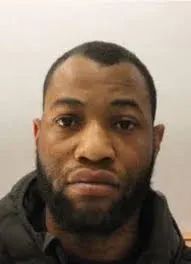
A Nigerian man and registered sex offender, Babatunde Odutola, has been sentenced to prison in the UK after exposing himself and masturbating in front of a woman on a train heading to Manchester.
Odutola, 36, who has no fixed address, was sentenced to 44 weeks in prison at Manchester Magistrates’ Court on Monday, September 14, after pleading guilty to outraging public decency and violating a suspended sentence order.
The incident took place around 7 p.m. on Friday, September 11, on a train traveling through Cheshire towards Manchester Piccadilly railway station.
According to the British Transport Police, Odutola approached a woman on the train, looked her up and down, and became aggressive when she refused to engage with him.
He then exposed himself while sitting in a wheelchair and began masturbating while staring at the woman and telling her to “come over.”
A fellow passenger intervened and helped escort the distressed woman from the carriage. Police reports indicate that CCTV footage showed Odutola continuing to masturbate as other passengers walked through the carriage.
British Transport Police officers arrested him after the train arrived at Manchester Piccadilly. He was prosecuted and jailed within 72 hours of the incident.
Detective Constable Leonidas Christoforou of the British Transport Police stated that Odutola’s behavior was “terrifying” for the victim, whom he allegedly targeted while she was traveling alone.
The National Hajj Commission of Nigeria (NAHCON) has announced that the Kingdom of Saudi Arabia has declined Nigeria’s request for an upward review of its 2027 Hajj allocation, leaving the country’s quota unchanged despite growing demand from intending pilgrims nationwide.
The Commission disclosed that it had formally engaged the Saudi Ministry of Hajj and Umrah, seeking additional pilgrimage slots to accommodate the increasing number of Nigerian Muslims desirous of undertaking the sacred journey and to address appeals from several state pilgrims’ welfare boards for enhanced allocations.
However, Saudi authorities communicated their inability to grant additional slots, citing capacity limitations, structural constraints within the holy sites, and the Kingdom’s policy of strict adherence to approved country quotas under the current operational framework.
Consequently, Nigeria’s allocation for the 2027 Hajj exercise remains fixed at 35,000 slots for government pilgrims and 15,000 slots for licensed tour operators, bringing the country’s total approved allocation to 50,000 pilgrims.
Commenting on the development, the Chairman and Chief Executive Officer of NAHCON, Ambassador Ismail Abba Yusuf, said the Commission fully understands the disappointment the decision may cause many aspiring pilgrims and state pilgrim boards that had hoped for additional allocations.
According to him, the Commission explored all available diplomatic and operational channels in pursuit of an increased quota but respects the final decision of the Saudi authorities.
“We appreciate the deep spiritual desire of many Nigerian Muslims to perform Hajj and understand the expectations of states and stakeholders seeking additional slots. While every effort was made to secure an upward review, the Saudi authorities have communicated their final position based on operational realities and capacity considerations,” Ambassador Yusuf stated.
The NAHCON Chairman urged state pilgrims’ welfare boards, agencies and licensed tour operators to make judicious and transparent use of their approved allocations while ensuring strict compliance with all timelines established by the Commission and the Saudi Nusuk platform.
He emphasized that the deadline for uploading the data of all prospective pilgrims for the 2027 Hajj exercise remains September 26, 2026, warning that no extensions would be granted under any circumstance.
“Kindly note that the deadline for uploading prospective pilgrims’ data remains September 26, 2026. We urge all partners, state pilgrim boards, tour operators and representatives to ensure that all required information is submitted before this date, as no extensions will be granted,” he said.
Ambassador Yusuf further advised intending pilgrims who may be unable to secure a slot under the approved 2027 allocation not to lose hope, revealing that preparations for the subsequent pilgrimage season have already commenced.
“Individuals who were unable to secure a slot for the upcoming Hajj are encouraged to register for the 2028 Hajj. The Commission has officially opened the registration portal for this period, and applications are now being accepted,” he added.
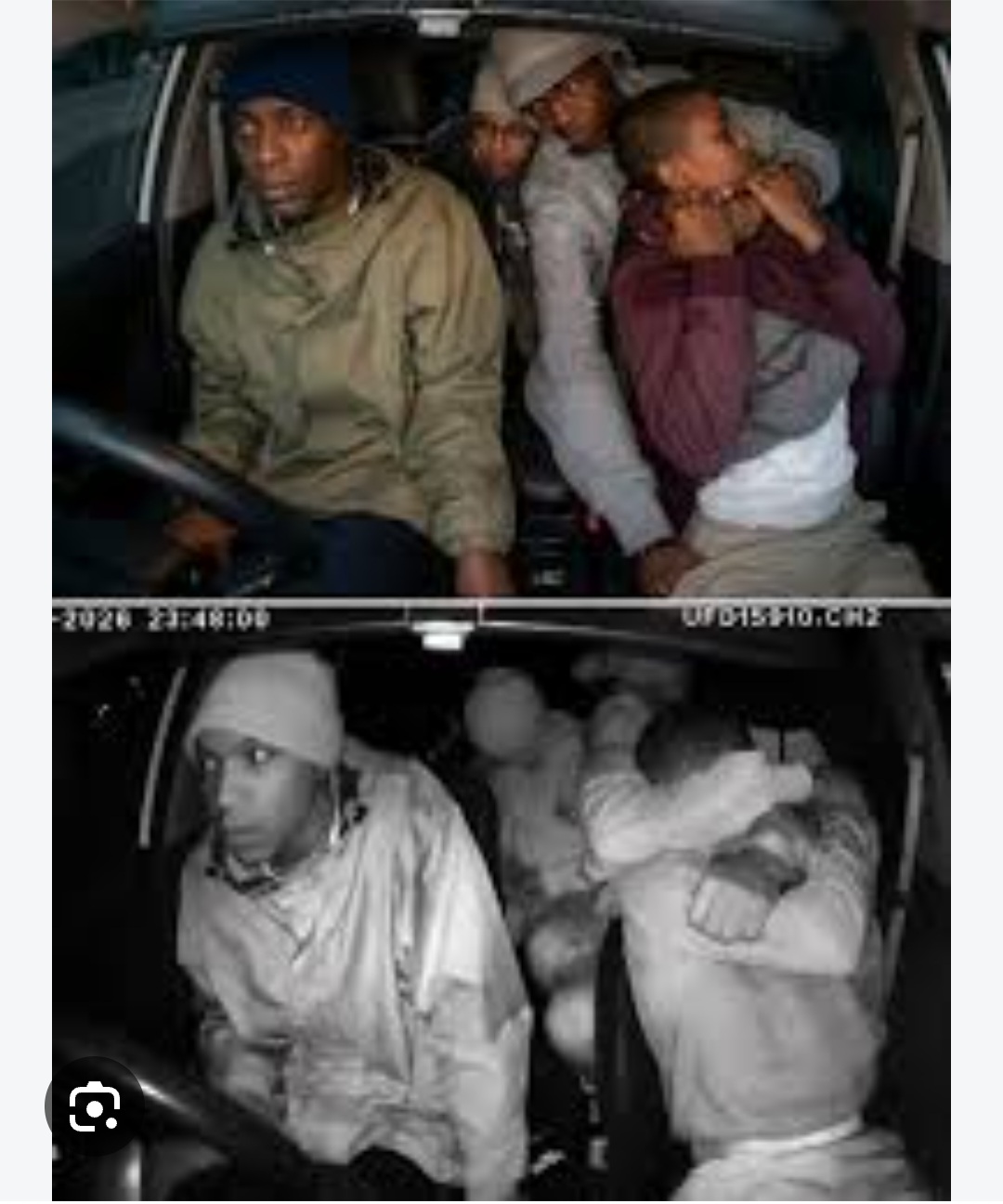
South African police have arrested five suspects after rescuing a 25-year-old e-hailing driver who was allegedly kidnapped, raped and held for ransom in Cape Town.
The South African Police Service (SAPS) said in a statement on Sunday that Steenberg police rescued the driver after he was allegedly raped by two female suspects and held at ransom by the group.
Police were alerted by the victim’s brother after the suspects contacted him and demanded R4,000 in cash for the driver’s release.
According to SAPS, the police used the victim’s vehicle tracker to locate him at Southampton Road in Heathfield, where he was rescued.
“Steenberg police rescued a 25-year-old e-hailing driver after he was raped and held at ransom by two female suspects and three males yesterday,” the police said.
The victim had reportedly met one of the female suspects the previous week through his e-hailing business.
According to police, the two exchanged telephone numbers and communicated throughout the week before arranging to meet.
“When he went to meet her, he was kidnapped by the suspects and the females raped him,” SAPS said.
Police subsequently arrested the two female suspects, aged 23 and 34, as well as three male suspects aged 16, 42 and 48.
The five suspects are expected to appear before the Wynberg Magistrate’s Court on Monday, September 14, 2026.
SAPS said they would face charges relating to the alleged kidnapping and rape.