
News
Nigeria’s Olympic Boxer, Jeremiah Okorodudu is Dead.

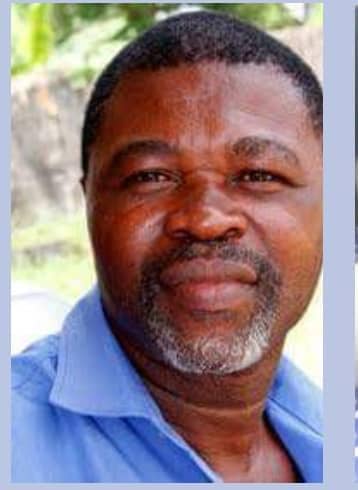
Nigeria’s Olympic Boxer, Jeremiah Okorodudu on Wednesday at about 1900 hours died at a Lagos Hospital while awaiting amputation surgery and the hospital authorities have vowed not to release his corpse until outstanding N600,000:00 debt is cleared.
The family of Okorodudu is distressed and his now widow, Adenike Okorodudu is terribly devastated at .the development as only N900,000:00 was paid as at Wednesday morning.
I gathered that his home State, Delta State and even Edo State where he grew up, did not react to pleas for support because of administrative bottle necks as they were waiting for letters to be written before support could be offered. It was only former Deputy Senate President, Senator Omo-Agege who lost election as Delta Gubernatorial Candidate, who sent in N100,000:00 on Tuesday night to shore up the money to N600,000:00 which was deposited to the Hospital account Wednesday morning.
One of the coordinators of SAVE JERRY FUNDS, Segun Olanrewaju told me that the Hospital Management blatantly refused any plea for clemency and therefore refused the release of the corpse of Okorodudu.
According to Olanrewaju most of Okorodudu’s colleagues abroad were only pleading for patience before sending in anything.
It was learnt that the surgery to amputate his leg would have been carried out by noon of Thursday if the funds were available. A Medical Doctor who pleaded to be anonymous said Jerry would have survived if the initial schedule to amputate his leg were carried out last Saturday.
Okorodudu aged 64 (born 24th May 1959) has been down at Dan’s Hospital, 46 Thomas Laniyan, Irawo Busstop, Ikorodu in Lagos Nigeria for two years now with partial stroke and diabetics that brought foot ulcer awaiting amputation.
Jerry as called in boxing circles was a Bronze Medalist at the 1982 Commonwealth Games in Brisbane, Australia from 30th September to 9th October and was controversially edged out at the quarterfinals of the 1984 Olympic Games at Vigil Hills on split decision of 3-2 by North Korean Sun Sho Shp which the Nigerian camp vehemently protested.
That 1984 Olympics was where Nigerian Boxer, Peter Konyegwachie won Silver in the Featherweight category and the Nigerian 4 x 400 Relay Men won Bronze.
Jerry was a Gold Medalist at the National Sports Festival, Oluyole ’79 which was my first professional outing with the Radio Organizations of Nigeria where I was the youngest Commentator under the leadership of both legendary Commentator, Ishola Folorunsho and Earnest Okonkwo and I was Stringer to Walter Batowei who led the Boxing coverage crew.
Jerry had 83 Amateur fights and 40 Professional boxing bouts but BOXING RECORD a publication on world pugilists’ states that Jerry had 21 international Pro bouts with 135 rounds and fought between 1986 and 1992.
Two memorable bouts will refresh boxing enthusiasts in Nigeria which was with Joe Lasisi. The first one at the National Stadium on 28th July 1985 Jerry had to retire with a broken right arm in the 2nd round. I was there and reported it for the Nation’s Model Station Ogun State Broadcasting Corporation OGBC. In the second bout between both boxers weighing 172 Ibs each on 16th December 1988 also at the National Stadium, Lagos Okorodudu claimed he was thumbed by Joe Lasisi but the score card read 68-65; 67-66 and 66-67 in favor of Lasisi.
Jerry told the media he was inspired to go into boxing from secondary school at Benin City in Nigeria through the brilliance of the man “that flies like a Butterfly and stings like a Bee”, Muhammed Ali who he never met.
You may still reach his wife, Adenike on +2348084200018 or send your token to his bank account: Jeremiah Okorodudu, Account Number 0011203501 Eco Bank at least for his corpse to be released to the family.
Eniola Olatunji
One person has been killed, and three others injured after gunmen allegedly attacked the convoy of the Nigeria Democratic Congress (NDC) House of Assembly candidate for Ezza South Constituency, Ebonyi State.
The police spokesperson, Joshua Ukandu, said the incident occurred at Amaezekwe community, Ezza South Local Government Area.
Ukandu said the command received a distress call reporting a disturbance in the community and immediately deployed operatives to the scene.
“Upon arrival, the operatives found four individuals with gunshot wounds and a burnt vehicle,” he said on Friday. “One of the victims was confirmed dead at the hospital, while the three others are receiving medical treatment.”
Meanwhile, the NDC candidate, Rollins Ovu-Unata Offia-Nwali, said suspected political thugs attacked his motorcade and set his Toyota Hilux vehicle ablaze.
In a statement, Offia-Nwali said he and members of his entourage escaped unhurt.
He expressed sympathy with those affected by the attack and urged youths across the state not to allow politicians to use them to pursue personal ambitions.
“No political ambition is worth the life of any young person,” he said.
A young man who identified himself as Emmanuel from Ebonyi State has confessed to killing his ex-girlfriend identified as Umuora Mmesoma from Uga in Aguata Local Government Area of Anambra State after she ended their relationship.
According to report, Mmesoma was declared missing on Friday, October 16, 2026, before her body was later discovered inside a bag in Uga on Friday, October 23.
In a video making the rounds on social media, security operatives questioned the suspect following his arrest.
In the video, the suspect confessed to killing the young woman, saying he carried out the act because she broke up with him.
“I killed her because she broke up with me. I killed her in my house in Uga, put her inside a bag and dumped her somewhere,” he said.
The killing of the young woman has sparked outrage among residents of the community and social media users, with calls for a thorough investigation and prosecution of the suspect and demands for justice for the deceased.
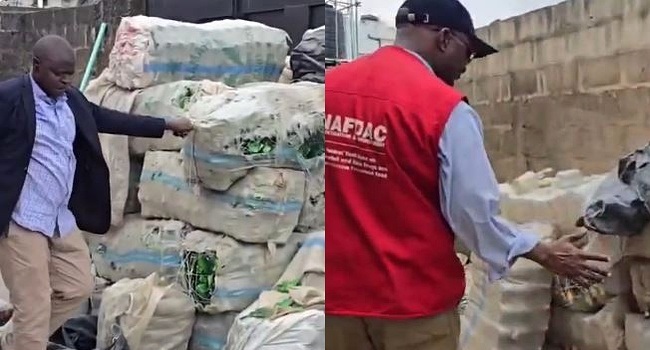
The National Agency for Food and Drug Administration and Control (NAFDAC) has uncovered a residential building in Lagos where more than 100 sacks of empty alcoholic beverage bottles were allegedly stockpiled for suspected use in the production of counterfeit drinks.
The bottles were discovered at a property located at 322B Meiran Road, Agbado Oke-Odo, Lagos, during an operation by the agency’s Investigation and Enforcement Directorate.
NAFDAC said the bottles were destroyed to prevent them from being reused in the production of counterfeit alcoholic beverages.
An Assistant Director in the directorate, Kunle Ojo, disclosed the development in a video released by the agency on Friday, explaining that the operation followed credible intelligence about activities at the location.
According to Ojo, the building was situated in a secluded residential area where different materials, including empty alcoholic beverage bottles covered with tarpaulins, were being stored.
The recovered bottles reportedly came in different sizes and included containers bearing labels associated with several alcoholic beverage brands, including Action Bitter and Royal Circle Premium Whiskey.
Ojo said investigators suspected that the bottles were being accumulated for onward distribution to individuals involved in the production of counterfeit alcoholic drinks.
He explained that the suspected practice involved supplying empty branded bottles to counterfeiters for reuse in packaging other products presented as genuine alcoholic beverages.
The discovery has raised concerns about the potential public health risks associated with counterfeit alcohol, which may be packaged in containers bearing the names and labels of established brands, making it difficult for consumers to distinguish genuine products from fake ones.
NAFDAC condemned the use of a residential property for the suspected activity, stressing that the operation was part of its efforts to protect public health and curb the production and distribution of counterfeit products.
The agency urged Nigerians to report suspicious activities in their neighbourhoods to the nearest NAFDAC office, noting that information from residents could help enforcement officers identify and disrupt suspected counterfeiting operations.
-
 Health & Wellness1 year ago
President Tinubu Directs Cut in Dialysis Cost from ₦50,000 to ₦12,000
-
News2 years ago
CBN Debunks Fake Circular on New ₦5,000 and ₦10,000 Notes
-
 Business7 months ago
Dangote Refinery Reduces Petrol Gantry Price To ₦1,200 Per Litre
-
 International News7 months ago
Indian Police Arrest Nigerian Over ₦290m Drug Haul
-
 Business7 months ago
After Plea Bargain, Court Discharges Stella Oduah of ₦2.5bn Fraud
-
Business2 years ago
Dangote; We Did Not Fix ₦600/Litre Petrol Price
-
 Trending News1 year ago
NELFUND Disburses ₦86bn To 449,000 Beneficiaries
-
 Opinion2 years ago
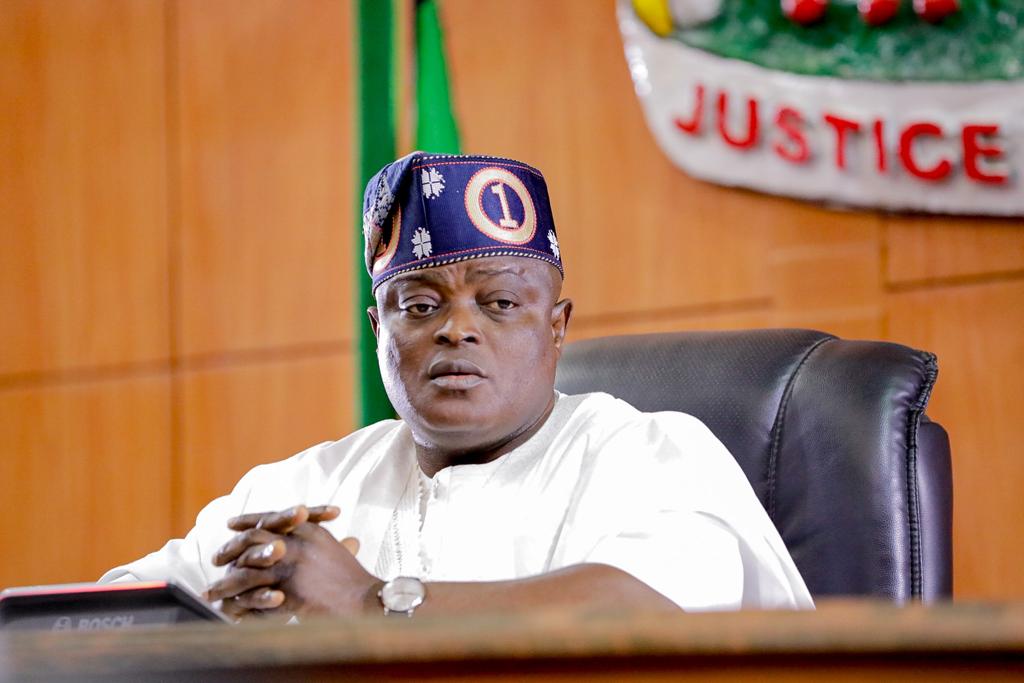
Championing the People’s Voice: Obasa’s Dedication to Grassroots Representation By Dave Agboola⁰