
News
US School Guard Not Guilty Of Failing To Stop Mass Shooting

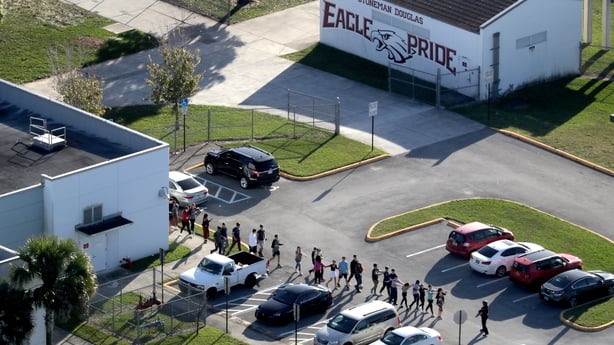
A guard who allegedly hid while a mass shooter killed 17 at a Florida high school in 2018 was found not guilty Thursday of charges of neglect and negligence.
In an emotionally charged trial, a jury found no fault with the actions of former sheriff’s deputy Scot Peterson, 60, during the shooting at the school in the suburban city of Parkland.
On February 14, 2018, then-19-year-old former student Nikolas Cruz walked into the school carrying a semiautomatic rifle and shot dead 14 students and three staff members.
Cruz, who was able to buy his powerful weapon despite having known mental health issues, wounded another 17 people.
Peterson, a guard at the school, was accused of failing to enter the school building to pursue Cruz even though he was armed and had received training in confronting an active shooter.
Peterson, believed the first law enforcement officer in the country charged for failing to take action during a school shooting, was indicted for multiple counts of felony child neglect, and culpable negligence and one count of perjury.
The jury on Monday ruled him not guilty on all counts. Peterson broke down in tears when the verdict was announced.
“I got my life back” after the four-year court saga, he said outside the court.
His attorney Mark Eiglarsh said it was “not just a victory for Scot, but a victory for all law enforcement officers.”
‘Coward’ or ‘scapegoat’?
The Parkland shooting stunned the nation and reignited debate on gun control and how to protect schools from armed attacks.
Families of the dead and injured placed some of the blame for the extent of the deaths and injuries on Peterson.
During the trial, prosecutor Steven Klinger said Peterson, who had been in law enforcement for 32 years and a school resource officer, or security guard, at the school since 2009, had been trained to deal with such attacks.
Klinger said Peterson took shelter in an alcove outside the school building and remained there for 48 minutes, well after the shooting ended.
“In an active shooter situation, you go for the gunshots. You’re trained to go for those shots, to find that shooter, because every shot could be a death,” Klinger said.
Eiglarsh countered that his client was made a scapegoat, and denied that he was a “coward.”
Peterson could not tell where the gunshots were coming from on the sprawling Parkland campus and “did everything that you possibly could with the limited information that he had,” Eiglarsh contended.
Manuel Oliver, whose 17-year-old son Joaquin was killed at Parkland, expressed anger after the verdict at the reactions by Peterson and Eiglarsh after the verdict was announced.
“Tell me about that pain,” he said.
Peterson “obviously made a mistake and needs to be accountable,” he said.
“The honest thing to do is to walk out of that room quiet,” he added.
AFP
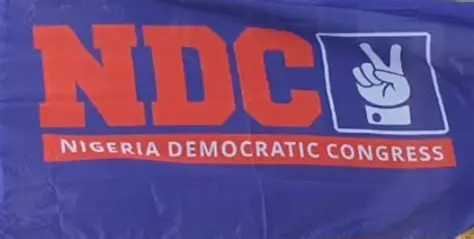
One person has been killed, and three others injured after gunmen allegedly attacked the convoy of the Nigeria Democratic Congress (NDC) House of Assembly candidate for Ezza South Constituency, Ebonyi State.
The police spokesperson, Joshua Ukandu, said the incident occurred at Amaezekwe community, Ezza South Local Government Area.
Ukandu said the command received a distress call reporting a disturbance in the community and immediately deployed operatives to the scene.
“Upon arrival, the operatives found four individuals with gunshot wounds and a burnt vehicle,” he said on Friday. “One of the victims was confirmed dead at the hospital, while the three others are receiving medical treatment.”
Meanwhile, the NDC candidate, Rollins Ovu-Unata Offia-Nwali, said suspected political thugs attacked his motorcade and set his Toyota Hilux vehicle ablaze.
In a statement, Offia-Nwali said he and members of his entourage escaped unhurt.
He expressed sympathy with those affected by the attack and urged youths across the state not to allow politicians to use them to pursue personal ambitions.
“No political ambition is worth the life of any young person,” he said.

A young man who identified himself as Emmanuel from Ebonyi State has confessed to killing his ex-girlfriend identified as Umuora Mmesoma from Uga in Aguata Local Government Area of Anambra State after she ended their relationship.
According to report, Mmesoma was declared missing on Friday, October 16, 2026, before her body was later discovered inside a bag in Uga on Friday, October 23.
In a video making the rounds on social media, security operatives questioned the suspect following his arrest.
In the video, the suspect confessed to killing the young woman, saying he carried out the act because she broke up with him.
“I killed her because she broke up with me. I killed her in my house in Uga, put her inside a bag and dumped her somewhere,” he said.
The killing of the young woman has sparked outrage among residents of the community and social media users, with calls for a thorough investigation and prosecution of the suspect and demands for justice for the deceased.
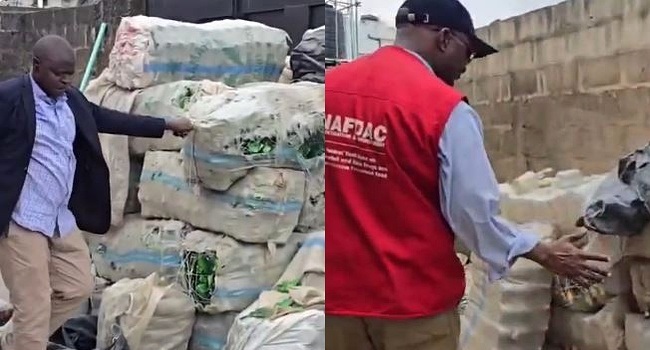
The National Agency for Food and Drug Administration and Control (NAFDAC) has uncovered a residential building in Lagos where more than 100 sacks of empty alcoholic beverage bottles were allegedly stockpiled for suspected use in the production of counterfeit drinks.
The bottles were discovered at a property located at 322B Meiran Road, Agbado Oke-Odo, Lagos, during an operation by the agency’s Investigation and Enforcement Directorate.
NAFDAC said the bottles were destroyed to prevent them from being reused in the production of counterfeit alcoholic beverages.
An Assistant Director in the directorate, Kunle Ojo, disclosed the development in a video released by the agency on Friday, explaining that the operation followed credible intelligence about activities at the location.
According to Ojo, the building was situated in a secluded residential area where different materials, including empty alcoholic beverage bottles covered with tarpaulins, were being stored.
The recovered bottles reportedly came in different sizes and included containers bearing labels associated with several alcoholic beverage brands, including Action Bitter and Royal Circle Premium Whiskey.
Ojo said investigators suspected that the bottles were being accumulated for onward distribution to individuals involved in the production of counterfeit alcoholic drinks.
He explained that the suspected practice involved supplying empty branded bottles to counterfeiters for reuse in packaging other products presented as genuine alcoholic beverages.
The discovery has raised concerns about the potential public health risks associated with counterfeit alcohol, which may be packaged in containers bearing the names and labels of established brands, making it difficult for consumers to distinguish genuine products from fake ones.
NAFDAC condemned the use of a residential property for the suspected activity, stressing that the operation was part of its efforts to protect public health and curb the production and distribution of counterfeit products.
The agency urged Nigerians to report suspicious activities in their neighbourhoods to the nearest NAFDAC office, noting that information from residents could help enforcement officers identify and disrupt suspected counterfeiting operations.
-
 Health & Wellness1 year ago
President Tinubu Directs Cut in Dialysis Cost from ₦50,000 to ₦12,000
-
News2 years ago
CBN Debunks Fake Circular on New ₦5,000 and ₦10,000 Notes
-

 Business7 months ago
Dangote Refinery Reduces Petrol Gantry Price To ₦1,200 Per Litre
-
 International News7 months ago
Indian Police Arrest Nigerian Over ₦290m Drug Haul
-
 Business7 months ago
After Plea Bargain, Court Discharges Stella Oduah of ₦2.5bn Fraud
-
Business2 years ago
Dangote; We Did Not Fix ₦600/Litre Petrol Price
-
 Trending News1 year ago
NELFUND Disburses ₦86bn To 449,000 Beneficiaries
-
 Opinion2 years ago
Championing the People’s Voice: Obasa’s Dedication to Grassroots Representation By Dave Agboola⁰