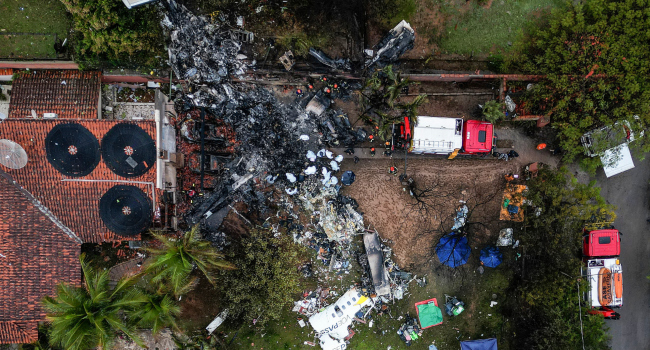
This photo shows an aerial view of the wreckage of an airplane that crashed with 61 people on board in Vinhedo, Sao Paulo State, Brazil, on August 10, 2024. (Photo by Nelson ALMEIDA / AFP)
Brazilian authorities on Saturday finished recovering the bodies of the 62 people who died when their plane tumbled from the sky, as experts began examining the doomed aircraft’s black boxes to determine the cause of the disaster.
Videos showed the ATR 72-500 plane in a sickening downward spin Friday before it crashed into a residential area in the town of Vinhedo, some 80 kilometers (50 miles) northwest of Brazil’s financial capital Sao Paulo.
The plane operated by airline Voepass fell almost vertically, landed on its belly and exploded in flames, striking with such force that it was nearly “flattened,” said Sao Paulo fire lieutenant Olivia Perroni Cazo.
“A total of 62 bodies (34 male and 28 female) were recovered and taken to the morgue in Sao Paulo for identification and delivery to their families,” the regional government said Saturday evening.
Two have already been identified through fingerprints, with Vinhedo Mayor Dario Pacheco saying they were the pilot and co-pilot.
The twin-engine turboprop, built by aviation firm ATR, was flying from Cascavel in southern Parana state to Sao Paulo’s Guarulhos international airport.
Experts from Brazil’s Aeronautical Accidents Investigation and Prevention Center (CENIPA) have begun analyzing two black boxes recovered from the wreckage, containing cabin conversations and in-flight data, said the center’s chief, Marcelo Moreno.
It plans to publish a preliminary report “within an estimated 30 days,” the Brazilian Air Force said.
According to the Flight Radar 24 website, the plane flew for about an hour at 17,000 feet (5,180 meters), until 1:21 pm (1621 GMT) when it began losing altitude at a catastrophic rate.
Radar contact was lost at 1:22 pm, the air force reported. It said the plane’s crew “at no time declared an emergency or were under adverse weather conditions.
– ‘No technical problems’ –
ATR, a joint subsidiary of European giant Airbus and Italy’s Leonardo, said its experts will assist in the investigation.
The plane, in use since 2010, was in compliance with current standards, the National Civil Aviation Agency said, adding that the four crew members were all fully certified.
Voepass’s operations director, Marcel Moura, said the plane had undergone routine maintenance the night before the accident and that “no technical problems” were found.
But experts suggested icing of the plane’s wings may have been behind the accident.
Moura said the plane was a type that flies at an altitude “where there is a greater sensitivity to icing,” but that conditions Friday were “within acceptable parameters for a flight.”
– National mourning –
The fiery crash transformed the plane’s fuselage into a mass of twisted metal. Despite the devastation, there were no casualties on the ground.
President Luiz Inacio Lula da Silva has declared three days of national mourning for what was one of the worst aviation accidents in the country’s history.
“It was horrible, horrible… such a sad tragedy,” said a trembling Lourdes da Silva Astolfo, 67, whose home is only yards (meters) from the crash site.
She told AFP she had first felt a “rumbling, almost like a tremor,” when she suddenly saw the plane almost directly overhead. Seconds later came the stunning impact and the horrified screams from neighbors as a thick cloud of acrid smoke billowed outward.
The normally peaceful, wooded enclave where the plane came down saw a steady stream Saturday of police cars, ambulances and firetrucks.
Voepass said all the victims were traveling on Brazilian identity documents. One woman was a dual citizen with Portugal, and there was also a family of three Venezuelans.
It was the worst major air disaster in Brazil in 17 years.
In 2007, an Airbus A320 of Brazil’s TAM airlines overran a runway at Sao Paulo’s Congonhas airport and crashed into a warehouse, killing all 187 on board and 12 runway workers.
German authorities deported at least 137 Nigerian citizens across five chartered flights between February and June 2026, according to migration monitoring reports.
Data from the DERS Team and Refugees4refugees.org shows the deportations occurred in phases, with 27 Nigerians returned in February, 37 in March through a joint European Union operation, 24 in April, 23 in May, and 26 in June.
The February operation departed from Stuttgart and landed at Lagos Cargo Airport, with Baden-Württemberg listed as a primary participant. The March operation represented the largest single return of Nigerians recorded over three years and was executed in collaboration with Spain, Austria, and Belgium.
The reports indicate a growing reliance on multi-national chartered flights by European states to repatriate undocumented or non-resident individuals to Nigeria.
The United States has condemned the killing of members of the family of Plateau-based cleric, Rev. Ezekiel Dachomo, describing the attack as horrific and urging Nigerian authorities to ensure those responsible are brought to justice.
In a statement shared on X on Thursday, the US Department of State’s Bureau of African Affairs expressed condolences to the victims’ families and called for stronger measures to prevent further attacks on vulnerable communities across Nigeria’s Middle Belt.
“The United States strongly condemns the horrific killing of members of Rev. Ezekiel Dachomo’s family in Plateau State, Nigeria. The continued violence targeting Christian communities and other vulnerable populations in Nigeria’s Middle Belt is deeply alarming,” the bureau said
The US said it had already engaged Nigerian officials on the worsening security situation, stressing that urgent action was needed to curb recurring attacks and hold perpetrators accountable.
“As I discussed last week with Nigerian officials, we must do more to prevent violent acts. The perpetrators must be held accountable, and urgent action is needed to strengthen security and protect Christians and other vulnerable communities,” the statement added.
The bureau reaffirmed Washington’s commitment to working with the Nigerian government to combat terrorism and violent extremism, stressing that Christians and other Nigerians should be able to practise their faith without fear of violence.
The statement followed the July 12 attack on Kum community in Riyom Local Government Area of Plateau State, where nine members of Rev. Dachomo’s extended family, including a two-month-old baby, were killed.
According to the cleric, the attackers, believed to be armed Fulani militias, asked for him by name before opening fire on his relatives.
Dachomo, who serves as Regional Chairman of the Church of Christ in Nations (COCIN) in Barkin Ladi Local Government Area, said his family had repeatedly been targeted because of his outspoken criticism of the violence in Plateau State.
He recalled that his grandmother and an uncle were also killed in previous attacks, adding that days after burying his relatives, he received a written death threat from the same group, warning that he would be their next target.
Saudi Arabia has updated its tourist eVisa programme for 2026, limiting eligibility in Africa to only three countries as part of its list of 66 nations whose citizens can apply through the Kingdom’s online visa platform.
The move leaves most African countries, including Nigeria, outside the simplified entry scheme.
The electronic visa allows eligible travellers to visit Saudi Arabia for tourism, leisure activities, family visits and Umrah, excluding the annual Hajj pilgrimage. Applications are completed online, eliminating the need for embassy visits and lengthy visa processing.
Saudi authorities said the eVisa forms part of ongoing efforts to expand tourism, attract international visitors and simplify travel procedures through a fully digital application system. The visa is available only to citizens of approved countries and territories listed on the Kingdom’s official tourism portal.
Below is the list of African countries eligible for Saudi Arabia’s eVisa.