
International News
Morocco Quake Death Toll Rises To 2,122


Using heavy equipment and even their bare hands, rescuers in Morocco on Sunday stepped up efforts to find survivors of a devastating earthquake that killed more than 2,100 people and flattened villages.
The first foreign rescuers flew in to help after the North African country’s strongest-ever quake killed at least 2,122 people and injured more than 2,400, many seriously, according to official figures updated late on Sunday.
Friday’s 6.8-magnitude quake struck 72 kilometres (45 miles) southwest of the tourist hub of Marrakesh, wiping out entire villages in the hills of the Atlas mountains.
On Sunday an aftershock of magnitude 4.5 rattled already-traumatised residents in the same region.
The mountain village of Tafeghaghte, 60 kilometres from Marrakesh, was almost entirely destroyed, an AFP team reported, with very few buildings still standing.
Amid the debris, civilian rescuers and members of Morocco’s armed forces searched for survivors and the bodies of the dead.
AFP saw them recover one body from the ruins of a house. Four others were still buried there, residents said.
“Everyone is gone! My heart is broken. I am inconsolable,” cried Zahra Benbrik, 62, who said she had lost 18 relatives, with only the body of her brother still trapped.
“I want them to hurry and get him out so I can mourn in peace,” she said.
Many houses in remote mountain villages were built from mud bricks.
In the village of Amizmiz, near Tafeghaghte, a backhoe dragged away the heaviest pieces of rubble before rescuers dug into the dusty debris with their bare hands to remove a body that appeared to be under a quilt.
– The crucial hours –
The two villages lie in Al-Haouz province, site of the epicentre, which suffered the most deaths, 1,351, authorities reported.
According to Moroccan public television, “more than 18,000 families have been affected” by the quake in Al-Haouz.
Citizens on Sunday rushed to hospitals in Marrakesh to donate blood to help the injured.
Spain’s defence ministry said an A400 airlifter took off from Zaragoza with 56 rescuers and four search dogs headed for Marrakesh to “help in the search and rescue of survivors”.
“We will send whatever is needed because everyone knows that these first hours are key, especially if there are people buried under rubble,” Defence Minister Margarita Robles told Spanish public television.
Many residents of the usually bustling tourist hotspot of Marrakesh spent a second night sleeping on the streets, huddled together under blankets and among bags filled with their belongings.
One of them, Fatema Satir, said many stayed outside for fear of their houses collapsing.
“There is no help for us,” Satir said. “Our houses have been cracked, others destroyed — like my daughter’s house which was wiped out. We are in a chaotic state.”
In the city’s historic Jemaa el-Fna square, about 20 people were huddled on the ground, wrapped in blankets, while others stayed on the lawn of the nearby town hall, its 12th-century ramparts partially collapsed.
The kingdom declared three days of national mourning, and a prayer for the quake victims was to be held Sunday in all of the kingdom’s mosques.
Morocco’s interior ministry said on Saturday evening that authorities are “mobilised to speed up rescue operations and evacuate the injured.”
In addition to Spain, several countries offered aid.
French President Emmanuel Macron said his country has mobilised “all technical and security teams to be able to intervene, when the Moroccan authorities deem it useful.”
Macron, along with Indian Prime Minister Narendra Modi and the heads of the World Bank, International Monetary Fund, African Union and European Commission, also pledged, in a joint statement, to “mobilise our technical and financial tools and assistance” to help the people of Morocco.
– Long recovery ahead –
The United States said it also had search-and-rescue teams ready to deploy, and Pope Francis on Sunday again expressed support for those affected by the disaster.
“I thank the rescuers and all those who are working to alleviate the suffering of the people,” he said from the Vatican window above St Peter’s Square.
Algeria, which has long had tense relations with neighbouring Morocco, opened its airspace, which had been closed for two years, to flights carrying humanitarian aid and evacuating the injured.
Israeli Prime Minister Benjamin Netanyahu, whose country in 2020 established ties with Morocco, offered to send search-and-rescue teams, declaring that “Israel stands by Morocco in its difficult time”.
The Red Cross warned that it could take years to repair the damage.
“It won’t be a matter of a week or two… We are counting on a response that will take months, if not years,” said Hossam Elsharkawi, its Middle East and North Africa director.
The quake was the deadliest in Morocco since a 1960 earthquake destroyed Agadir and killed more than 12,000 people.
AFP

The Peel Regional Police in Canada has arrested eight Nigerians among 12 suspects allegedly linked to an international vehicle theft syndicate that specialises in the export of stolen cars.
In a statement released on Monday, the Peel police said the car theft investigation codenamed “Project Cadetta” led to the recovery of 96 stolen vehicles valued at $4.5 million and “destined for overseas markets”.
Police said the operation targeted a warehouse in Brampton used as a “primary staging area for stolen vehicles that were concealed in shipping containers and destined for West Africa through Canadian ports”.
The Peel police said the 12 suspects are expected to face 231 criminal charges.
“The investigation subsequently uncovered a broader criminal network operating throughout the Greater Toronto Area and surrounding jurisdictions,” the statement reads.
“Police allege the network was led by five key suspects responsible for coordinating the theft, movement and export of stolen vehicles. Other accused individuals are alleged to have supported the operation.
“Together, investigators linked the network to loading sites, container movements and the transportation of stolen re-VINed vehicles.
“Following a series of coordinated search warrants and arrests in fall 2026, Peel Regional Police charged 12 individuals in connection with the investigation.
“Investigators laid 231 charges and recovered 96 stolen luxury SUVs, pickup trucks, and other high-value vehicles concealed within shipping containers.”
The eight Nigerians are Stanley Udeh (46), Odewale Abraham (57), Oluyemi Sodade (51), Tosin Damilola Oyebade (45), Oluwaseyi Olawale Bameke (39), Gbolahan Qudus Babatunde (29), Olushola Oke (42), and Kenneth Okafor (58).
Other suspects are Karamveer Singh (26), Henrik Gancz (57), Jaspreet Singh (25), and Darryl Davance (25).
Police said some suspects charged in court may be referred to the Canada Border Services Agency (CBSA) for immigration enforcement action, including deportation, after their trial.
International News
Man Sentenced After ‘Horrific’ Attempted Murder Of Three Children Sparked Off Unprecedented Riot
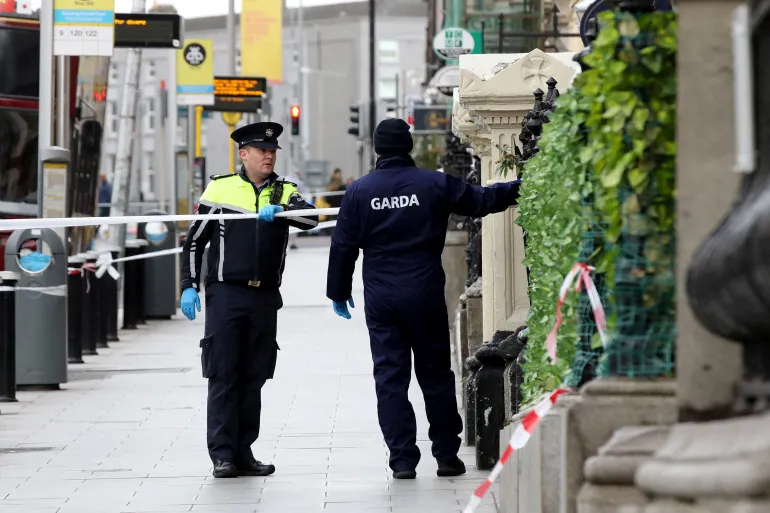
A 52-year-old man has been sentenced to life in prison for the attempted murder of three children outside a primary school in Dublin’s Parnell Square in November 2023.
Riad Bouchaker, of no fixed address, was also found guilty of assault causing serious harm to creche worker Leanne Flynn, and of assaulting two other children and a teenager.
On Monday, Judge Tony Hunt imposed the overall sentence of life imprisonment in Dublin’s Central Criminal Court.
Rioting across many parts of Dublin following the attack led to the deployment of the most riot police in Irish history.
Bouchaker was originally from Algeria but had lived in Ireland for 25 years prior to the attack, and he had Irish citizenship.
He was assisted by an Arabic interpreter and a speech-and-language expert during the trial, who were present in court for the sentencing.
The attack took place outside Gaelscoil Choláiste Mhuire in Parnell Square, shortly after 13:40 local time on 23 November.
A group of 13 children, aged five and six, were lined up on Parnell Square waiting to go to their afterschool provision. Childcare worker Leanne Flynn was helping a little boy zip up his jacket when Bouchaker pulled his knife on the children.
A five-year-old girl was left with a lifelong brain injury after being stabbed in the heart.
Now eight, she is non-verbal and can only communicate by blinking, uses a wheelchair and has to be fed through a tube in her stomach as she cannot swallow safely by herself.
The judge said the child will never live independently and that her life, and the lives of her family, had been permanently altered.
He also noted that Flynn suffered life-threatening injuries, including a collapsed lung and the loss of a spleen, as well as profound psychological consequences and her services not being available to children.
The judge said she had acted fearlessly to protect the children and hoped she could return to work in the future, but said the possibility of such remains an unanswered question.
Speaking outside court Garda (Irish police) Det Supt Colm Murphy acknowledged the actions of those “who immediately reacted to the situation as it unfolded, in particular to Leanne Flynn – her actions on the day saved lives”.
Murphy, who was the senior investigating officer in charge added: “To those who intervened and stopped the attack again, their actions saved lives”.
He also gave praise to medical personnel on the ground and hospital staff, saying that they too “saved lives”.
Murphy also acknowledged the principal of Gaelscoil Choláiste Mhuire, “for the way he and the staff at the school reacted on the day”, and also to the parents who had to endure such a traumatic incident”.
Unprecedented case
Judge Hunt said this was an unprecedented, highly unusual case involving a sudden, ferocious, sustained attack on young children and their childcare worker.
He said he had to mark the exceptional gravity of the offending against very young children and their carer, with a lethal weapon leading to consequences of the utmost gravity.
He said the circumstances were uniquely horrific and marked a profound assault on the most fundamental values protected by the criminal law.
The judge said the children happened to be selected because they were there and he was not yet sure what inference could be drawn from how Bouchaker found himself at their collection point.
At an earlier hearing, the court heard he received brain surgery in 2021 and a portion of his skull was removed, leaving a part of his brain vulnerable.
He suffered a head injury when members of the public intervened during the Parnell Square attack, after which he received hospital treatment for a month.
His defence team, which the judge ordered cannot be named due to safety concerns, said Bouchaker’s cognitive function, memory, concentration, communication and decision-making were affected as a result of the impairment.
The most riot police in Irish state history were deployed to deal with the rioting following the attack
The attack was followed by riots across much of Dublin.
The most riot police in Irish state history were deployed to deal with the unrest.
Within hours of the attack, rioters destroyed 11 police vehicles, while 13 shops were badly damaged and more were looted during clashes with riot police.
Three buses and a tram were also destroyed and several police officers were injured during three hours of sustained violence.
Ireland’s police chief at the time, Drew Harris blamed the rioting on a “lunatic, hooligan faction driven by a far-right ideology”.
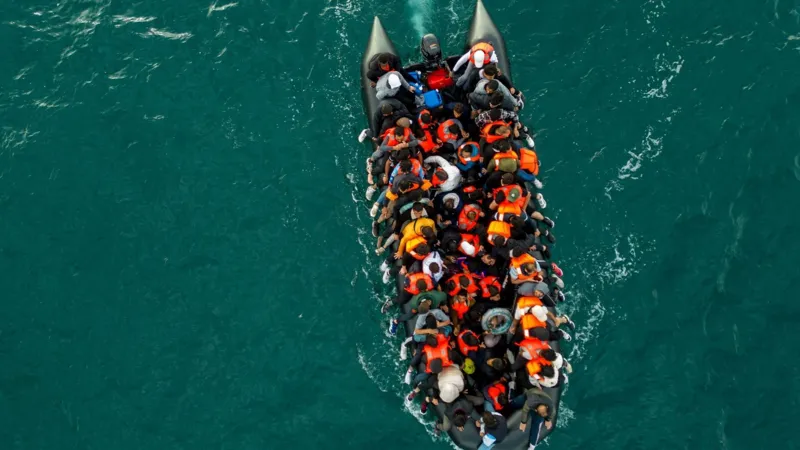
Five EU countries will open a migrant deportation centre in Rwanda next year as part of a broader push to boost removals.
Germany, Denmark, Austria, Greece and the Netherlands are expected to open a “return hub” ready to accept transfers in 2027, the Dutch and Danish governments announced in statements.
The countries said the scheme would apply to migrants staying illegally in their nations who are subject to deportation, with the Dutch government adding it will provide an alternative if deportees cannot be returned to their country of origin.
Deportees will be able to either integrate into Rwandan society or return to their home country, the nations said.
The scheme will apply to people who have exhausted their legal avenues to stay in the five nations – unlike a scrapped British deal that envisaged sending people to Rwanda to have their claims processed. Legal challenges meant the UK deal never took off, and it was eventually junked by the incoming Labour government in 2024.
Downing Street has not ruled out the UK joining the scheme, saying they will watch it “with interest”.
The five countries say the plan to send migrants abroad is in line with EU and international law, but human rights bodies say it could violate migrant rights.
The deal follows a recent EU reform that allowed for the creation of hubs outside of the bloc.
In a joint press conference in Vienna on Monday, Austrian Chancellor Christian Stocker said the five countries wanted to relieve European asylum systems and stop traffickers arranging deadly trips across the Mediterranean.
In a written statement, the Dutch government said the five countries will “only return single men” as part of the first phase of the deal, adding that the focus for the Netherlands “will be on persons from countries of origin in the same region as Rwanda”.
Once in Rwanda, people will be able to integrate into society, which means they will have the right of residence, as well as access to education, healthcare, the labour market and the legal system.
Rwandan Interior Minister Vincent Biruta said the country is commmited to working with European partners to provide a “safe, legal and dignified solution for migrants”.
He added that they would also work on “correcting the global imbalance in economic opportunities”, which he called a “key driver of irregular migration”.
Ahead of the announcement, diplomatic sources said the hub is expected to initially run as a pilot, hosting about 100 people, with each of the five nations possibly sending about 20 migrants.
The United Nations’ International Organisation for Migration (IOM) could play an ancillary role.
“IOM has a long history of providing assistance to migrants in situations of transit, including in complex contexts,” an IOM spokesperson said, adding the agency was in discussions with some EU countries “on plans for the establishment of return hubs or similar mechanisms”.
With elections approaching in several EU nations, administrations have been under pressure to show they can control migration.
Concerns around security, struggling economies and disillusionment with governing parties have all had a major role in shaping attitudes towards people leaving their home countries.
Human Rights Watch’s senior Africa researcher Clementine de Montjoye said the choice of Rwanda would be a cause of concern as it had a “well-established record of repression of dissent, arbitrary detention, ill-treatment in detention” and support for armed rebels in the neighbouring Democratic Republic of Congo.
“Paying Kigali to host a deportation programme would not only cause suffering and harm to those deported, it would finance and provide political leverage to a government responsible for serious human rights abuses at home and abroad.”
The independent EU Agency for Fundamental Rights argued any third country hosting a return hub should “respect fundamental rights”, including that people should not be sent to a country where they face serious risk of persecution.
The agency added that unaccompanied children should not be sent to a return hub, which the Dutch government has confirmed will not take place.
According to the European Border and Coast Guard Agency, there were almost 110,000 irregular border crossings into the EU in the first 10 months of 2026, which represents a 29% decrease compared to the previous year.
In October, about 18,100 crossings were detected, which is about 6% less than October 2025 but 22% more than in September “largely because of a sharp rise in arrivals on the Western African route to the Canary Islands”.
-
 Opinion2 years ago
Championing the People’s Voice: Obasa’s Dedication to Grassroots Representation By Dave Agboola⁰
-
News2 years ago
CBN Debunks Fake Circular on New ₦5,000 and ₦10,000 Notes
-
 Health & Wellness1 year ago
President Tinubu Directs Cut in Dialysis Cost from ₦50,000 to ₦12,000
-
 International News8 months ago
Indian Police Arrest Nigerian Over ₦290m Drug Haul
-
 Business8 months ago
Dangote Refinery Reduces Petrol Gantry Price To ₦1,200 Per Litre
-
 Business8 months ago
After Plea Bargain, Court Discharges Stella Oduah of ₦2.5bn Fraud
-
Business2 years ago
Dangote; We Did Not Fix ₦600/Litre Petrol Price
-
 Trending News1 year ago
NELFUND Disburses ₦86bn To 449,000 Beneficiaries