Connect with us

News

Tinubu Scheduled to Meet with Organised Labour on Thursday over Minimum Wage

Published

on

Spread the love

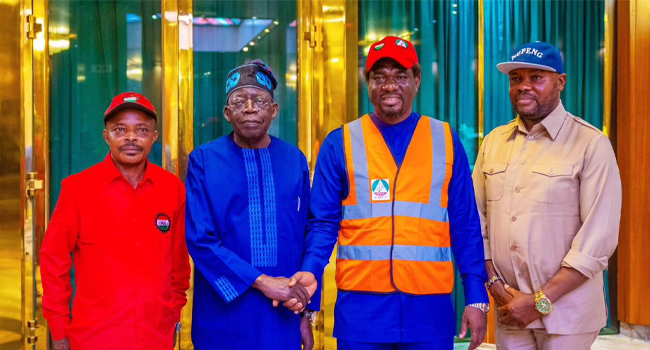
[FILE] L-R: NLC President Joe Ajaero, President Bola Tinubu, TUC President Festus Osifo, and NUPENG President NUPENG National President Williams Akporeha at the Presidential Villa, Abuja on Wednesday, August 2, 2023.

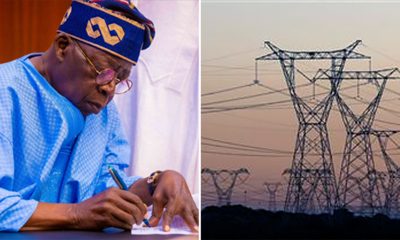
President Bola Tinubu will meet with the Organised Labour in Abuja on Thursday to further discussions on a new minimum wage for workers in Nigeria.

A top labour ssaid that the President invited the leadership of the Nigeria Labour Congress (NLC) and Trade Union Congress (TUC) to the meeting expected to be held at the Aso Villa in the nation’s capital city.

The President is expected to make a decision on the ₦62,000 proposal of the government and private sector side; as well as the ₦250,000 demand of the Organised Labour.

The Thursday meeting is coming about a month after the President said in his Democracy Day speech on June 12, 2024, that an executive bill on the new national minimum wage for workers would soon be sent to the National Assembly for passage.


On June 25, the Federal Executive Council (FEC) chaired by the President stepped down from consideration and deliberation on the memo on the new minimum wage to allow for more engagement with stakeholders.


Two days after, Tinubu and Vice President Kassim Shettima, at the 141st meeting of the National Economic Council (NEC), met with governors of the 36 states of the Federation and ministers to deliberate on a new minimum wage for workers.

Long Walk To New Wage

Talks for a new minimum wage for Nigerian workers have been on for a while. The Minimum Wage Act of 2019, which made ₦30,000 the minimum wage, expired in April 2024. The Act should be reviewed every five years to meet with contemporary economic demands of workers.


President Bola Tinubu in January set up a Tripartite Committee to negotiate a new minimum wage for workers. The committee comprises the Organised Labour, representatives of federal and state governments as well as the Organised Private Sector.


However, the committee members failed to reach an agreement on a new realistic minimum wage for workers, forcing labour to declare an indefinite industrial action on Monday, June 3, 2024. Businesses were paralysed as labour shut down airports, hospitals, the national grid, banks, National Assembly, and state assemblies’ complexes.


FILES: Members of the Nigeria Labour Congress (NLC)


The labour unions said the current minimum wage of ₦30,000 can no longer cater to the well-being of an average Nigerian worker, saying the government should offer workers something economically realistic in tandem with current inflationary pressures, attendant effects of the twin policies of petrol subsidy removal and unification of the forex windows of the current administration.


Labour “relaxed” its strike on June 4, 2024 following assurances from the President that he was committed to a wage above ₦60,000.
 

Both the Trade Union Congress (TUC) and Nigeria Labour Congress (NLC) leadership subsequently resumed talks with the representatives of the Federal Government, states, and the Organised Private Sector.


On Friday, June 7, 2024, the two sides (labour and the government) still failed to reach an agreement. While labour dropped again its demand from ₦494,000 to ₦250,000, the government added ₦2,000 to its initial ₦60,000 and offered workers ₦62,000.


Both sides submitted their reports to the President who is expected to make a decision and send an executive bill to the National Assembly to pass a new minimum wage bill to be signed into law by the President.

News

Xenophobia:Nigeria Asks ECOWAS To Drag South Africa Before AU

Published

on

Spread the love


Nigeria has advocated a concerted response to xenophobia in South Africa.

It has asked the Economic Community of West African States (ECOWAS) to take the issue from the regional bloc to the continental body, the African Union (AU).

Nigeria and Ghana, two leading members of ECOWAS, are among the countries worst hit by attacks on fellow Africans by mobs in South Africa, while the Cyril Ramaphosa government looks on.

Nigeria, like other countries whose citizens living in South Africa came under attack, had citizens killed, maimed or deprived of their means of livelihood through the looting of their shops, and subsequently evacuated many of them.

Citizens of Southern African countries neighbouring South Africa – Malawi, Zimbabwe, Lesotho and Botswana, among others – were also not spared by the rampaging mobs.

Yesterday, President Bola Ahmed Tinubu told the 69th Ordinary Session of the ECOWAS Authority of Heads of State and Government in Lungi, Sierra Leone, that xenophobia stands condemned.

“Nigeria condemns in strong terms the recent Afrophobic attack on its citizens and other fellow Africans in the Republic of South Africa.

“As already mentioned by His Excellency, the President of Ghana, ECOWAS should present this matter before the next meeting of the Authority of the African Union to send a clear message that this type of behaviour is unacceptable.

“South Africa should be reminded that the freedom the country currently enjoys is due to the liberation efforts of African countries such as Nigeria.

“The Nigerian Government has evacuated one thousand, four hundred and ninety of its citizens in seven batches and is prepared to engage on this matter,” the President said in an address delivered by Vice President Kashim Shettima.

This position further expands the hint given by the Minister of Foreign Affairs, Ambassador Bianca Odumegwu-Ojukwu, that Nigeria would take retaliatory measures against South Africa.

She said the National Assembly would make recommendations in this regard.

The National Assembly has condemned the attacks on Africans and is already reviewing the development to come up with its position.

Continue Reading

News

Uniport Dissolves Students’ Union, Orders Leaders To Face Probe Panel

Published

on

Spread the love


The management of the University of Port Harcourt (UNIPORT) has dissolved all Students’ Union (SU) activities with immediate effect, directing all elected student leaders to relinquish union property and prepare to appear before an investigative panel to account for their stewardship.


The directive, contained in an official memorandum issued by the Office of the Dean of Student Affairs, was signed by the Dean of Student Affairs, Prof. G. N. Woke, on the instruction of the Vice-Chancellor, Prof. Chike, Princewill R. Chike.

The memorandum, referenced UPH/SADean/26 and dated July 19, 2026, announced the immediate dissolution of the three arms of the Students’ Union, Hall Representatives, and all other Students’ Union activities until further notice.

“I am directed by the Vice Chancellor, Prof. Chike, Princewill R. Chike, to notify the Three Arms of the Students’ Union, Hall Reps. and all other Student Union activities that you have been dissolved with immediate effect until further notice,” the memorandum stated.

Following the dissolution, the university directed all executive members of the Students’ Union to immediately hand over every item belonging to the union to the Office of the Dean of Student Affairs.

According to the directive, the officials are expected to surrender all union property, official documents, financial records, keys, identification materials, and any other items in their possession.

“Consequently, all Executive members are directed to immediately hand over all Union property, official documents, financial records, keys, identification materials and any other item belonging to the Students’ Union in your possession to the Dean of Student Affairs,” the memorandum added.

The affected student leaders were also instructed to make themselves available whenever invited to appear before an investigative panel constituted by the university to provide an account of their administration.

The university warned that failure to comply with the directive would attract disciplinary sanctions.

“All affected officers are expected to comply with this directive promptly. Failure to do so will attract appropriate disciplinary action,” the memorandum stated.

The notice was copied to the Vice-Chancellor; the Deputy Vice-Chancellor (Administration and Advancement); the Deputy Vice-Chancellor (Academic); the Deputy Vice-Chancellor (Research and Development); the Registrar; the Chief Security Officer; the Bursar; all Deans of Faculties; all Heads of Departments; and the entire University Community.

The university, however, did not disclose the reasons behind the dissolution of the Students’ Union leadership or the specific issues being investigated by the panel.

Continue Reading

News

Women Lawyers Hail Badejo-Okusanya’s Emergence As NBA’s 2nd Female President

Published

on

Spread the love


Oyinkansola Badejo-Okusanya (SAN) made history at the weekend as the second female president of the Nigerian Bar Association (NBA), 35 years after Dame Priscilla Kuye assumed the role in 1991.

Mrs Kuye became president from her position as First Vice President after the then president of the association, Chief Clement Akpamgbo (SAN), was appointed Attorney-General and Minister of Justice by the military government of General Ibrahim Babangida.

Senior female lawyers, including Senior Advocates Funke Adekoya, Yinka Omorogbe, Ronke Adeyemi, Funke Agbor, and former Education Minister, Dr Oby Ezekwesili, publicly endorsed her candidacy.

Their support reflected both confidence in her professional credentials and the symbolic importance of a woman returning to the presidency of the NBA after more than three decades.

In her endorsement, Mrs Adekoya argued that the NBA had historically achieved some of its most significant reforms under presidents who emerged from outside the traditional circle of national NBA politics.

“She is open to refreshing the NBA and the legal profession, absent preconceived views from holding a national office previously.”

Omorogbe described her as a lawyer with the experience, courage, and temperament required to lead the Bar at a critical period, while also highlighting her commitment to mentoring younger lawyers.

Adeyemi said her record reflected competence, consistency, and dedication to institutional development.

“I have every confidence that Mrs Oyinkansola Badejo-Okusanya (SAN) will lead with wisdom, integrity, and an abiding commitment to the continued growth of our Association.”

Ezekwesili, who endorsed her candidacy before the election, described her as a lawyer whose engagements frequently focused on professional ethics, arbitration, governance, and improving conditions for young practitioners.

Badejo-Okusanya’s victory followed a fiercely contested three-way election in which she defeated fellow Senior Advocates of Nigeria, Lateef Omoyemi Akangbe and Aare Olumuyiwa Akinboro.

She secured 12,317 votes out of the 26,106 ballots cast, representing 47.18 per cent. Akangbe came second with 7,934 votes, while Akinboro received 5,855 votes.

The NBA president-elect, a founding partner of Africa Law Practice NG & Company, has built a legal career spanning litigation, arbitration, and alternative dispute resolution. She is a Fellow of the Chartered Institute of Arbitrators and serves on the board of the Lagos Court of Arbitration.

She earned a Bachelor of Arts (Hons) degree in English from the University of Lagos before pursuing a law degree at the same institution. She was called to the Nigerian Bar in 2002.

The senior lawyer was appointed Senior Special Assistant on Justice Sector Reform to then Lagos State Governor Babatunde Fashola, whom she also served as General Counsel.

But her victory cannot be explained by gender alone, as one perceived advantage she held over her opponents was her relative distance from the NBA’s traditional national political establishment.

Unlike some past NBA presidents and her opponents in the election, she had not previously held a major national elective position within the association.

Her campaign also appeared to resonate strongly with lawyers who wanted the NBA to focus more directly on the economic and professional welfare of its members.

Her message, “A Bolder Bar That Works for Everyone,” was built around the promise that lawyers should “earn better, live better and practise better.”

She also signalled her intention to make the NBA more responsive to the realities faced by lawyers outside traditional centres of influence.

This could be significant in a profession whose members operate across private practice, government, academia, corporate organisations, and other specialised fields of law.

In her acceptance speech, Badejo-Okusanya pledged to lead with “integrity, courage, humility, fairness, and accountability.”

She also promised to work with her former opponents, saying the election was over and that members remained united by their commitment to advancing the profession, justice, and the rule of law.

Before the election, Badejo-Okusanya received significant support from prominent women in the legal sector.

Her election has therefore raised expectations beyond the symbolic fact that a woman is leading the NBA for only the second time.

Her victory followed an election delayed by several hours after the NBA Electoral Committee announced that its electronic voting platform had been hacked.

The process was subsequently moved to a new domain, and lawyers also reported technical and authentication issues.

Her two defeated opponents rejected the result and raised concerns about the conduct of the election.

Consequently, one of Badejo-Okusanya’s immediate tasks will be to unify a Bar that has emerged from a highly polarised electoral process.

The main challenge will be whether she can turn her promise of a “Bolder Bar That Works for Everyone” into tangible improvements in lawyers’ professional and financial prospects while also uniting a profession emerging from a deeply divisive election.

Continue Reading

Trending

Copyright © 2026 TheColumn NG