Connect with us

International News

Firefighting Pilot, 18 Dead In South Korea Raging Wildfires

Published

on

Spread the love
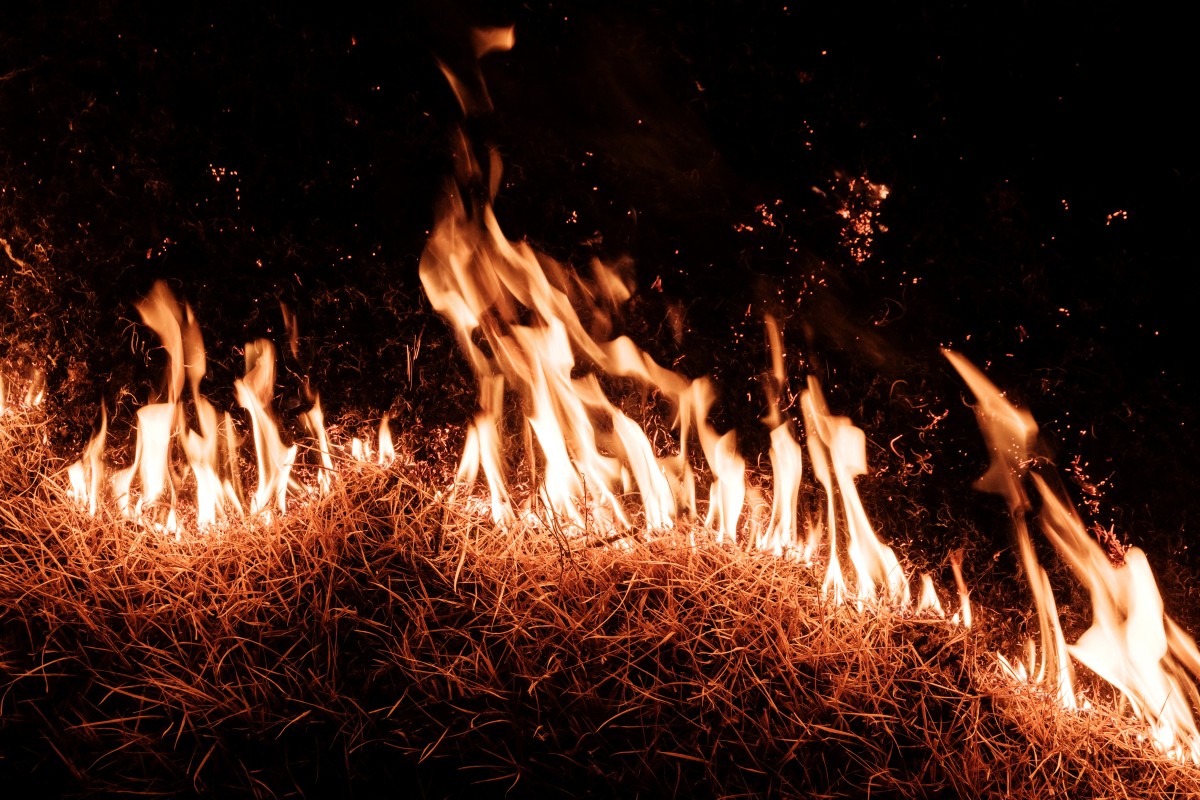
A wildfire spreads in Andong on March 26, 2025. At least 18 people have been killed in one of South Korea’s worst wildfire outbreaks, with multiple blazes burning and causing “unprecedented damage”, the acting president said. (Photo by YASUYOSHI CHIBA / AFP)


At least 19 people have been killed in one of South Korea’s worst wildfire outbreaks, with multiple raging blazes causing “unprecedented damage”, the acting president said Wednesday.

More than a dozen fires broke out over the weekend, scorching wide swathes of the southeast, forcing around 27,000 people to urgently evacuate, with the fire cutting off roads and downing communications lines as residents fled in panic.

Overnight into Wednesday, the death toll jumped to 19 as wind-driven flames tore through neighbourhoods and razed an ancient temple.

Eighteen people were killed in the wildfires and a pilot in a firefighting helicopter died when his aircraft crashed in a mountain area, officials said.

According to the interior ministry, the wildfires have charred 17,398 hectares (42,991 acres), with the blaze in Uiseong county alone accounting for 87 percent of the total.
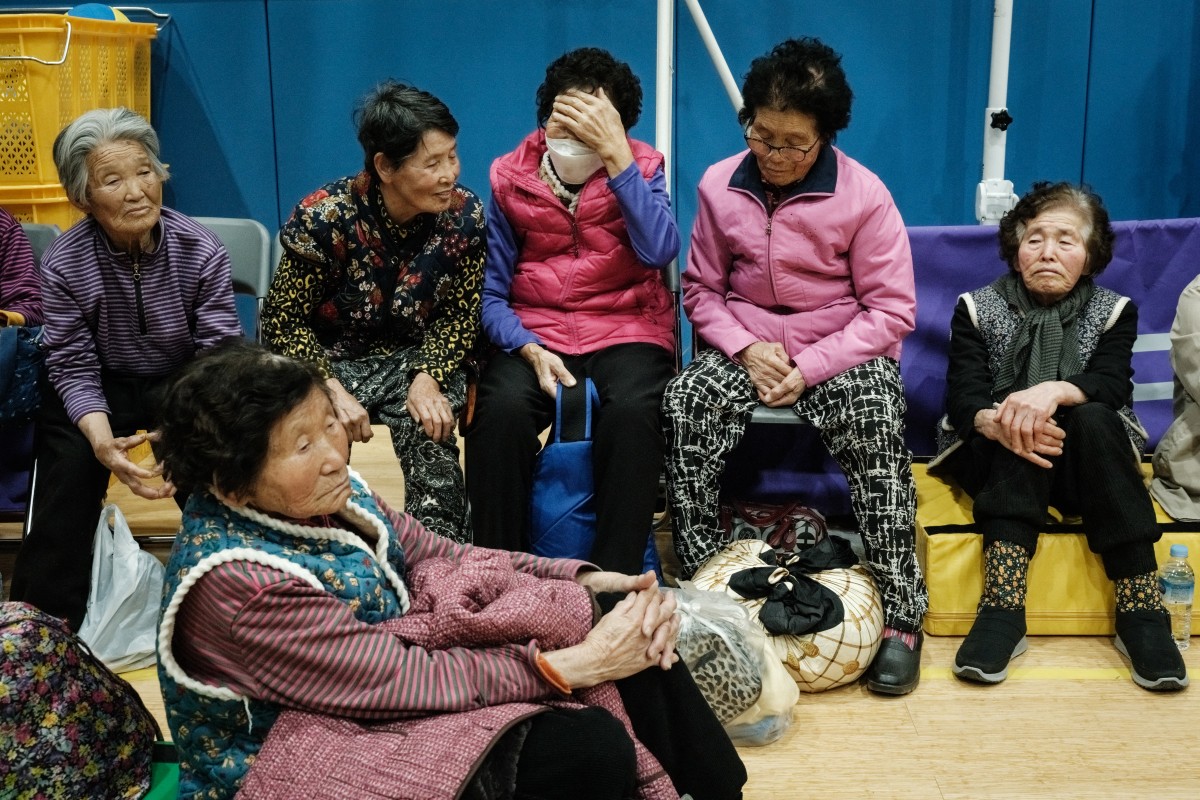
People evacuated from their homes due to the approaching wildfire, stay at the gymnasium of Sinsung Elementary School in Andong, South Korea, on March 25, 2025. Inhabitants of a UNESCO-listed village were ordered to evacuate while a historic Buddhist temple was burned to the ground as South Korea scrambled to contain worsening wildfires, which are tearing across the country’s southeast. (Photo by Yasuyoshi CHIBA / AFP)

The government has raised the crisis alert to its highest level and taken the rare step of transferring thousands of inmates out of prisons in the area.

“Wildfires burning for a fifth consecutive day… are causing unprecedented damage,” South Korea’s acting president Han Duck-soo said.

He told an emergency safety and disaster meeting that the blazes were “developing in a way that is exceeding both existing prediction models and earlier expectations.”

“Throughout the night, chaos continued as power and communication lines were cut in several areas and roads were blocked,” he added.
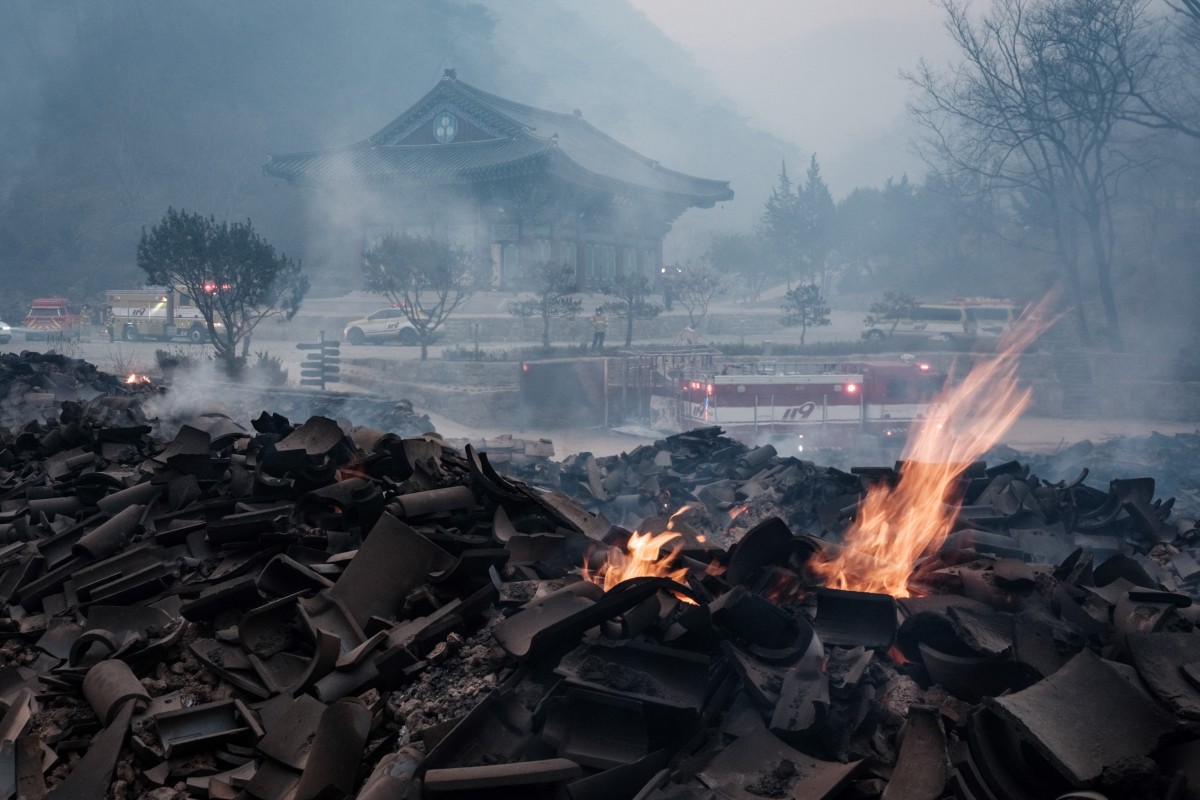
Embers remain among the debris after most of the buildings were burned to the ground in a wildfire at Gounsa Temple in Uiseong on March 26, 2025. At least 18 people have been killed in one of South Korea’s worst wildfire outbreaks, with multiple blazes burning and causing “unprecedented damage”, the acting president said. (Photo by YASUYOSHI CHIBA / AFP)

In the city of Andong, some evacuees sheltering in an elementary school gym told AFP they had to flee so quickly they could bring nothing with them.

“The wind was so strong,” Kwon So-han, a 79-year-old resident in Andong told AFP, adding that as soon as he got the evacuation order he fled.

“The fire came from the mountain and fell on my house,” he said.

“Those who haven’t experienced it won’t know. I could only bring my body.”

– ‘Most devastating’ –

Authorities had been using helicopters to battle the blazes, but suspended all such operations after a helicopter crashed Wednesday, killing the pilot on board.

Authorities said changing wind patterns and dry weather had revealed the limitations of conventional firefighting methods.

Thousands of firefighters have been deployed, but “strong winds reaching speeds of 25 metres per second persisted from yesterday afternoon through the night, forcing the suspension of helicopter and drone operations,” acting president Han said.

The fires are “the most devastating” yet in South Korea, Han said.

By Wednesday, one of the fires was threatening historic Hahoe Folk Village — a UNESCO-listed world heritage site popular with tourists but now under an emergency alert.

Huge plumes of smoke turned the sky over the village grey, AFP reporters saw, with fire trucks and police cars lined up at the edges of the historic site.

– ‘Fireballs’ –

Last year was South Korea’s hottest year on record, with the Korea Meteorological Administration saying that the average annual temperature was 14.5 degrees Celsius — two degrees higher than the preceding 30-year average of 12.5 degrees.

The fire-hit region had been experiencing unusually dry weather with below-average precipitation, authorities have said, with the South experiencing more than double the number of fires this year than last.

Some types of extreme weather have a well-established link with climate change, such as heatwaves or heavy rainfall.

Other phenomena, such as forest fires, droughts, snowstorms and tropical storms can result from a combination of complex factors.

“We can’t say that it’s only due to climate change, but climate change is directly (and) indirectly affecting the changes we are experiencing now. This is a sheer fact,” Yeh Sang-Wook, professor of climatology at Seoul’s Hanyang University, told AFP.

“Wildfires will become more frequent,” he added.

“Basically, as the atmosphere becomes warmer due to climate change, the water vapour in the ground evaporates more easily, so the amount of moisture contained in the ground decreases. So, all this creates the conditions wildfires can occur more frequently.”

The major fire in Uiseong was reportedly caused by a person tending to a family grave who accidentally ignited the blaze.

Apple farmer Cho Jae-oak told AFP that he and his wife had sprayed water around their house all day in a desperate bid to protect it.

“We kept spraying and guarded. When the fire was burning on the mountain, fireballs flew here,” he said, adding that the encroaching flames eventually forced them to leave.




AFP

Continue Reading
Click to comment

Leave a Reply

Your email address will not be published. Required fields are marked *

International News

US Wants Justice In The killing Of Pastor Dachomo’s 9 Family Members 

Published

on

Spread the love


The United States has condemned the killing of members of the family of Plateau-based cleric, Rev. Ezekiel Dachomo, describing the attack as horrific and urging Nigerian authorities to ensure those responsible are brought to justice.


In a statement shared on X on Thursday, the US Department of State’s Bureau of African Affairs expressed condolences to the victims’ families and called for stronger measures to prevent further attacks on vulnerable communities across Nigeria’s Middle Belt.

“The United States strongly condemns the horrific killing of members of Rev. Ezekiel Dachomo’s family in Plateau State, Nigeria. The continued violence targeting Christian communities and other vulnerable populations in Nigeria’s Middle Belt is deeply alarming,” the bureau said

The US said it had already engaged Nigerian officials on the worsening security situation, stressing that urgent action was needed to curb recurring attacks and hold perpetrators accountable.

“As I discussed last week with Nigerian officials, we must do more to prevent violent acts. The perpetrators must be held accountable, and urgent action is needed to strengthen security and protect Christians and other vulnerable communities,” the statement added.

The bureau reaffirmed Washington’s commitment to working with the Nigerian government to combat terrorism and violent extremism, stressing that Christians and other Nigerians should be able to practise their faith without fear of violence.

The statement followed the July 12 attack on Kum community in Riyom Local Government Area of Plateau State, where nine members of Rev. Dachomo’s extended family, including a two-month-old baby, were killed.

According to the cleric, the attackers, believed to be armed Fulani militias, asked for him by name before opening fire on his relatives.

Dachomo, who serves as Regional Chairman of the Church of Christ in Nations (COCIN) in Barkin Ladi Local Government Area, said his family had repeatedly been targeted because of his outspoken criticism of the violence in Plateau State.

He recalled that his grandmother and an uncle were also killed in previous attacks, adding that days after burying his relatives, he received a written death threat from the same group, warning that he would be their next target.

Continue Reading

International News

Nigeria Missing As Saudi Arabia Names African Countries Eligible For eVisa

Published

on

Spread the love


Saudi Arabia has updated its tourist eVisa programme for 2026, limiting eligibility in Africa to only three countries as part of its list of 66 nations whose citizens can apply through the Kingdom’s online visa platform.


The move leaves most African countries, including Nigeria, outside the simplified entry scheme.

The electronic visa allows eligible travellers to visit Saudi Arabia for tourism, leisure activities, family visits and Umrah, excluding the annual Hajj pilgrimage. Applications are completed online, eliminating the need for embassy visits and lengthy visa processing.

Saudi authorities said the eVisa forms part of ongoing efforts to expand tourism, attract international visitors and simplify travel procedures through a fully digital application system. The visa is available only to citizens of approved countries and territories listed on the Kingdom’s official tourism portal.

Below is the list of African countries eligible for Saudi Arabia’s eVisa.

1. Mauritius

2. Seychelles

3. South Africa

Continue Reading

International News

South Africa Says Over 53,000 Deported In Migration Campaign

Published

on

Spread the love


The South African government says more than 53,000 foreign nationals have been deported or repatriated since launching a “migration management” campaign five weeks ago.

Most were from Malawi, Zimbabwe, and Mozambique, officials say, and the number is likely to rise as repatriations and deportations continue.

South Africa is carrying out one of its biggest crackdowns on undocumented migrants in years, following weeks of anti-immigration protests that have seen violence, intimidation and looting.

Protesters have been demanding tighter border controls and mass deportations, accusing migrants of contributing to high unemployment, rising crime rates and collapse of public services.

The UN has warned against using migrants as scapegoats for South Africa’s socioeconomic challenges.

Anti-migrant activists have threatened to stage weekly protests to pressure the government until their demands are met, and there are fears the protests could turn violent.

The demonstrators had set an “unofficial deadline” of 30 June for all undocumented migrants to leave the country, which has seen many foreigners leave to escape violence and intimidation.

Several countries, including Ghana, Nigeria, Uganda and Kenya, have flown their citizens home in recent weeks.

Justice and Constitutional Development Minister Mmamoloko Kubayi announced on Sunday that 53,499 foreign nationals have been processed for deportation and repatriation, “which is dominated by the Malawians, followed by Zimbabweans and Mozambicans”.

“We are striving to achieve an orderly and regular migration which is mindful and sensitive to the concerns raised by our people, while observing human rights and dignity of all people in our country, irrespective of their citizenship and immigration status,” Kubayi told a news conference in Pretoria.

She said the repatriation and deportation process has helped them catch people who were wanted by the police for alleged criminal activity.

Authorities will continue to enforce its immigration laws, she added, but warned that protesters should not conduct unauthorised searches of homes and businesses that are suspected of sheltering undocumented migrants.

South Africa’s President Cyril Ramaphosa has acknowledged public concerns about immigration but has condemned attacks against migrants, warning citizens against taking the law into their own hands.

South Africa is the continent’s wealthiest nation and has long attracted migrants searching for better economic opportunities, some of whom enter the country illegally.

Continue Reading

Trending

Copyright © 2026 TheColumn NG