Connect with us

International News

China Probes Top Military Official For Corruption

Published

on

Spread the love

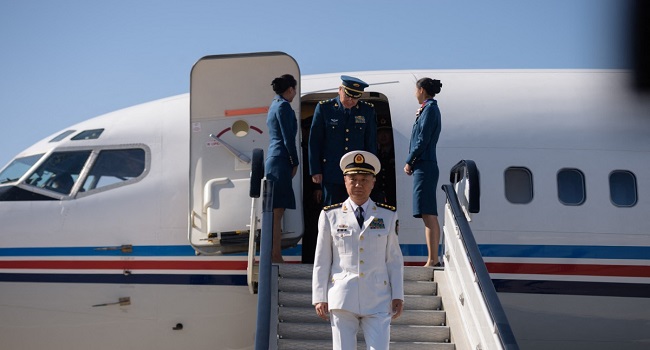
(FILES) Miao Hua (C), China’s director of the political affairs department of the Central Military Commission, disembarks his aircraft after arriving at Pyongyang International Airport on October 14, 2019. (Photo by KIM Won Jin / AFP)

A top Chinese military official has been dismissed while an investigation into “serious violations of discipline” takes place, Beijing said Thursday, the latest senior apparatchik to fall in a sweeping crackdown on graft in the country’s armed forces.


The ruling Chinese Communist Party has “decided to suspend Miao Hua from duty pending investigation”, Wu Qian, a spokesman for Beijing’s defence ministry, told a press briefing.

Wu did not provide further details about the charges against Miao, an admiral and a member of Beijing’s powerful Central Military Commission (CMC).

But “serious violations of discipline” are commonly used by officials in China as a euphemism for corruption.

Miao sat on China’s Central Military Commission alongside five other men, including President Xi Jinping at the top.


He headed the CMC’s Political Work Department, the top military body’s most important office.


Miao has been described as a “close ally” of Xi and a “trusted interlocutor” between the military and the party by Lyle Morris, a senior fellow at the Asia Society.


Beijing has deepened a crackdown on alleged graft in the armed forces over the past year, with Xi this month ordering the military to stamp out corruption and strengthen its “war-preparedness”.


The intensity of the anti-graft drive in the military has been partially driven by fears that it may affect China’s ability to wage a future war, Bloomberg reported citing US officials this year.


The removal of Miao reveals the “endurance of corruption and discipline issues across the system in the PLA, despite the strong efforts made by Xi,” one expert told AFP.


“I think the fact that these probes are still done, and done fairly openly and publicly, despite the obvious reputational hits, shows the resolve of Xi to really address and try to root it out,” said Dylan Loh, an assistant professor at Singapore’s Nanyang Technological University.

Deepening crackdown

At the same briefing, Wu denied reports that Defence Minister Dong Jun has been placed under investigation for corruption.

“The reports in question are pure fabrications,” Wu said.

“The rumour-mongers are ill-intentioned. China expresses its strong dissatisfaction with such slanderous behaviour,” he added.

A former navy commander, Dong was appointed defence minister in December following the surprise removal of predecessor Li Shangfu just seven months into the job.

Li was later expelled from the Communist Party for offences including suspected bribery, state media said. He has not been seen in public since.

His predecessor, Wei Fenghe, was also kicked out of the party and passed on to prosecutors over alleged corruption.

The country’s secretive Rocket Force — which oversees China’s vast arsenal of strategic missiles, both conventional and nuclear — has come under particularly intense scrutiny.

In July, a top Chinese official in the Rocket Force, Sun Jinming, was kicked out of the party and placed under investigation for corruption.

At least two other high-ranking officers connected to the Rocket Force, a relatively new unit of the Chinese military, have also been removed for graft.

“We will see many more investigations into the PLA and this will not end with Miao Hua or Li Shangfu,” Alfred Wu, an associate professor at the Lee Kuan Yew School of Public Policy in Singapore, told AFP.



AFP

Continue Reading
Click to comment

Leave a Reply

Your email address will not be published. Required fields are marked *

International News

Artemis II Nears Pacific Splashdown Finale

Published

on

Spread the love

Their dramatic grand finale fast approaching, Artemis II’s astronauts aimed for a splashdown in the Pacific on Friday to close out humanity’s first voyage to the moon in more than half a century.

The tension in Mission Control mounted as the miles melted away between the four returning astronauts and Earth.

All eyes were on the capsule’s life-protecting heat shield that has to withstand thousands of degrees during reentry. On the only other test flight of the spacecraft — in 2022, with no one on board — the shield’s charred exterior came back looking as pockmarked as the moon.

Commander Reid Wiseman, pilot Victor Glover, Christina Koch, and Canada’s Jeremy Hansen were on track to hit the atmosphere traveling Mach 32 — or 32 times the speed of sound — a blistering blur not seen since NASA’s Apollo moonshots of the 1960s and 1970s.

This screen grab from NASA’s feed released on April 3, 2026, shows the four Artemis II crew members (L-R) Canadian Space Agency (CSA) astronaut Jeremy Hansen, Artemis II mission specialist, NASA astronauts Reid Wiseman, Artemis II commander, Christina Koch, Artemis II mission specialist and Victor Glover, Artemis II pilot as they head to orbit the Moon for the first time in more than half a century. Photo by HANDOUT / NASA TV / AFP

They didn’t plan on taking manual control except in an emergency. Their Orion capsule, dubbed Integrity, is completely self-flying.

Like so many others, lead flight director Jeff Radigan anticipated feeling some of that “irrational fear that is human nature,” especially during the six minutes of communication blackout preceding the opening of the parachutes. The recovery ship USS John P. Murtha awaited the crew’s arrival, along with a squadron of military planes and helicopters.

The last time NASA and the Defense Department teamed up for a lunar crew’s reentry was Apollo 17 in 1972. Artemis II was projected to come screaming back at 34,965 feet (10,657 meters) per second — or 23,840 mph (38,367 kph) — not a record but still mind-bogglingly fast before slowing to a 19 mph (30 kph) splashdown.


Artemis II’s record flyby and lunar views

\

This handout picture provided by NASA shows Earth as seen through the Orion spacecraft’s window, photographed by NASA astronaut Reid Wiseman, commander of Artemis II, on April 2, 2026, after completing the translunar injection burn. (Photo by Reid Wiseman/NASA / NASA / AFP)

Launched from Florida on April 1, the astronauts racked up one win after another as they deftly navigated NASA’s long-awaited lunar comeback, the first major step in establishing a sustainable moon base.

Artemis II didn’t land on the moon or even orbit it. But it broke Apollo 13’s distance record, making Wiseman and his crew the farthest that humans have ever journeyed from Earth when they reached 252,756 miles (406,771 kilometers). Then, in the mission’s most heart-tugging scene, the teary astronauts asked permission to name a pair of craters after their moonship and Wiseman’s late wife, Carroll.

During the record-breaking flyby, they documented scenes of the lunar far side never seen before by the naked eye and savored a total solar eclipse courtesy of the cosmos thanks to their launch date. The eclipse, in particular, “just blew all of us away,” Glover said.

This handout picture by an Artemis II crew member provided by NASA shows Artemis II mission specialist Christina Koch looking back at earth through the window of the Orion spacecraft on April 2, 2026. (Photo by Handout / NASA / AFP)

Their sense of wonder and love awed everyone, as did their breathtaking pictures of the moon and Earth. The Artemis II crew channeled Apollo 8’s first lunar explorers with Earthset, showing our blue marble setting behind the gray moon. It was reminiscent of Apollo 8’s famous Earthrise shot from 1968.

“It just makes you want to continue to go back,” Radigan said on the eve of splashdown. “It’s the first of many trips, and we just need to continue on because there’s so much” more to learn about the moon.

Their moonshot drew global attention as well as star power, earning props from President Donald Trump; Canadian Prime Minister Mark Carney; Britain’s King Charles III; Ryan Gosling, star of the latest space flick “Project Hail Mary;” Scarlett Johansson of the Marvel Cinematic Universe; and even Captain Kirk himself, William Shatner of TV’s original “Star Trek.”

Artemis II was a test flight for future moon missions

A view through a window of the Orion spacecraft mockup on April 7, 2026 at Johnson Space Center in Houston, Texas.  (Photo by RONALDO SCHEMIDT / AFP)


Despite its rich scientific yield, the nearly 10-day flight was not without technical issues. Both the capsule’s drinking water and propellant systems were hit with valve problems. In perhaps the most high-profile predicament, toilet trouble prevented the crew from using it for No. 1 most of the trip, forcing them to resort to old-time bags and funnels.

The astronauts shrugged it all off.

“We can’t explore deeper unless we are doing a few things that are inconvenient,” Koch said, “unless we’re making a few sacrifices, unless we’re taking a few risks, and those things are all worth it.”

Added Hansen: “You do a lot of testing on the ground, but your final test is when you get this hardware to space, and it’s a doozy.”

A journalist looks at the Orion spacecraft mockup on April 7, 2026 at Johnson Space Center in Houston, Texas. Photo by RONALDO SCHEMIDT / AFP


Under the revamped Artemis program, next year’s Artemis III will see astronauts practice docking their capsule with a lunar lander or two in orbit around Earth. Artemis IV will attempt to land a crew of two near the moon’s south pole in 2028.

The Artemis II crew’s allegiance was to those next Artemis crews, Wiseman said.

“But we really hoped in our soul is that we could for just for a moment have the world pause and remember that this is a beautiful planet and a very special place in our universe, and we should all cherish what we have been gifted,” he said.

Continue Reading

International News

Real Madrid Denies Plans to Appoint Sporting Director

Published

on

Spread the love

Real Madrid has stated that rumors on considering incorporating a sports director into its structure are categorically false.


According to Fabrizio Romano’s X post on Friday, the club was quoted as saying, “Real Madrid extraordinarily values the work that the club’s sports management has been carrying out, which has allowed us to live through one of the most successful periods in our entire history with the achievement of numerous titles, including 6 European Cups in ten years.”

It strongly reaffirm confidence in its current sporting management structure.

It also praise the existing leadership, crediting it for one of the most successful eras in the club’s history.

As evidence, they point to major achievements, including six UEFA Champions League titles in the last decade.

Overall, it’s a standard club statement aimed at shutting down speculation while reinforcing trust in their current internal setup.

Madrid have long operated with a distinct organisational model, where key transfer and sporting decisions are primarily overseen by senior executives and trusted football leadership rather than a traditional sporting director structure common in many European clubs.

The club’s denial comes amid continued speculation in Spanish football media about potential internal changes, particularly as elite clubs across Europe increasingly adopt centralized sporting director systems to streamline recruitment and long-term squad planning.

Continue Reading

International News

Thousands of Iranians rally in memory of late supreme leader Khamenei

Published

on

Spread the love

Thousands of Iranians paid tribute on Thursday to the late supreme leader Ali Khamenei, who ruled the country for nearly four decades until his killing in US-Israeli strikes at the start of the Middle East war.


His son Mojtaba Khamenei has succeeded him but he has not been seen in public since before the war, and it appeared unlikely that he would be present at ceremonies being held across Iran on Thursday.

Images broadcast on state television showed thousands of people taaking part in rallies, many holding portraits of the late revolutionary, including in Urmia in the northwest, Gorgan in the northeast and the capital Tehran.

The national homage began at 9:40 am (0610 GMT), the time at which Ali Khamenei was killed on February 28 at his Tehran residence, alongside numerous senior Iranian figures.

The attack marked the start of the Middle East war that rapidly spread across the region, with Iran retaliating against US interests in the Gulf and striking Israel.

Owing to the war, a state funeral has yet to take place for the late leader.


AFP

Continue Reading

Trending

Copyright © 2026 TheColumn NG