
Business
Dangote Refinery Reduces Petrol Gantry Price To ₦1,200 Per Litre

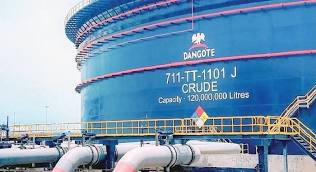
The Dangote Petroleum Refinery and Petrochemicals has reduced its gantry price for premium motor spirit (PMS), popularly known as petrol, to ₦1,200 per litre.
Disclosing this in a statement sighted by Channels Television on Friday, the spokesperson for the Dangote Group, Anthony Chiejina, said the refinery pegged its coastal price at ₦1,153 per litre, a development expected to reshape fuel supply costs across Nigeria’s downstream distribution chain.
According to him, the price adjustment represents a downward review in the refinery’s pricing template.
This comes at a time of heightened uncertainty in the global oil market, driven by geopolitical tensions in the Middle East.
“Dangote Petroleum Refinery & Petrochemicals has reduced its gantry price for petrol to ₦1,200 per litre and its coastal price to ₦1,153 per litre, a move that comes amid ongoing tensions in the Middle East that continue to influence global oil markets.
“The adjustment marks a downward review in the refinery’s pricing structure and is expected to influence fuel supply costs across distribution channels, including depots and retail outlets,” Chiejina stated.
The price drop reflects a decrease of ₦75 from the previous rate of ₦1,275 per litre.
The refinery had recently increased its petrol price from ₦1,175 per litre to ₦1,245 per litre.
Chiejina maintained that the “price adjustment represents a downward review in the refinery’s ex-depot pricing and is expected to ripple across Nigeria’s downstream sector, potentially easing supply costs for marketers and influencing pump prices at retail outlets.
He added that lower ex-depot prices typically translate into reduced pump prices.”
The spokesman expressed worry that the “Middle East crisis has introduced renewed uncertainty into global oil markets, affecting shipping routes, insurance premiums, and supply chains”.
“For Nigeria, the presence of large-scale local refining capacity is increasingly seen as a stabilising factor, offering some insulation from external shocks even as global market pressures persist,” he added.
With the new ₦1,200 per litre rate, marketers are expected to recalibrate their landing costs, especially those sourcing locally instead of importing.
Similarly, the coastal price of ₦1,153 per litre is expected to affect marine deliveries to coastal depots, providing an alternative supply route for distributors operating in southern corridors.

The Federal Government has commenced a six-week review of the new tax laws to identify implementation gaps, address consequences that have emerged since their implementation and consider concerns raised by the organised private sector and other stakeholders.
The review will examine areas including Value Added Tax thresholds, withholding tax, capital gains treatment and multiple taxation.
Recall that President Bola Ahmed Tinubu last year signed into law four new tax bills passed by the National Assembly, describing the laws as pivotal to the success of his administration’s reforms and the country’s prosperity.
The bills were the Nigeria Tax Bill (Ease of Doing Business), which seeks to consolidate Nigeria’s fragmented tax laws into a harmonised statute; the Nigeria Tax Administration Bill, which establishes a uniform legal and operational framework for tax administration across the federal, state and local governments.
Others are the Nigeria Revenue Service (Establishment) Bill, which repeals the Federal Inland Revenue Service Act and creates a more autonomous and performance-driven national revenue agency, the Nigeria Revenue Service (NRS); and the Joint Revenue Board (Establishment) Bill, which provides a formal governance structure to facilitate cooperation between revenue authorities at all levels of government.
While inaugurating the Technical Subcommittee on Fiscal Policy and Tax Reforms in Abuja yesterday, the Minister of Finance and Coordinating Minister of the Economy, Taiwo Oyedele, said implementation of the new laws had exposed areas requiring clarification and further reforms.
“The real test begins when the law meets the economy, as businesses interpret it, administrators implement it, investors respond to it, and citizens experience it. Implementation inevitably reveals areas requiring clarification, refinement or further reform,” the minister said.
Oyedele said the government was shifting from fundamental tax reforms to continuous improvement, stressing that the review was not intended to reverse the 2025 reforms.
He said, “The Finance Bill 2027 should not be seen as just another annual legislative exercise. Our task is not to rewrite the 2025 reforms, but to preserve their fundamental principles while learning from implementation and responding to new economic realities.
“We must ask where implementation has revealed ambiguity, where unintended consequences have emerged, where compliance can be simplified, and where we can improve investment and competitiveness.”
The review will also cover fiscal policy and management, public financial management, debt, transparency, capital markets and cross-border capital flows.
According to Oyedele, the government received 134 submissions from across Nigeria’s geopolitical zones after inviting public input, alongside additional submissions made in hard copy.
Preliminary concerns raised by stakeholders included calls to clarify and simplify VAT thresholds, withholding tax and capital gains provisions.
Stakeholders also proposed stronger measures against multiple taxation and improved coordination among revenue authorities.
They called for greater digitalisation and data sharing to prevent taxpayers from repeatedly submitting information already available to government agencies.
Other proposals included stronger taxpayer rights, faster refunds, safeguards for small businesses and measures to improve investment and competitiveness in mining, renewable energy, healthcare and capital markets.
Oyedele urged the subcommittee to assess the economic impact of proposed changes, particularly on low-income households, workers and businesses.
“Every tax reform produces winners and losers; the question is whether a policy is fair, efficient and competitive, not whether it is popular with everyone,” he said.
He added, “A provision that raises revenue may impose a far greater cost on the wider economy. The government must optimise the whole economy, not merely achieve a single objective.”
The minister warned that complicated tax rules could increase compliance costs for businesses.
Beyond preparing recommendations for the Finance Bill 2027, the subcommittee will review the Deduction of Tax at Source Regulations 2024 and prepare revised withholding tax regulations.
It will also review the Companies Income Tax (Significant Economic Presence) Order 2020 and develop an updated framework aligned with the new tax laws and international practices.
The Permanent Secretary of the Federal Ministry of Finance chairs the subcommittee, while Chairman of the Tax Advisory Committee Albert Folorunsho serves as co-chair.
Members include representatives of the Federal Ministry of Justice, Nigeria Revenue Service, Joint Revenue Board, Nigeria Customs Service, Central Bank of Nigeria, Debt Management Office, Budget Office of the Federation and Nigerian Investment Promotion Commission.
Other members are drawn from the Small and Medium Enterprises Development Agency of Nigeria, Manufacturers Association of Nigeria, Nigerian Economic Summit Group, Nigerian Bar Association, Association of National Accountants of Nigeria, Chartered Institute of Taxation of Nigeria and Institute of Chartered Accountants of Nigeria.
Representatives of the Nigerian Association of Chambers of Commerce, Industry, Mines and Agriculture and the Big Four accounting firms — Deloitte, EY, KPMG and PwC — are also members.
The Nigeria Tax Act 2025, Nigeria Tax Administration Act 2025, Nigeria Revenue Service (Establishment) Act 2025 and Joint Revenue Board (Establishment) Act 2025 took full effect on January 1, 2026.
The Corporate Affairs Commission, CAC has revealed plans to expose the real owners behind Nigerian companies.
Hussaini Ishaq Magaji, Registrar-General of the CAC, made the disclosure at an engagement with journalists on Tuesday in Abuja.
According to him, there are legal owners of Nigerian companies and real individuals behind the corporate structure.
He said there is an urgent need for the public to know the real human beings behind corporate entities under its beneficial ownership disclosure framework.
He added that the move would help track illicit financial inflows within the country’s corporate ecosystem.
“In simple terms, there may be a legal owner on paper and the real person behind the corporate structure.
“We want to know the human being behind the corporate structure. And that is why beneficial ownership disclosure is not merely a bureaucratic requirement,” Magaji said.
The Central Bank of Nigeria (CBN) has rolled out a stronger supervisory framework that seeks to deter the use of Nigerian banks and financial institutions for terrorism financing and other abuses.
In a statement, the apex bank’s Acting Director, Corporate Communications/Investor Relations Department, Hakama Sidi-Ali, said the CBN has made terrorism financing supervision one of its current priorities.
According to her, the focus is part of the bank’s ongoing commitment to protecting the Nigerian financial system from abuse by illicit actors.
She explained that this new push covers four broad areas including how financial institutions manage terrorism financing risk, how they monitor transactions for signs of terrorism financing, how they carry out targeted financial sanctions, and how they report suspicious transactions linked to terrorism.
She said the apex bank would not be sitting back and waiting for problems to surface on their own, rather it plans to use a risk-based approach, which means banks and institutions seen as more exposed to this kind of risk will attract closer attention.
Sidi-Ali said: “This supervisory focus also supports Nigeria’s ongoing domestic and international cooperation on counter-terrorism financing, counter-proliferation financing, financial integrity, and the protection of the financial system. Further supervisory engagement will be undertaken as appropriate.”
According to her, the bank will continue to apply a risk-based supervisory approach, including on-site and off-site engagement, to support effective Anti-Money Laundering, Combating the Financing of Terrorism, and Countering Proliferation Financing (AML/CFT/CPF) controls across the financial sector in line with existing legal and regulatory obligations.
She added that further supervisory engagement will be undertaken as appropriate, suggesting that more steps could follow depending on what its checks turn up.
-
 Health & Wellness1 year ago
President Tinubu Directs Cut in Dialysis Cost from ₦50,000 to ₦12,000
-
 News1 year ago
PICTURE: In Lagos Couple Sentenced to 22½ Years for Cannabis Trafficking
-
 Trending News1 year ago
NELFUND Disburses ₦86bn To 449,000 Beneficiaries
-
 Business2 years ago
Heritage Bank Customers’ Path to Securing ₦5m Insured Funds: A Step-By-Step Guide by NDIC”
-
Business2 years ago
Dangote; We Did Not Fix ₦600/Litre Petrol Price
-

 International News6 months ago
Indian Police Arrest Nigerian Over ₦290m Drug Haul
-

 Business6 months ago
After Plea Bargain, Court Discharges Stella Oduah of ₦2.5bn Fraud
-
News2 years ago
NELFUND: Tertiary Institution Students To Get ₦850m Loan Today