Connect with us

Uncategorized

Internal Dispute Erupts in PDP Over Anyanwu

Published

on

Spread the love

The crisis within the Peoples Democratic Party (PDP) has deepened, creating sharp divisions within both the National Working Committee (NWC) and the Governors’ Forum. At the heart of the dispute is the contentious position of National Secretary.


Besides, there is uncertainty over the National Executive Committee (NEC) meeting billed for Monday.

Two developments yesterday exposed the underbelly of the PDP crisis.

Acting National Chairman, Ambassador Umar Damagum, announced that Senator Samuel Anyanwu had been reinstated as the National Secretary.

He also said Monday’s NEC meeting had been put off.

But another group of leaders, comprising Deputy National Chairman (South) Taofeek Arapaja and other key members of the NWC, repudiated the position expressed by Damagum.

Damagum’s statement followed the advice by the Independent National Electoral Commission (INEC) to the main opposition party to follow the guidelines on the issuance of the notice for the NEC meeting.

Acting National Chairman, Ambassador Umar Damagum, announced that Senator Samuel Anyanwu had been reinstated as the National Secretary.

He also said Monday’s NEC meeting had been put off.

But another group of leaders, comprising Deputy National Chairman (South) Taofeek Arapaja and other key members of the NWC, repudiated the position expressed by Damagum.

Damagum’s statement followed the advice by the Independent National Electoral Commission (INEC) to the main opposition party to follow the guidelines on the issuance of the notice for the NEC meeting.

Eleven of the 19-member NWC, led by Arapaja, denounced the decision, saying that it contradicted the resolution of the 99th NEC that the Deputy National Secretary, Setonji Koshoedo, should act as Secretary.

Also, Federal Capital Territory (FCT) Minister, Nyesom Wike, chided Damagum for waiting for directives from the electoral commission before implementing the Supreme Court judgment that affirmed Anyanwu as secretary.

Wike, who spoke in Abuja during the inauguration of some projects, said the issue of reinstating Anyanwu did not arise because the secretary was not an appointee of the Chairman, but a party officer who has been working since his election.

‘Reason Anyanwu was reinstated’

Explaining the reason for reinstating Anyanwu, the chairman said it was the outcome of the meeting between the party leadership and INEC.

Damagum, who spoke with reporters at the PDP National Secretariat in Abuja, said: “After due consultation and everything, we thought it’s a bitter pill and we have to swallow it.”

He said the party had no option but to ask Anyanwu to return to his office, adding that the observation by the electoral agency cannot be dismissed with a wave of the hand.

With Damagum at the news conference were the chairman of the PDP Governors’ Forum, Bauchi State Governor Bala Mohammed; Chairman of PDP National Assembly Caucus, Senator Abba Moro; House of Representatives Minority Leader, Kingsley Chinda; Chairman of PDP Strategy Committee, Senator Bukola Saraki; former governor of Bayelsa State, Senator Seriake Dickson, and some members of the NWC.

Damagum also explained that the PDP/INEC meeting necessitated the postponement of the NEC meeting.

He said: “We met with some of our governors, the Governors Forum, members of the Board of Trustees and the PDP Caucus in the National Assembly.

“Today (yesterday), I convened a critical meeting of the PDP NWC, though at short notice. We had an extensive meeting, and critical issues were discussed. We know where our problem is.

“INEC is our regulator and they have told us their position as it is; as it affects the issue surrounding the National Secretary.

“We are all aware that the National Secretary is a signatory of this party; it is a critical position that he holds.

“As such, we have decided to abide by the advice they gave us, especially as we have a very, very important election before us, that is, the FCT local government election, and we are running out of time.

“So, we have no option but to abide by the decision.”

Damagum urged the party faithful to show understanding about the difficult yet important decision.

He added: “The survival of the party is more than all of us, more than everything that you feel that you know and yearn for so.

“I want to use this opportunity to tell you that we will do the right thing, and it is the decision of most members of this party, led by the organs of the party.

“The leaders of the organs of the party will have an expanded caucus so that we can discuss extensively the way forward. That would be on the 30th, and we will issue the notice as there is not going to be NEC, but an expanded caucus.

“INEC told us that they do not have any notice of a NEC meeting from us because I was the only person who signed, and we have not followed the guidelines.

“So, the expanded caucus meeting will make a decision for NEC as well as all critical issues brought before us and leading to our national convention.

“Now,  Anyanwu will resume as the National Secretary. I think that’s the most important thing.”

Wike: Anyanwu has always been secretary

Wike said it was erroneous for the chairman to announce a reinstatement, stressing that Anyanwu never vacated the office of secretary.

He said: “I heard it when the acting national chairman of PDP was directing the National Secretary to resume.

“The National Secretary is not your appointee. The National Secretary has been doing his work. So, you can’t call him to resume.

“The National Secretary has been working and will continue to work. He doesn’t require anybody to direct him to resume work.

“If it’s because of your ignorance of the law, too bad. The law does not recognise ignorance. That you’re ignorant of the law is not an excuse.

“I feel so bad when people can now move to INEC, for INEC to direct them to obey the Supreme Court judgment, it’s most unfortunate.”

Wike urged Damagum to seek guidance instead of acting out of ego or relying solely on allocations, adding that money is not the solution to every problem.

He said: “I will not be a party of those who will shoot themselves. When you don’t know something, ask the right person. Not because of ego, not because of oh, I’m receiving a monthly allocation. Money does not solve all the problems.

“There’s nothing you can do about it. If you want to learn, come and meet us, we will teach you how to go about it.”

Damgum led some governors and other leaders of the party to a meeting with INEC chairman Prof. Mahmood Yakubu on Tuesday.

Prof. Yakubu advised the PDP chieftains who wanted him to guide the opposition party on who is their National Secretary, to take a decision based on the Supreme Court judgment.

He said it was for the party to decide and not the electoral agency.

Thereafter, Damagum promised to meet with party stakeholders to take a stance.

It was learnt that party stakeholders met all through Tuesday night, where they agreed to allow Anyanwu to continue in office.

NWC divided over reinstatement

According to the 11 NWC members who opposed Anyanwu’s reinstatement, the chairman took the decision without recourse to Section 31[3] of the PDP Constitution.

The aggrieved party officers also insisted in a statement that the PDP NEC meeting would be held on June 30.

“The attention of the NWC of the PDP has been drawn to a press briefing by Ambassador Damagum, wherein he attempted to overturn the resolution of the 99th National Executive Committee (NEC) meeting, which scheduled the 100th NEC meeting for Monday, 30th June 2025.

“The Acting National Chairman also reportedly announced that Senator Samuel Anyanwu has been asked to resume as National Secretary of the party, contrary to the resolution of the 99th NEC meeting, which referred all matters relating to the office of the National Secretary to 100th NEC meeting.

“The pronouncements by the Acting National Chairman have no foundation as no organ of the party (including the NWC), individual or group has the power to cancel, overrule, veto or vary the resolution of the NEC under the Constitution of the PDP (as amended in 2017).

“For the avoidance of doubt, the NEC is the highest decision-making organ of the party, second only to the National Convention.

“By virtue of Section 31 (3) of the PDP Constitution, the resolution of the NEC to hold its 100th meeting on Monday 30th June, 2025 is binding on all organs, officers, chapters and members of the party and no organ, group or individual can vary or veto this resolution of NEC.

“Furthermore, the claim by Amb. Damagum that Sen. Anyanwu has been asked to resume office as the National Secretary of the party is therefore misleading, being contrary to the resolution of NEC.

“In the light of the foregoing, the 100th NEC meeting as scheduled for Monday, 30th June, 2025 has not been cancelled or postponed. “

Signatories to the statement are: Arapaja;  Koshoedo (Deputy National Secretary), Ahmed Yayari Mohammed (National Treasurer), Okechukwu Obiechina Daniel (National Auditor), Debo Ologunagba (National Publicity Secretary), Woyengikuro Daniel (National Financial Secretary), Chief Ali Odefa (National Vice Chairman (Southeast),  Emmanuel Ogidi (Caretaker Committee Chairman (Southsouth), Mrs. Amina Darasimi D. Bryhm (National Woman Leader),  Senator Hayatu Bello Gwarzo and Ajisafe Kamoru Toyese (National Vice Chairman (Southwest).

The statement indicates a division, not just in the NWC but also in the PDP Governors’ Forum.

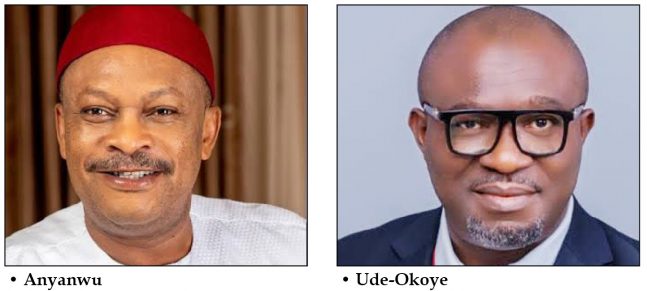
Arapaja is a known supporter of Oyo State Governor Seyi Makinde. The governor is known to be opposed to Anyanwu but favours Sunday Ude-Okoye as National Secretary.

It was at a meeting of the Governors Forum he hosted in Ibadan that an arrangement was reached to side-step Anyanwu and Ude-Okoye for Setonji to act as national secretary.

That arrangement was dumped following superior legal advice and the admonition by the INEC chairman.

Suswam: Governors, Damagum are PDP’s  problem

Former Benue State Governor Gabriel Suswam yesterday accused Damagum and the governors of creating problems for the opposition party.

He said he may quit the PDP, adding: “With what’s going on in the PDP, I have started consultation on which party to move to.”

The former governor, who spoke on a television programme, said the chance of participating in next year’s governorship polls in Ekiti and Osun states by the party is remote.

Suswan, who said these chieftains were bent on destroying the party, hinted that he may leave along with his supporters.

He said Damagum and the governors were not good leaders, lamenting that their actions had led to confusion in the party.

The former governor said the confusion is underscored by the antagonistic statements of the chairman and other members of the NWC.

Suswan said: “The last time I was here, I told you about leadership.  Certain qualities define a good leader: integrity and clarity. The PDP leadership doesn’t have any of these. There’s no integrity in PDP leadership.

“I’m happy that Nyesom Wike mentioned repeatedly that Damagum is not a leader. It’s obvious here.

“What should have happened was that after a meeting with the INEC, a good leader would have met with the NWC to brief them before holding any press conference.

“I believe if he had met with them and agreed on the way to go, no member of the NWC would have gone out there to give a contrary opinion. I am sure they are not in the know of the outcome of the PDP/INEC meeting. That’s not leadership.

“Damagum has been the problem of the PDP. Since he assumed the acting national chairmanship office, the party has been drifting downwards. I have said this without number.

“First and foremost, they breached the provisions of the constitution, which stipulates that he should act for a certain time after which the position of the chairman returns to the Northcentral.

“Now, the magnitude of the confusion is unimaginable.

“We’re supposed to have a NEC meeting. While the chairman is saying one thing about the meeting, other NWC members are saying another thing about the meeting.

“It’s quite unfortunate that people who have benefited from this platform are the ones who are intentionally or unintentionally destroying the party.

“The governors cannot be exonerated from the confusion that has reigned in our party. The same governors, led by Bala Mohammed, met and passed a vote of confidence in the leadership of Damagum.

“So, a lot is going on that we don’t know. And, I believe that there’s more to it than what we see.

“And when you have a leader without clarity with focus and purpose, this is where it will lead us.

“It is very ridiculous that the PDP wrote letters to the INEC with different names as national secretary.

“How can you keep such a person leading a party as big as PDP and expect to get a different result?

“If Damagum, alongside the governors, issued a statement saying that Anyanwu should continue as a National Secretary and other members of the NWC being controlled by these governors, issuing another statement to counter Damagum’s, then, there’s more to it than meets the eye.

“Based on this confusion, we might end up not having a candidate in the Ekiti governorship election in 2026.

“Whether that is intentional, we don’t know. They just want to kill the PDP, and the governors are complicit in it.”
Uncategorized

Between ADC, INEC And Rule Of law –By Thomas Akor

Published

on

Spread the love

Since the Independent National Electoral Commission (INEC) suspended recognition of all leadership factions in the African Democratic Congress (ADC) following a ruling by the Court of Appeal and ongoing litigation over the party’s leadership, the polity has been on edge. That is understandable given the status of the party as an emerging opposition platform.


In a statement by its spokesperson, Mohammed Haruna, the electoral commission hinged its decision on an order by the Court of Appeal. In obedience to the court order, the commission decided to stop engaging with any of the two warring factions until there is a substantive court judgement after it received conflicting letters demanding recognition from both sides. Pointedly, the judgement did not favour the faction led by David Mark, prompting INEC to decline recognition of his chairmanship.

The point, then, is that the court ruling of the Appeal Court undermines the legitimacy of David Mark’s leadership, and INEC’s position reinforces the legal effect of the judgement, effectively limiting his authority in dealing with the electoral body. To say that the decision places the party in a contested leadership situation, pending possible appeals or internal resolution, is to put it very mildly.

Not just ahead of the 2027 general election but in politics generally, it is a no-brainer that internal divisions impair coordinated campaign efforts across states. If the ADC refuses to put its house in order, it risks disintegration and utter irrelevance, both in the build up to the election and thereafter.

Disputes over legitimate party leadership will inevitably lead to conflicting candidate lists, risking disqualification or exclusion from ballots. Besides, the party’s ability to form alliances or coalitions ahead of elections will be significantly diminished. If the party continues to present a picture of instability, voters will simply look the other way.

The question they would be asking themselves is how a party that cannot properly organise, harmonise and manage its internal issues can hope to govern Nigeria effectively. The inescapable conclusion, given ADC’s antics so far, is that it is not prepared for the 2027 polls but is only interested in bickering and wrangling, intent on leading Nigerians, particularly undecided or swing voters, down a slippery slope.

If unresolved before key electoral deadlines, the ADC risks reduced participation or irrelevance in the forthcoming elections. The party is likely to experience operational disruptions unless a legally recognized leadership emerges quickly. Its performance may decline significantly in comparison to more stable parties, unless the crisis is resolved and unity restored.

The best-Case Scenario would be for swift judicial clarification or internal reconciliation restores leadership legitimacy and stabilizes party operations, while the worst-case scenario would be prolonged litigation and factional conflict result in parallel structures, disqualification risks, and electoral underperformance.

The court ruling and INEC’s response represent a critical inflection point for the African Democratic Congress. Without rapid resolution, the party faces a high-risk trajectory that could significantly undermine its competitiveness in the forthcoming elections.

The genesis of the current crisis plaguing the party is the decision by a member of the National Working Committee (NWC) of the party to drag its factional chairman, Senator David Mark to the Federal High Court, seeking an ex parte order. The judge didn’t grant it outright. Instead, he asked Mark to come and show cause why the request shouldn’t be approved.

Rather than argue his case at that court, the former Senate President proceeded to the Court of Appeal. The appellate court was clear: go back to the Federal High Court and argue your case. More importantly, the Court of Appeal cautioned INEC not to take any action that could render the pending suit useless. In simple terms “dont recognize anybody”. Not Mark. Not Nafiu. No faction

.Until the court settles the leadership tussle, there is officially no recognized leadership. INEC didn’t pick sides; it simply obeyed the court. However, in their typical manner, members of the party have been clutching at straws, accusing the electoral body of bias when the real bias and lack of objectivity lies within their own ranks. Rather than going through the legal process dictated by the laws of the land, they have been scheduling press conferences, issuing acerbic statements, and attempting to reap political capital from their own self-inflicted wounds. This move is, for want of a better position, patently illogical.

To the extent that INEC’s action is in tandem with the orders of court, to that extent is its position grouned in law, logic and democratic ethos. There is no basis for an alternative conclusion at the moment.


Thomas Akor a public analyst sent this piece from Gboko, Benue State

Continue Reading

Uncategorized

NNPCL lost $500m monthly to refineries operation-Ojulari

Published

on

Spread the love

The country lost between $300 million and $500million monthly while the Port Harcourt Refinery was operating, Group Chief Executive Officer (GCEO) of the Nigerian National Petroleum Company Limited (NNPCL), Bayo Ojulari said yesterday.


He said: “When I resumed, one of the first priorities I focused on was the refinery. I did a quick review to see if we could quickly fix it. What I found is that we were losing between $300 million to $500 million on a monthly basis in the refinery. We were pumping about 50,000 barrels of crude to go into the refinery. What was coming out was less than 40 per cent equivalent of what was coming in.”

Ojulari said this when he met with the leadership of Petroleum and Natural Gas Senior Staff Association of Nigeria (PENGASSAN) in his office at Abuja.

The Port Harcourt Refinery, after years of being in comatose, started working in November, 2024 when former GCEO Mele Kyari announced the reopening to a wide applause by Nigerians, but the operation was halted in May, barely one month after Ojulari’s resumption.

Ojulari, who assumed office on April 2, the same day Kyari was relieved of the job, said he halted the operation of the refinery to prevent further losses and work towards a sustainable arrangement.

Ojulari explained: “The first thing we said was rather than continue to lose, let’s quickly stop and look for a way to put this refinery into a sustainably profitable venture.”

He said the NNPCL was working to revive the moribund refineries to operate at full capacity by adopting the Nigeria Liquefied Natural Gas (NLNG) model (Public, Private, Partnership), which PENGASSAN advocated during the meeting.

The NNPCL chief said talks were on to find a viable solution to the refining crisis, ensuring the refineries become a sustainably profitable venture.

He said the national oil company had concluded a technical review for the three refineries, pointing out that the long term neglect and lack of maintenance were major reasons behind the huge losses recorded monthly, despite the huge investments to make them work

The NNPCL chief explained that a lot of money has been spent on these refineries, but admitted that it’s been challenging to translate those funds into profitability.

He likened the situation of the refineries to parking an old car for some time without any greasing and oiling. He added that the Port Harcourt refinery has been difficult to put back because of years of neglect and it’s been difficult: when you fix one thing, the other thing is still there.

Turning to PENGASSAN, Ojulari said: “The solution you are proposing (the NLNG model) is what we are working on. We’ve completed technical review of the three refineries, but it’s not just about technical. It’s also about commercial viability, it has to make money. Maybe not a lot, but it should not be making a loss.

“We’ve completed the commercial review for the Port Harcourt refinery and from that commercial review, we have come to the conclusion that the best way forward is to get a true professional refinery company to join us and co-operate with us.

“We’ve been having meetings with potential parties, but we need to find the pathway that will work. We’ve also realised that it was not in the best interest of Nigeria, not in the best interest of NNPCL, that we will continue to put money into a place where we do not have the full ability to fully operationalise. So, when we bring in partners, we can work with them.”

Ojulari appealed to Nigerians, contractors, traders and beneficiaries to be patient with the shutdown of the refineries.

In the course of the briefing, the NNPCL chief said his team was facing attacks, but said he will not be deterred. “We are under attack. We will not budge to short-term pressure, as it will not be in the best interest of Nigerians. You cannot drive change without a price, and the transformation is tough,” he said, adding that patience will be required from Nigerians to get to the other side of change, which will benefit the citizens.

He restated his commitment to stay focused in driving the mandate given to the team by President Bola Ahmed Tinubu.

“Tinubu did not put pressure on me to go and do the wrong thing. The baseline was to go and ensure that whatever we’re doing, going forward, sustainably works. There’s no need for us to pretend, there was no negative political pressure for NNPCL to just continue to run at a loss, so we decided to freeze on it, and we’ve been working astutely fine.

“My commitment is that when this refinery is reworking, everybody will be back to work but for now, we all need to co-operate and work together to ensure that whatever we put in place is sustainable.”

Ojulari declared that he is not a politician, saying that he will have to learn a bit more about politics. “I’m not hiding from anybody. I’m not a politician. I will have to learn a bit more about politics, but for me, it is a development plan, and I’m ready to learn.”

The NNPCL chief raised concerns about threats to his life, and some members of the company’s management, saying his major “offence” was the reforms he introduced in the oil and gas sector in line with President Tinubu’s directive to revive the country’s ailing refineries. He said some powerful interests were plotting to unseat him, but insisted that he remained focused on ensuring the success of the refinery rehabilitation plan.

Osifo said the pipelines have been working optimally since Ojulari became the GCEO, leading to an increase in production.

He commended the management of NNPCL for moving beyond addressing the welfare of members.

While seeking answers to the reasons behind the shutdown of the refineries, Osifo noted that PENGASSAN was committed to supporting the NNPCL to stabilise the system, which has been bedevilled with so many challenges, including non-producing fields, to boost production to 2.6 million barrels per day next year.

The PENGASSAN president, who is also president of the Trade Union Congress (TUC), said: “Managing institutions as this and trying to bring about change, we know that there are always ups and downs, which is expected in life. But at PENGASSAN, we assure you that we are solidly behind you, that we will work with you, we will collaborate with you and your team to ensure the stability of the system, because for us, when the system is not stabilised, it has a way of trickling down to our members.

“We will work with you to ensure that the system is stabilised and to ensure that NNPCL continuously remains vibrant, the way it has been, and even to take it a notch higher, because today we are doing approximately 1.8 million barrels of crude.

“We believe that with a lot of capacities and experience that will be brought in, we’ll be able to bring about an improvement in our production”.

The tale surrounding the new development with the nation’s refineries, as painted by Ojulari, runs counter to that of his predecessor, Mele Kyari, who described the reopening of the Port Harcourt Refinery Company in Novembe,r 2024, as a monumental achievement for Nigeria, which signified a new era of energy independence and economic growth for the country.

In a statement, Kyari had said: “The Nigerian National Petroleum Company Limited (NNPCL) has fulfilled its pledge of re-streaming the Port Harcourt Refining Company (PHRC), signalling the commencement of crude oil processing from the plant and delivery of petroleum products into the market.”

Ojulari’s briefing yesterday is coming barely nine months after the Port Harcourt Refinery was adjudged fit for production by Kyari.


Continue Reading

Uncategorized

Gov Nwifuru Increases Minimum Wage To ₦90,000 For Workers

Published

on

Spread the love

The Ebonyi State  Executive Government has announced a new minimum wage of ₦90,000 for all civil and public servants, an increase of ₦20,000 from the previous wage of ₦70,000.


According to the state government, the new minimum wage takes immediate effect.

This decision was an outcome of the Executive Council meeting held on Wednesday, August 27, 2025, at the New Government House in Abakaliki, the Ebonyi state capital.

The announcement was made in a press statement signed by the Commissioner for Information, Ikeuwa Collins-Omebeh, made available to Channels Television on Thursday.

According to the statement, the state government’s decision to increase the minimum wage to ₦90,000 was directly tied to Governor Francis Nwifuru’s ‘People’s Charter of Needs Agenda’.

He added that the governor was prioritising the welfare of the state’s workers, and the increase was a reflection of that commitment.

Meanwhile, Omebeh disclosed that the state government also approved the establishment of Ebonyi State Virology Research and Innovative Centre.

He noted that this would strengthen the state’s capacity for research, diagnosis, surveillance of viral diseases, training in line with the state’s public health needs, and global scientific advancements.

On Wednesday,the Imo State Government has approved an increase in the minimum wage from ₦70,000 to ₦104,000.

Governor Hope Uzodimma made the announcement during a crucial meeting with labour leaders at the Government House in Owerri, the state capital.

In July 2024, President Bola Tinubu signed the minimum wage bill into law, ending months of deliberations between government authorities, labour unions, and the private sector.

He signed it at the State House in Abuja days after the National Assembly passed the Minimum Wage Act, 2019, to increase the National Minimum Wage from ₦30,000 to ₦70,000.

However, some state governors increased the minimum wage above ₦70,000 for civil servants in their respective states.

Continue Reading

Trending

Copyright © 2026 TheColumn NG