
International News
Powerful Earthquake In Morocco Kills More Than 800 People


A woman reacts standing infront of her earthquake-damaged house in the old city in Marrakesh on September 9, 2023. (Photo by FADEL SENNA / AFP)
Morocco’s deadliest earthquake in decades has killed at least 820 people, officials said Saturday, causing widespread damage and sending terrified residents and tourists scrambling to safety in the middle of the night
The 6.8-magnitude quake struck a mountainous area 72 kilometres (45 miles) southwest of tourist hotspot Marrakesh at 11:11 pm (2211 GMT) Friday, the US Geological Survey reported.
Strong tremors were also felt in the coastal cities of Rabat, Casablanca and Essaouira.
“We felt a very violent tremor, and I realised it was an earthquake,” Abdelhak El Amrani, 33, told AFP by telephone from Marrakesh.
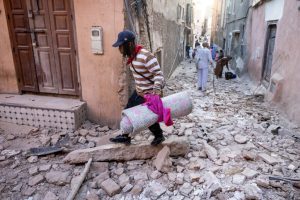
A man walks with his belongings through the rubble in an alleyway in the earthquake-damaged old city in Marrakesh on September 9, 2023. (Photo by FADEL SENNA / AFP)
“I could see buildings moving,” said Amrani who went outside, joining many other people, “all in shock and panic. The children were crying and the parents were distraught.”
It was the most powerful quake to ever hit the country, and one expert called it the region’s “biggest in more than 120 years”.
“Where destructive earthquakes are rare, buildings are simply not constructed robustly enough… so many collapse, resulting in high casualties,” said Bill McGuire, professor emeritus at Britain’s University College London.
Updated interior ministry figures on Saturday showed the quake killed 820 people, more than one-third of them in Al-Haouz, the epicentre, and Taroudant provinces.
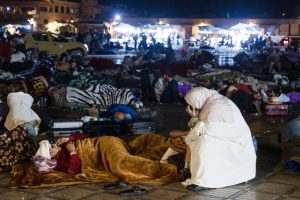
Residents stay out at a square in Marrakesh on September 9, 2023, after an earthquake. – A powerful earthquake that struck Morocco on September 8 night has killed at least 632 people and injured 329 others, according to an updated interior ministry toll. (Photo by FADEL SENNA / AFP)
Updated interior ministry figures on Saturday showed the quake killed 820 people, more than one-third of them in Al-Haouz, the epicentre, and Taroudant provinces.
The ministry also recorded deaths in Ouarzazate, Chichaoua, Azilal and Youssoufia provinces, as well as in Marrakesh, Agadir and the Casablanca area.
Another 672 people were injured, including 205 in a critical condition, the ministry said.
‘Unbearable’ screams’
Faisal Baddour, an engineer, said he felt the earthquake three times in his building.
“There are families who are still sleeping outside because we were so scared of the force of this earthquake,” he said. “It was as if a train was passing close to our houses.”
Frenchman Michael Bizet, 43, who owns three traditional riad houses in Marrakesh’s old town, told AFP that he was in bed when the quake struck.
“I thought my bed was going to fly away. I went out into the street half-naked and immediately went to see my riads. It was total chaos, a real catastrophe, madness,” he said.
Bizet shared video of piles of rubble from collapsed walls in the streets.
Other footage on social media showed part of a minaret collapsed on Jemaa el-Fna square in the historic city.
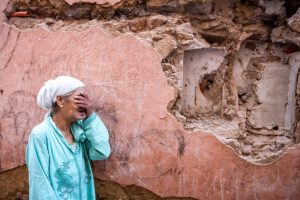
A woman reacts standing infront of her earthquake-damaged house in the old city in Marrakesh on September 9, 2023. (Photo by FADEL SENNA / AFP)
Houda Outassaf, a local resident, told AFP he was walking around the square when the ground began to shake.
“It was a truly staggering sensation. We’re safe and sound, but I’m still in shock,” he said.
“I have at least 10 members of my family who died… I can hardly believe it, as I was with them no more than two days ago.”
Fayssal Badour, another Marrakesh resident, told AFP the earthquake hit while he was driving.
“I stopped and realised what a disaster it was… The screaming and crying was unbearable,” he said.
The interior ministry said authorities have “mobilised all the necessary resources to intervene and help the affected areas”.
The regional blood transfusion centre in Marrakesh called on residents to donate blood for those injured.
In the town of Al-Haouz, near the quake’s epicentre, a family was trapped in the rubble after their house collapsed, local media reported.
Significant damage likely
“We heard screams at the time of the tremor,” a resident of Essaouira, 200 kilometres west of Marrakesh, told AFP.
“People are in the squares, in the cafes, preferring to sleep outside. Pieces of facades have fallen.”
The USGS PAGER system, which provides preliminary assessments on the impact of earthquakes, issued a “red alert” for economic losses, saying extensive damage is probable and the disaster is likely widespread.
Past events with this alert level have required a national or international level response, according to the US government agency.
Internet connectivity was disrupted in Marrakesh due to power cuts, according to global internet monitor NetBlocks.
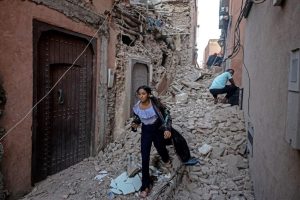
A woman evacuates with her belongings through the rubble in the earthquake-damaged old city of Marrakesh on September 9, 2023. (Photo by FADEL SENNA / AFP)
European leaders offered condolences, as did Russian President Vladimir Putin and Arab countries, including Saudi Arabia, the United Arab Emirates, and Egypt, along with the Organisation of Islamic Cooperation.
Benjamin Netanyahu, the prime minister of Israel which established diplomatic ties with Morocco in 2020, ordered “any necessary assistance.”
The earthquake was also felt in neighbouring Algeria, where the Algerian Civil Defence said it had not caused any damage or casualties.
In 2004, at least 628 people were killed and 926 injured when a quake hit Al Hoceima in northeastern Morocco, and in 1960 a magnitude 6.7 quake in Agadir killed more than 12,000.
The 7.3-magnitude El Asnam earthquake in neighbouring Algeria in 1980 killed 2,500 people and left at least 300,000 homelessness
AFP

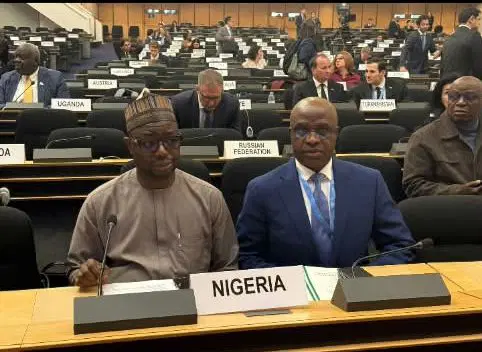
The Federal Government has called for stronger international responsibility sharing and innovative arrangement to address the growing humanitarian needs of over 142,000 refugees and asylum seekers from 42 countries.
The Minister of Humanitarian Affairs and Poverty Reduction, Dr. Bernard Doro, made the call while delivering Nigeria’s national statement at the 77th Session of the Executive Committee of the United Nations High Commissioner for Refugees (UNHCR), currently holding at the Palais des Nations in Geneva.
In a statement by his Senior Technical Adviser on Information Systems and Data Analysis, Dr. Abimbola Fasanu, the Minister disclosed that as of September 2026, Nigeria had received over 24,000 returnees and was managing a population of more than 6.7 million internally displaced persons (IDPs).
Doro reaffirmed Nigeria’s commitment to international refugee protection obligations, noting that the country continues to maintain an asylum system under the National Commission for Refugees, Migrants and Internally Displaced Persons (NCFRMI) Act of 2022.
He stated that no case of refoulement had been recorded in Nigeria in 2026, reaffirming the country’s commitment to protecting people fleeing persecution from being returned to situations where their lives or freedom could be threatened.
Highlighting progress on durable solutions, the Minister disclosed that over 7,000 Nigerian refugees had voluntarily returned from neighbouring countries this year under Tripartite Agreements, while another 14,000 in Cameroon had registered their intention to return. An agreement covering the return of 2,000 Nigerians from Niger is also being finalised.
He acknowledged the continued hospitality of Cameroon, Chad and Niger in providing refuge to displaced Nigerians.
According to the Minister, improved security conditions in parts of the country are creating opportunities for voluntary return, while Resettlement Cities established in seven locations are supporting the phased closure of displacement camps in conditions of safety and dignity.
Beyond return and resettlement, Dr. Doro outlined measures aimed at promoting self-reliance and reducing prolonged dependence on humanitarian assistance.
He explained that refugees in five states are benefiting from access to land, agricultural inputs and skills training, while the newly established Public-Private Partnership Department of the NCFRMI is supporting efforts to expand livelihood opportunities.
The Minister also cited the successful local integration of former Liberian and Sierra Leonean refugees, some of whom have established businesses and become economically active members of their host communities.
On access to essential services, he disclosed that displaced persons and host communities are being enrolled in Nigeria’s national identity system to facilitate access to banking, education and social services.
He added that refugees are being incorporated into state action plans and social registers, while ten mobile documentation buses are expected to extend identity services to underserved and remote communities.
Doro further highlighted the development of a Digital Gateway in collaboration with UNHCR to provide refugees with secure online access to information.
Addressing the growing pressure on humanitarian financing, the Minister urged the international community to strengthen support for refugee-hosting countries through expanded resettlement opportunities, complementary pathways and greater responsibility-sharing.
He specifically called on UNHCR to explore partnerships with regional and subregional financial institutions, including the African Development Bank and the ECOWAS Bank for Investment and Development, as a means of mobilising additional resources for refugee protection and durable solutions.
The Minister emphasised that the responsibility for addressing displacement could not rest on host countries alone, particularly at a time of increasing humanitarian needs and declining international resources.
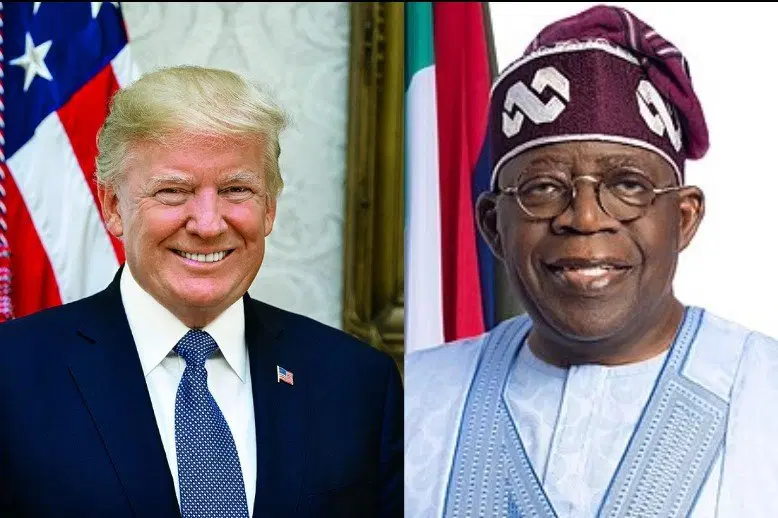
The United States has listed Nigeria among 14 countries identified for recruiting or using child soldiers, warning that the designation could trigger restrictions on certain forms of military assistance.
The listing is contained in the 2026 Trafficking in Persons (TIP) Report, which covers the period from April 1, 2025, to March 31, 2026.
According to the report, restrictions under the Child Soldiers Prevention Act (CSPA) could affect international military education and training, foreign military financing, excess defence articles, peacekeeping operations and licences for direct commercial sales of military equipment, unless a presidential waiver is granted.
Nigeria was listed alongside Afghanistan, Burma, the Central African Republic, the Democratic Republic of the Congo, Ethiopia, Iran, Russia, Rwanda, Somalia, South Sudan, Sudan, Venezuela and Yemen.
The report also retained Nigeria on Tier 2 for human trafficking, a category for countries whose governments do not fully meet the minimum standards for eliminating trafficking but are making significant efforts to comply.
However, the US raised concerns about corruption and alleged official complicity in human trafficking crimes.
“The government did not report any investigations, prosecutions, or convictions of government employees allegedly complicit in trafficking crimes or provide details or other actions taken against complicit officials from previous years,” the report stated.
The report also faulted Nigeria’s efforts to protect trafficking victims, stating that 675 victims received assistance in 2025, compared with 2,058 in the previous year.
It said support services, particularly for male victims, remained limited, with only one dedicated non-governmental organisation shelter for adult male victims operating during the reporting period.
The report further stated that shelters operated by the National Agency for the Prohibition of Trafficking in Persons (NAPTIP) restricted residents’ freedom of movement, while access to certain protection services depended on victims cooperating with law enforcement proceedings.
Despite these concerns, the report acknowledged increased government efforts in investigating, prosecuting and securing convictions in human trafficking cases compared with the previous reporting period.
The United States has listed Nigeria among 14 countries identified for recruiting or using child soldiers, warning that the designation could trigger restrictions on certain forms of military assistance.
The listing is contained in the 2026 Trafficking in Persons (TIP) Report, which covers the period from April 1, 2025, to March 31, 2026.
According to the report, restrictions under the Child Soldiers Prevention Act (CSPA) could affect international military education and training, foreign military financing, excess defence articles, peacekeeping operations and licences for direct commercial sales of military equipment, unless a presidential waiver is granted.
Nigeria was listed alongside Afghanistan, Burma, the Central African Republic, the Democratic Republic of the Congo, Ethiopia, Iran, Russia, Rwanda, Somalia, South Sudan, Sudan, Venezuela and Yemen.
The report also retained Nigeria on Tier 2 for human trafficking, a category for countries whose governments do not fully meet the minimum standards for eliminating trafficking but are making significant efforts to comply.
However, the US raised concerns about corruption and alleged official complicity in human trafficking crimes.
“The government did not report any investigations, prosecutions, or convictions of government employees allegedly complicit in trafficking crimes or provide details or other actions taken against complicit officials from previous years,” the report stated.
The report also faulted Nigeria’s efforts to protect trafficking victims, stating that 675 victims received assistance in 2025, compared with 2,058 in the previous year.
It said support services, particularly for male victims, remained limited, with only one dedicated non-governmental organisation shelter for adult male victims operating during the reporting period.
The report further stated that shelters operated by the National Agency for the Prohibition of Trafficking in Persons (NAPTIP) restricted residents’ freedom of movement, while access to certain protection services depended on victims cooperating with law enforcement proceedings.
Despite these concerns, the report acknowledged increased government efforts in investigating, prosecuting and securing convictions in human trafficking cases compared with the previous reporting period.
-
 Health & Wellness1 year ago
President Tinubu Directs Cut in Dialysis Cost from ₦50,000 to ₦12,000
-
News2 years ago
CBN Debunks Fake Circular on New ₦5,000 and ₦10,000 Notes
-
 International News7 months ago
Indian Police Arrest Nigerian Over ₦290m Drug Haul
-
 Business7 months ago
Dangote Refinery Reduces Petrol Gantry Price To ₦1,200 Per Litre
-
 Business7 months ago
After Plea Bargain, Court Discharges Stella Oduah of ₦2.5bn Fraud
-
Business2 years ago
Dangote; We Did Not Fix ₦600/Litre Petrol Price
-
 Trending News1 year ago
NELFUND Disburses ₦86bn To 449,000 Beneficiaries
-
 Opinion2 years ago
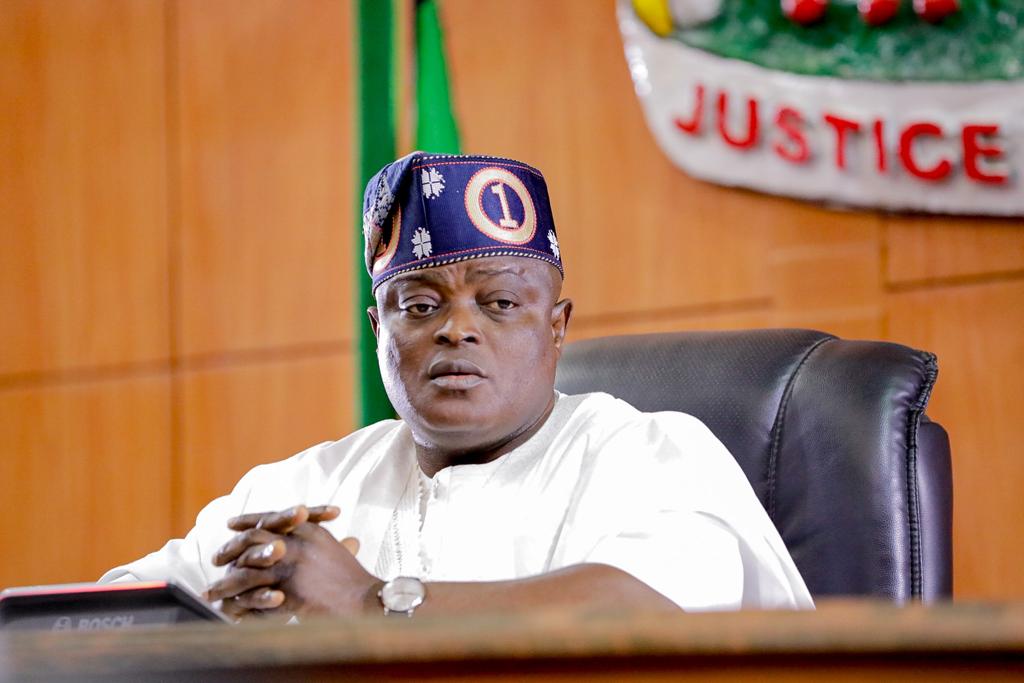
Championing the People’s Voice: Obasa’s Dedication to Grassroots Representation By Dave Agboola⁰