Connect with us

News

President Tinubu Replaces NNPCL CEO Kyari with Ojulari

Published

on

Spread the love

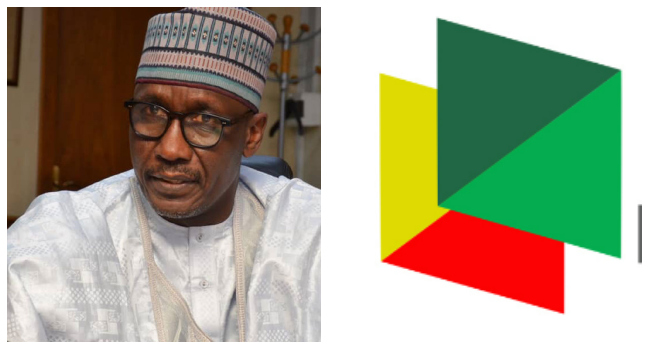
FILES: NNPCL Boss Mele Kyari and NNPCL logo


President Bola Tinubu has approved the reconstitution of the Nigerian National Petroleum Company (NNPC) Limited board, removing the Chairman, Chief Pius Akinyelure and the Group Chief Executive Officer, Mallam Mele Kyari.

In a statement by Special Adviser to the President (Information & Strategy), Bayo Onanuga, in the early hours of Wednesday, Tinubu removed all other board members appointed with Akinyelure and Kyari in November 2023.

The new 11-man board has Engineer Bashir Ojulari as the Group CEO and Ahmadu Kida as Non-Executive Chairman.

Adedapo Segun, who replaced Umaru Ajiya as the chief financial officer last November, has been appointed to the new board by President Tinubu. six board members, non-executive directors, represent the country’s geopolitical zones.

They are Bello Rabiu, North West; Yusuf Usman, North East, and Babs Omotowa, a former managing director of the Nigerian Liquified Natural Gas( NLNG), who represents North Central. President Tinubu appointed Austin Avuru as a non-executive director from the South-South, David Ige as a Non-executive director from the South-West, and Henry Obih as a non-executive director from the South East. Mrs Lydia Shehu Jafiya, permanent secretary of the Federal Ministry of Finance, will represent the ministry on the new board.

In contrast, Aminu  Ahmed will represent the Ministry of Petroleum Resources.

All the appointments are effective from April 2.

President Tinubu, invoking the powers granted under Section 59, subsection 2 of the Petroleum Industry Act, 2021, emphasised that the board’s restructuring is crucial for enhancing operational efficiency, restoring investor confidence, boosting local content, driving economic growth, and advancing gas commercialisation and diversification.

President Tinubu also gave the new board an immediate action plan to conduct a strategic portfolio review of NNPC-operated and Joint Venture Assets to ensure alignment with value maximisation objectives.

Since 2023, the Tinubu administration has implemented oil sector reforms to attract investment.

Last year, NNPC reported $17 billion in new investments within the sector.

The administration now envisions increasing the investment to $30 billion by 2027 and to $60 billion by 2030.

The Tinubu administration aims to raise oil production to two million barrels daily by 2027 and three million daily by 2030.

Concurrently, the government wants gas production jacked to 8 billion cubic feet daily by 2027 and 10 billion cubic feet by 2030.

Furthermore, President Tinubu expects the new board to elevate NNPC’s share of crude oil refining output to 200,000 barrels by 2027 and reach 500,000 by 2030.

The new board chairman, Kida, is from Borno State. He is an alumnus of Ahmadu Bello University, Zaria, where he received a degree in civil engineering in 1984.

He also obtained a postgraduate diploma in petroleum engineering from the Institut Francaise du Petrol (IFP) in Paris.

He started his career in the oil industry at Elf Petroleum Nigeria and later joined Total Exploration and Production as a trainee engineer in 1985.

Kida became Total Nigeria’s Deputy Managing Director of Deep Water Services in 2015. Last year, he became an Independent Non-Executive Director at Pan Ocean-Newcross Group.

Apart from his oil industry career, Kida is a former basketballer and the president of the Nigerian Basketball Federation(NBBF).

Ojulari, the new NNPC Limited Group CEO, hails from Kwara State.

Until his new appointment, he was Executive Vice President and Chief Operating Officer of Renaissance Africa Energy Company.

His Renaissance recently led a consortium of indigenous energy firms in the landmark acquisition of the entire equity holding in the Shell Petroleum Development Company of Nigeria (SPDC), worth $2.4 billion.

Like Kida, Ojulari is also an alumnus of Ahmadu Bello University, Zaria. He graduated with a degree in Mechanical Engineering.

He worked for Elf Aquitaine as the first Nigerian process engineer to begin a stellar career in the oil sector.

From Elf, he joined Shell Petroleum Development Company of Nigeria Ltd in 1991 as an associate production technologist.

Apart from working in Nigeria, he worked in Europe and the Middle East in different capacities as a petroleum process and production engineer, strategic planner, field developer, and asset manager.

In 2015, he became the managing director of Shell Nigeria Exploration and Production Company (SNEPCO). During his career, he was chairman and member of the board of trustees of the Society of Petroleum Engineers (SPE Nigerian Council) and a fellow of the Nigerian Society of Engineers.

President Tinubu thanked the old board members for their dedicated service to NNPC Limited, particularly their efforts in rehabilitating the old Port Harcourt and Warri refineries, which enabled them to resume petroleum product production after prolonged shutdowns.

He wished them well in their future endeavors.

International News

Israel Says Struck Two Naval Missile Production Sites In Tehran

Published

on

Spread the love

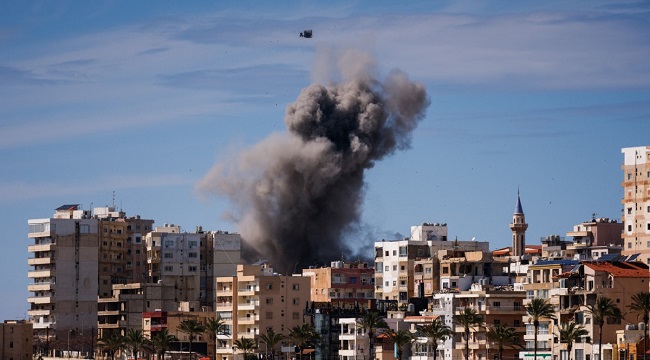
The Israeli military announced on Wednesday it had struck two naval cruise missile production facilities operating under Iran’s ministry of defence in Tehran.


“In recent days, the Israeli air force acting on IDF intelligence struck two key naval cruise missile production sites in Tehran,” the military said.

It said the facilities were used to “develop and manufacture long-range naval cruise missiles, which are capable of rapidly destroying targets at sea and on land”.

The strikes “represent another step in deepening the damage done to the regime’s military production infrastructure”, the military added.

Last week, the military announced its fighter jets had struck several Iranian naval ships in the Caspian Sea, including vessels equipped with anti-submarine missiles.


AFP

Continue Reading

International News

2025 ‘Deadliest Year’ Yet For Red Sea Migrants, UN Reports 922 Deaths

Published

on

Spread the love

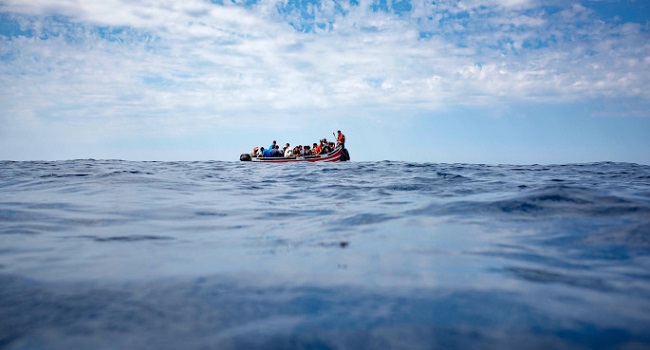
The number of migrants who died on the “Eastern Route” from the Horn of Africa to the Arabian Peninsula doubled to a record high of 922 last year, the UN migration agency said Wednesday.

Tens of thousands of migrants from Ethiopia, Somalia and neighbouring countries take the route across the Red Sea each year, mostly from Djibouti to Yemen, in search of work as labourers or domestic workers in wealthy Gulf countries.

“2025 was the deadliest year ever recorded on the Eastern migration route… with 922 people dead or missing — double the number from the previous year,” Tanja Pacifico, head of mission for the International Organisation for Migration (IOM) in Djibouti, told AFP.

The majority of victims were from Ethiopia, the second most-populous country in Africa with more than 130 million people. It is plagued by multiple internal conflicts and deep poverty.

“IOM remains fully committed to working alongside the government of Djibouti to promote safe and dignified migration pathways, in order to prevent further tragedies,” said Pacifico.

Many migrants who cross the Red Sea find themselves stuck in Yemen, the poorest country on the Arabian Peninsula, which has been embroiled in a civil war for nearly a decade, and some even choose to return.

Rapid economic growth in Ethiopia — estimated to reach around 10 percent in 2026 — could encourage less migration, IOM says, but that is mitigated by high inflation, also around 10 percent in February.


AFP

Continue Reading

International News

Denmark Faces Lengthy Negotiations To Form A Government

Published

on

Spread the love
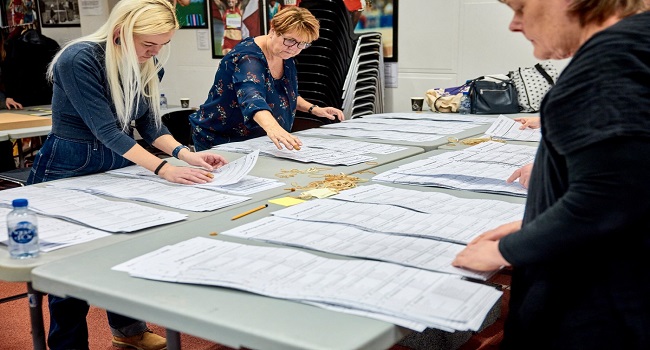
Election workers recount ballots in the Marselisborg Hallen in Aarhus, Denmark on March 25, 2026. (Photo by Mikkel Berg Pedersen / Ritzau Scanpix / AFP) /

Denmark’s political parties began the thorny process of forming a government Wednesday, with the centrist Moderates as kingmaker after the prime minister’s Social Democrats scraped through a general election without a majority.

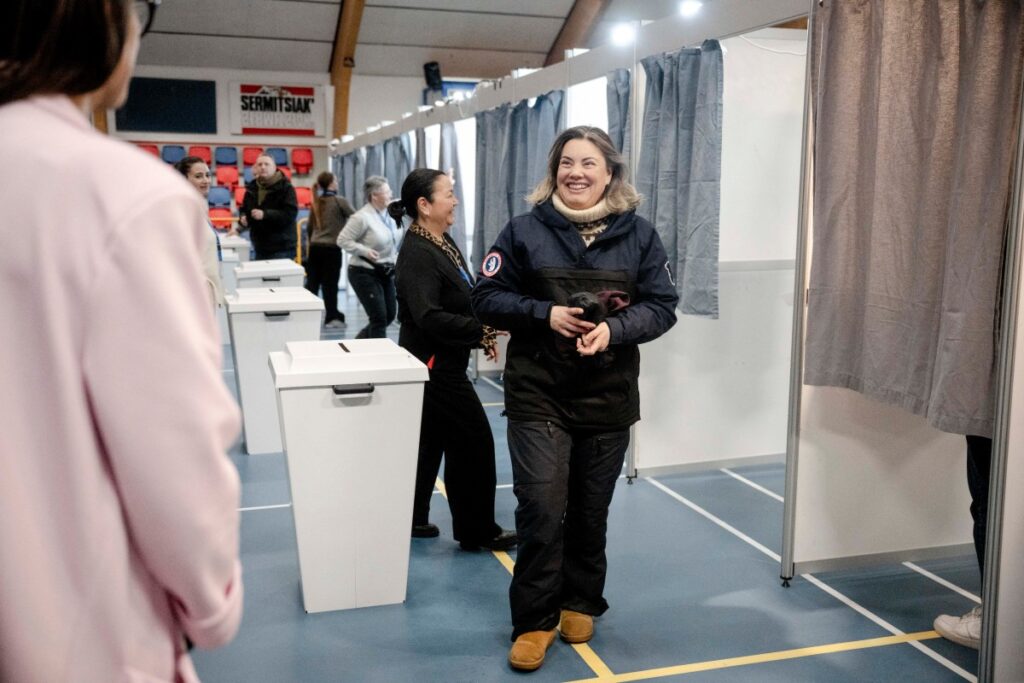
Greenland’s Inuit Ataqatigiit party member Naaja Nathanielsen (C) looks on in a polling station in Nuuk, on March 24, 2026, during the parliamentary election in Denmark (Photo by Oscar Scott Carl / Ritzau Scanpix / AFP) / Denmark OUT

Danes were braced for a weeks-long process as Prime Minister Mette Frederiksen seeks to consolidate power in the deeply splintered parliament after Tuesday’s snap vote.

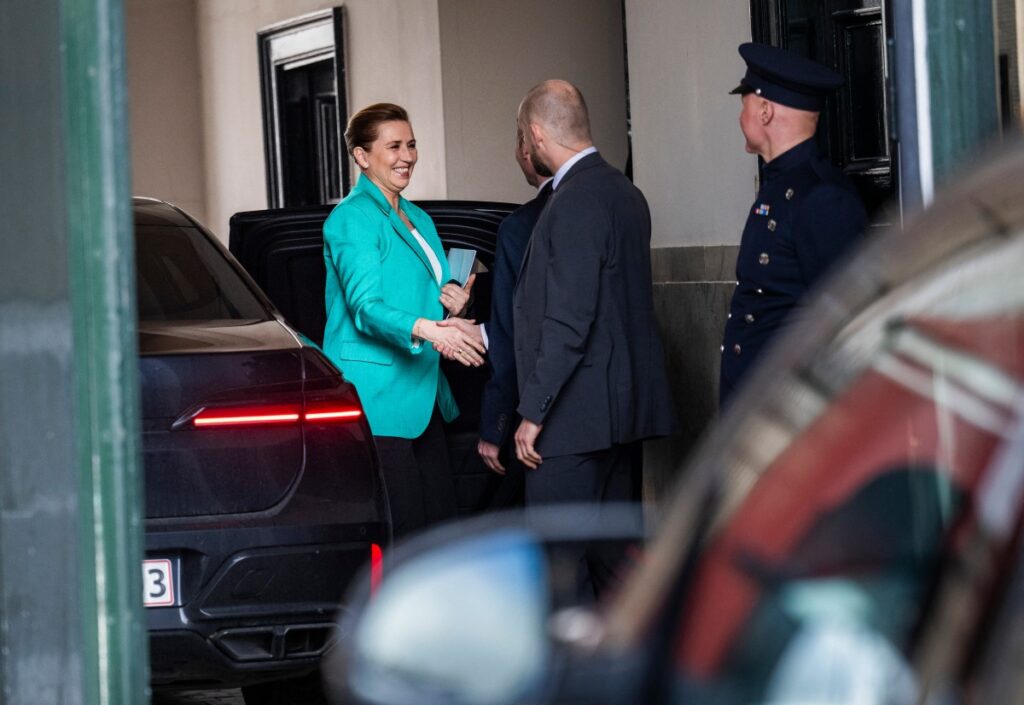
Denmark’s Prime Minister Mette Frederiksen arrives at Amalienborg Palace in Copenhagen to inform the king about the election result one day after the parliamentary election on March 25, 2026. (Photo by Martin Sylvest / Ritzau Scanpix / AFP) 

A left-wing bloc made up of five parties, including Frederiksen’s Social Democrats, won 84 seats; the right-wing and far-right claimed 77; and the Moderates won 14 in the election.

The Social Democrats posted their worst election score since 1903—though they remained Denmark’s largest single party, with 38 seats in the 179-seat parliament.

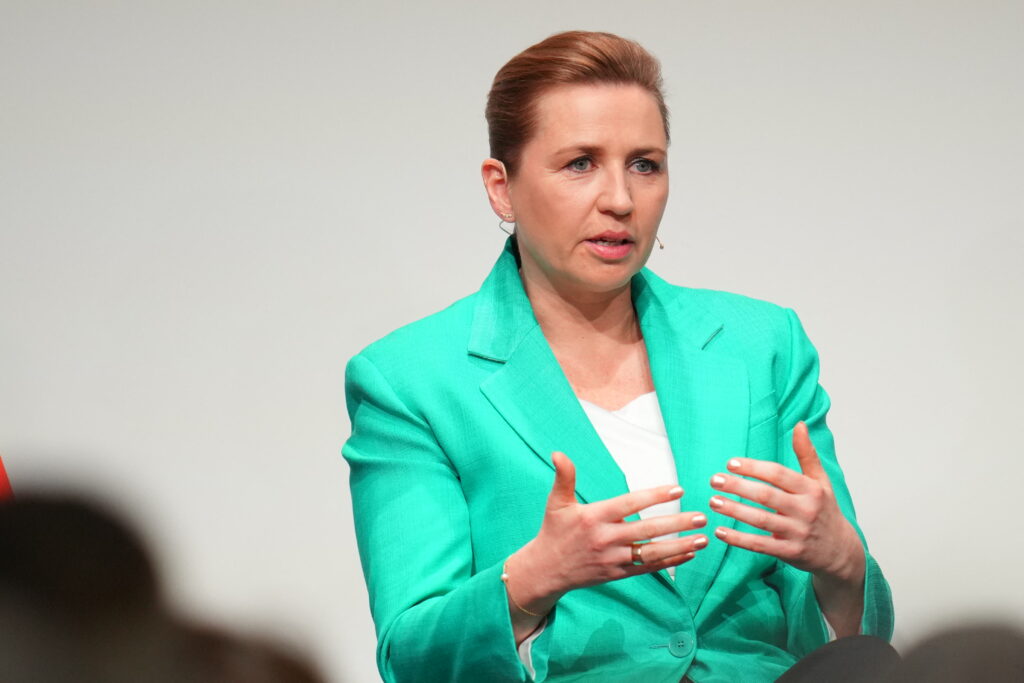
Chairwoman of the Social Democrats Mette Frederiksen attends a party leader debate hosted by Publicists’ Club one the day after the parliamentary election at the Confederation of Danish Industry’s building in Copenhagen on March 25, 2026. (Photo by Liselotte Sabroe / Ritzau Scanpix / AFP)


Frederiksen formally tendered her coalition government’s resignation to King Frederik on Wednesday, telling a televised party leader debate she wanted to try to form a centre-left government.

“The most realistic scenario” would be a coalition with the five parties on the left and the centre-right Moderates, she said.

But it is not certain the Moderates, led by Foreign Minister Lars Lokke Rasmussen, would agree to that.

“I don’t believe that Denmark needs policies aligned with” the leftist Red-Green Alliance, Lokke said.

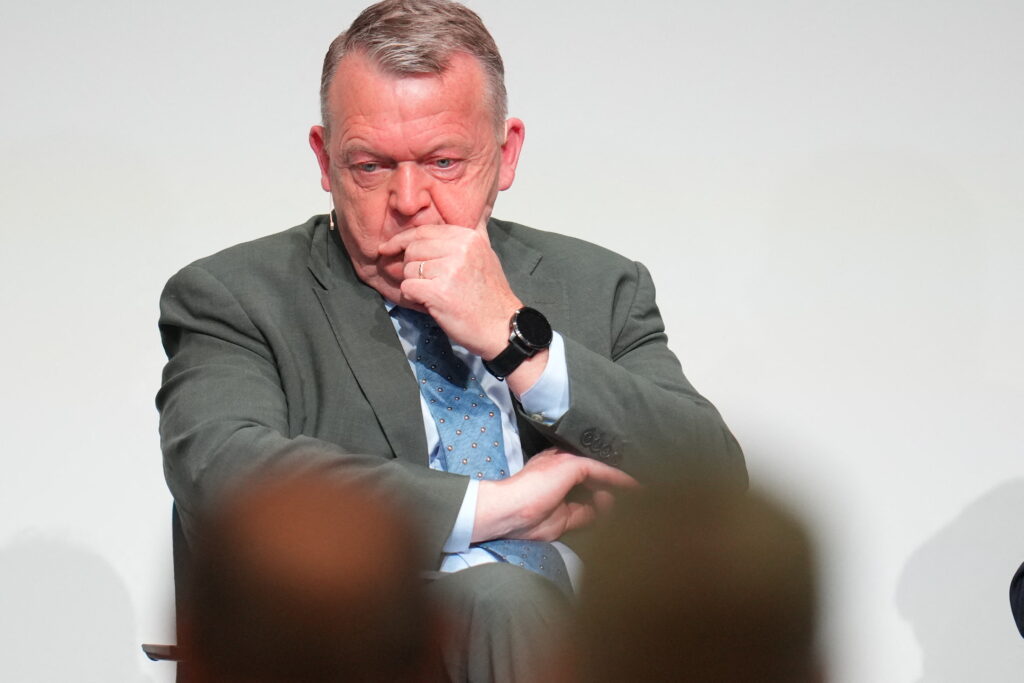
Chairman of the Moderates Lars Loekke Rasmussen attends a party leader debate at the Confederation of Danish Industry’s building in Copenhagen on March 25, 2026, the day after the parliamentary election. (Photo by Liselotte Sabroe / Ritzau Scanpix / AFP) / Denmark OUT

King Frederik was to meet party leaders individually later Wednesday to determine who should be asked to try to form the next government.

“My expectation is that Mette Frederiksen will become prime minister,” University of Copenhagen political science professor Rune Stubager told reporters.

“But I don’t know with the backing of which parties, like the left wing or the right wing,” he said.

He noted that Lokke, a two-time former prime minister, would likely vie for the position of prime minister, even though he has adamantly denied any interest in the job.

“Danes want me and not another prime minister. I still have the backing to be able to continue on behalf of the Danish people,” Frederiksen insisted during the debate.

Frederiksen has for the past four years headed an unprecedented left-right coalition made up of her Social Democrats, the Moderates and the Liberals.

The Liberals have refused to continue in a Social Democrat-led government.

‘Too Hard To Say’

Danes are now prepared for long negotiations. After the 2022 election, the talks lasted six weeks.

“It’s a long process, which means the government won’t be formed and it will be quite difficult to pass laws during this period,” lamented Jesper Dyrfjeld Christensen, a 54-year-old engineer.

“It’s really too hard to say who will be part of the coalition,” admitted Stubager.

With 12 parties in parliament, the political landscape is jagged — though Denmark is accustomed to minority governments.

“To some extent, this is the way Danish politics works. You have a minority government in the centre which forms a majority with the left on some issues and with the right on others,” he explained.

The negotiations are expected to focus on economic and pension issues, pollution and immigration, he said.

The traditional far-right party, the Danish People’s Party, which has heavily influenced policy since the late 1990s but slumped in the 2022 election, more than tripled its result to 9.1 per cent of votes.

The three anti-immigration groups together garnered 17 per cent, a stable figure for Denmark’s populist right over the past two decades.

“If negotiations take place in the left-wing bloc with the moderates, then there will be more focus on green issues than on immigration,” Stubager said.

“But if, instead, the Moderates negotiate with the parties on the right, then the central issue will be immigration.”

Four seats in Denmark’s parliament are held by its two autonomous territories — two for Greenland and two for the Faroe Islands.

While the Faroese renewed the mandates of the two outgoing lawmakers, with one for each bloc, Greenland overwhelmingly backed the left-wing party and Naleraq, which advocates rapid independence from Denmark.


AFP

Continue Reading

Trending

Copyright © 2026 TheColumn NG