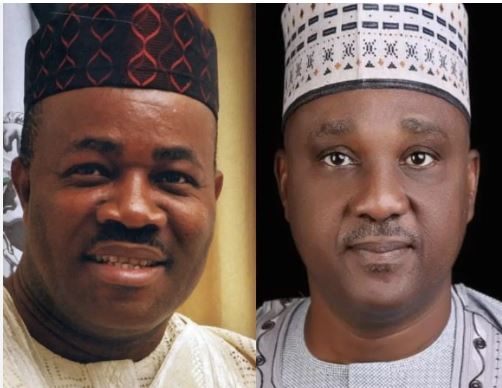
Socio-Economic Rights and Accountability Project (SERAP) has urged the Senate President, Godswill Akpabio, and Speaker of the House of Representatives, Tajudeen Abbas “to cut the proposed budget of N9.4bn on travels, refreshment/meals, and foodstuff/catering materials for the presidency, and the proposed N344.85bn for the lawmakers, and to use the savings to address the budget deficit.”
SERAP urged Mr Akpabio and Mr Abbas “to request President Bola Tinubu to present a fresh supplementary appropriation bill, which reflects the reduced presidency budget and National Assembly budget, for the approval of the National Assembly.”
SERAP asked Mr Akpabio and Mr Abbas “to promptly disclose the detailed breakdown of the proposed National Assembly budget of N344.85bn, including the details for personnel cost, salaries and allowance of lawmakers.”
SERAP also urged Mr Akpabio, and Mr Abbas “to invite the heads of the alleged corrupt ministries, departments and agencies [MDAs] to explain the whereabouts of the missing billions of naira of public funds, as documented in the recently released 2021 audited report by the Office of the Auditor-General of the Federation.”
In the letter dated 21 December 2024 and signed by SERAP deputy director Kolawole Oluwadare, the organisation said: “Any proposed unnecessary spending by the presidency and the National Assembly would amount to a fundamental breach of the Nigerian Constitution 1999 [as amended].”
SERAP said, “the proposed huge spending is neither necessary nor in the public interest, especially in the face of the country’s dire economic situation and the level of proposed borrowing to fund the 2025 budget.”
The letter, read in part: “The National Assembly has transparency obligations to disclose the details and breakdown of the proposed budget for the lawmakers. We urge you to publicly commit that the National Assembly will reduce and not increase its proposed budget of N344.85bn for 2025.”
“While the presidency budget for ‘rehabilitation and repairs of fixed assets’ in the 2024 budget was N14bn, the budget for the same item in the 2025 budget is N26bn, an increase of about N12bn.”
“Should the National Assembly and its leadership fail to reduce the unnecessary spending and tackle the systemic corruption in MDAs, SERAP would consider appropriate legal action to compel the National Assembly to discharge its constitutional oversight and fiduciary responsibilities.”
“The National Assembly seems to budget the same amounts in the 2025 budget for the same budget items in the 2024 budget.”
“It would be a grave violation of the public trust and constitutional oath of office for the members of the National Assembly to approve unnecessary spending for themselves and the presidency.”
“Many Nigerians will find it quite odd, unfair and unjust that the government and lawmakers are spending so much money on many of these items in the middle of a public borrowing crisis.”
“The proposed spending could be better allocated to improve access of Nigerians to basic public goods and services.
“Cutting unnecessary spending by the presidency and the National Assembly would show that the National Assembly can discharge its constitutional responsibility of amplifying the voices of Nigerians.”
“It will also show that the body is acting in the best interest of the people. Nigerians have a right to honest and faithful performance by their public officials including lawmakers, as public officials owe a fiduciary duty to the general citizenry.”
“Holding to account the MDAs which are reportedly responsible for the missing billions of naira of public funds would contribute to addressing the widespread and systemic corruption in MDAs.”
“In the consideration of the proposed 2025 budget, the National Assembly under your leadership has a responsibility to ensure the interest of the well-being and prosperity of Nigeria and its citizens.”
“The National Assembly also has constitutional and fiduciary responsibilities to ensure that any proposed budgets for the presidency and the lawmakers reflect the current economic realities in the country, address the debt crisis, and prevent retrogressive economic measures.”
“Persistent borrowing is neither sustainable nor fair to the Nigerian people. The National Assembly has constitutional oversight and fiduciary duties to ensure a responsible budget spending.”
“The proposed spending figures by both the presidency and the National Assembly highlight the lack of political will to cut the cost of governance.”
The country’s fiscal situation must be changed – and changed quickly – through some combination of cuts in the areas of spending by the presidency and the National Assembly. Cutting waste and apparently unnecessary spending would go a long way in addressing the budget deficit and debt problems.”
“The recommended measures would also ensure that the spending of the country’s maximum available resources to respect, protect, promote and fulfil the rights of the poor and marginalized groups.”
“According to our information, the presidency has proposed N8.74 billion on both local and international trips for President Bola Tinubu and Vice President Kashim Shettima in 2025.”
“The details are contained in the N47.9tn appropriation bill titled ‘Budget of Restoration: Securing Peace, Rebuilding Prosperity’ presented to the National Assembly this week by the president.”
“The Office of the President proposes N7,014,596,511 for travel and transport expenses. This includes N873,886,689 for local travel and transport, and N6,140,709,822 for international travel and transport.”
“For the Office of the Vice President, N1,732,106,437 is proposed for travel and transport expenses. This is divided into N417,488,198 for local travel and transport, and N1,314,618,239 for international travel and transport.”
“The combined total allocation for the Office of the President and the Office of the Vice President is N11,636,444,082.”
“Both offices also plan to spend N546,215,080 on food stuff/catering materials supplies and N71,431,389 refreshment and meals in the coming year. The combined allocation for Honorarium and Sitting Allowance across both offices is N87,576,661.”
“Other recurrent expenditures for the offices include: drugs and medical supplies, N79,671,849 (Office of the President only); postages and courier services: N3,919,783; publicity and advertisements: N26,460,195; welfare packages: N24,907,558 (Office of the Vice President only); and sport activities: 3,098,655 (Office of the Vice President only).”
“The proposed budget for the National Assembly is over N334 billion [N344,852,880,669]. However, the lawmakers have not disclosed the details of the budget.”
“Section 14(2)(b) of the Nigerian Constitution of 1999 [as amended] provides that, ‘the security and welfare of the people shall be the primary purpose of government.”
“Under Section 16(1)(a)(b), the National Assembly has the obligations to ‘harness the resources of the nation and promote national prosperity and an efficient, a dynamic and self-reliant economy’, and to ‘secure the maximum welfare, freedom and happiness of every citizen.’”
“Section 15(5) of the Nigerian Constitution 1999 (as amended) requires public institutions to abolish all corrupt practices and abuse of power. Section 16(2) of the Nigerian Constitution further provides that, ‘the material resources of the nation are harnessed and distributed as best as possible to serve the common good.’”
“Section 13 of the Nigerian Constitution imposes clear responsibility on the National Assembly to conform to, observe and apply the provisions of Chapter 2 of the constitution.”
“Section 882) of the Nigerian Constitution provides the National Assembly shall have the powers to ‘expose corruption, inefficiency or waste in the execution or administration of laws within its legislative competence and in the disbursement or administration of funds appropriated by it.’”