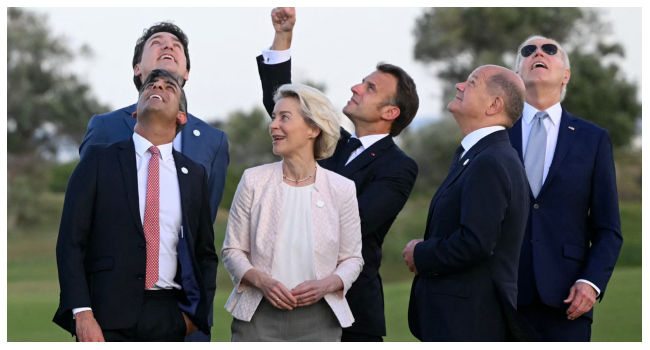
British Prime Minister Rishi Sunak, Canadian Prime Minister Justin Trudeau, President of the European Commission Ursula von der Leyen, French President Emmanuel Macron, German Chancellor Olaf Scholz and US President Joe Biden attend a skydiving demonstration at Borgo Egnazia Golf Club San Domenico during the G7 Summit hosted by Italy in Apulia region, on June 13, 2024 in Savelletri. (Photo by Mandel NGAN / AFP)
G7 leaders turn their attention to China on Friday on the second day of an Italy summit, with a focus on how to protect their industries while avoiding an outright trade war with Beijing.
Fair trade with the world’s second-largest economy, notably on green technology, will be discussed by US President Joe Biden and the leaders of Japan, France, Germany, Italy, Canada and Britain in Puglia.
The Group of Seven rich democracies will also be seeking a common response to China’s alleged support of Russia’s military expansion, which Washington says is fuelling the war in Ukraine.
“G7 countries are on the same page vis-a-vis China,” a Japanese government source told AFP.
The meeting comes amid souring trade relations between China and the West, exemplified by the European Union’s announcement this week of plans to impose new tariffs on Chinese electric vehicles.
The US, Japan and the European Union — which attends G7 summits as an unofficial eighth partner — have all voiced concern over China’s so-called “industrial overcapacity”.
They say generous subsidies by Beijing, particularly in green energy and technology sectors such as solar panels and electric vehicles, result in unfairly cheap goods flooding the global market.
That excess capacity threatens Western companies struggling to compete, particularly in the growing green tech sector.
“We will confront China’s non-market policies that are leading to harmful global spillovers,” John Kirby, the US National Security Council spokesman, told journalists ahead of the summit.
China has dismissed the concerns, but Washington is pressing for a united G7 front.
The group’s finance ministers warned last month that they would weigh steps to “ensure a level playing field” for all countries.
– Export curbs –
On the eve of the summit at the luxury Borgo Egnazia resort, the EU threatened to hit imports of Chinese electric vehicles with tariffs of up to 38 percent beginning next month.
Beijing denounced what it called “naked protectionist behaviour” and said it reserved the right to file a suit with the World Trade Organization (WTO).
The United States hiked tariffs last month on Chinese green tech imports, including a 100 percent tariff on electric vehicles, with Biden blasting “cheating” on Beijing’s part.
Another focus Friday is China’s recent restrictions on exports of minerals such as gallium, germanium and graphite, which are critical in industries such as telecommunications and electric vehicles.
The curbs threaten international supply chains, and there are fears they could be followed by restrictions on other materials such as rare earth elements needed in electronics.
Analysts warn of near-term supply shortages and higher prices if China were to further restrict exports, even as the United States and other countries seek to diversify their supplies, including by boosting domestic production.
– ‘Russia’s war machine’ –
Security and defence concerns are also being addressed at the summit, including accusations Beijing has helped expand Russia’s armed forces.
During a press conference with Ukraine’s President Volodymyr Zelensky on Thursday, Biden said the G7 had “agreed to taking collective action” against China’s role in supplying Russia with “materials they need for their war machine”.
Washington has accused Beijing of helping Russia’s defence industry — and therefore its invasion of Ukraine — through joint production of drones and exports of machine tools needed for ballistic missiles.
Zelensky said he had spoken by phone with Chinese President Xi Jinping, who “gave me his word” that he would not sell weapons to Russia.
“We will see,” Zelensky added.
G7 leaders will also address security in the Asia-Pacific, where China’s confrontational tactics and militarisation of islands in the South China Sea — as well as its recent war games around self-ruled Taiwan — have increased fears of a potential conflict.
At the last G7 summit, in Japan, the leaders said in their final statement that they “oppose China’s militarisation activities in the region”.
The Japanese government source said it was crucial for the leaders meeting in Puglia to send a clear message to Xi that the issue was not merely regional, but of concern to all the G7 nations.
“All the (G7) countries are aware that we need to convey the message very candidly to the Chinese at the very top level,” the source said.
US President Donald Trump says he is “not a big fan” of Pope Leo XIV, after the global leader of Catholics made a plea for peace amid the war in the Middle East.
The 70-year-old American pope publicly implored leaders on Saturday to end the violence, telling worshippers at St Peter’s Basilica: “Enough of the idolatry of self and money! Enough of the display of power! Enough of war!”
“I’m not a big fan of Pope Leo. He’s a very liberal person, and he’s a man that doesn’t believe in stopping crime,” Trump told reporters at Joint Base Andrews in Maryland.
He accused the pontiff of “toying with a country that wants a nuclear weapon.”
Trump later doubled down on his comments to reporters with a post on Truth Social, saying: “I don’t want a Pope who thinks it’s OK for Iran to have a Nuclear Weapon.”
“Pope Leo is WEAK on Crime, and terrible for Foreign Policy,” he said.
The president added that Leo had only been elected “because he was an American, and they thought that would be the best way to deal with President Donald J. Trump.”
“If I wasn’t in the White House, Leo wouldn’t be in the Vatican.”
Trump later posted an AI-generated image seemingly depicting himself as Jesus Christ.
In the image, the president appears dressed in red and white robes as he cures a man with his healing hand. The American flag is shown over his shoulder.
Trump and the White House have previously shared AI-generated images, including one that showed the president dressed as the pope.
On Friday, a Vatican official denied reports that a top Pentagon official gave the church’s envoy to the United States a “bitter lecture” over Pope Leo’s criticisms of the Trump administration.
The story in the Free Press — which the Pentagon had already dismissed as “distorted” — reported that Cardinal Christophe Pierre was summoned in January to the Pentagon, where he was given a dressing-down by US Under Secretary of Defense for Policy Elbridge Colby.
The military official reportedly told the cardinal that the United States “has the military power to do whatever it wants — and that the Church had better take its side.”
Vatican spokesman Matteo Bruni said in a statement “the account presented by certain media outlets regarding this meeting does not correspond to the truth in any way.”
While both parties insist the meeting was cordial, the Holy See and the White House have openly been at odds over the Trump administration’s hardline mass deportation campaign — which the pope called “inhuman” — and the use of military force in the Middle East and Venezuela.
When Trump made genocidal threats against Iran Tuesday — saying “A whole civilization will die tonight, never to be brought back again” — the pontiff slammed the “truly unacceptable” statement and urged parties to “come back to the table” for negotiations.
Earlier this month, Pope Leo hailed the news of a ceasefire between the United States and Iran as a “sign of real hope.”
But peace talks between the United States and Iran, held in the Pakistani capital Islamabad, ended abruptly and without a resolution on Saturday, with US Vice President JD Vance telling reporters after a marathon-session of talks that Washington has delivered its “final and best offer.”
Pep Guardiola has explained the reason for Manchester City’s resurgence as they push for the Premier League title.
The win lifts City to 64 points from 31 games, cutting the deficit to leaders Arsenal—who have 70 points from 32 matches—to just six points, ramping up the title race in the closing stages of the campaign.
Meanwhile, Chelsea, led by manager Liam Rosenior, remain on 48 points in sixth place after 32 matches, continuing to produce inconsistent results this season.
Asked why Manchester City have been in such fine form in the final stages of the season, Pep Guardiola joked: “The sun! If it had been shining in November, we’d have been league champions by January… No, I’m joking, of course. In Manchester, the sun doesn’t shine very often.”
Looking ahead to next Sunday’s 32nd-round clash with Arsenal in the Premier League, he added: “That game will feel like a final for both teams, but there is a tactical detail we need to review, so we may make some adjustments.
“Everyone is talking about the Arsenal game, but matches against Brentford, Bournemouth and the other sides are just as important. The season is still long.”
Guardiola added “We’re in better shape, and in training everyone knows exactly what they have to do. We’ve faced three strong opponents, three Champions League teams. We didn’t put in a complete performance for the full 90 minutes, but we were organised enough, didn’t concede many chances, and our attacking threat was always there.”
Pep Guardiola
He added:One of our secrets as a club and a system is that, after one success after another, we have remained humble and have always asked ourselves: what must we do to stay at the top? Winning once or twice is normal, but to remain at the top for nine years—with the exception of last season—reflects the strength of the entire system.”
Their dramatic grand finale fast approaching, Artemis II’s astronauts aimed for a splashdown in the Pacific on Friday to close out humanity’s first voyage to the moon in more than half a century.
The tension in Mission Control mounted as the miles melted away between the four returning astronauts and Earth.
All eyes were on the capsule’s life-protecting heat shield that has to withstand thousands of degrees during reentry. On the only other test flight of the spacecraft — in 2022, with no one on board — the shield’s charred exterior came back looking as pockmarked as the moon.
Commander Reid Wiseman, pilot Victor Glover, Christina Koch, and Canada’s Jeremy Hansen were on track to hit the atmosphere traveling Mach 32 — or 32 times the speed of sound — a blistering blur not seen since NASA’s Apollo moonshots of the 1960s and 1970s.
This screen grab from NASA’s feed released on April 3, 2026, shows the four Artemis II crew members (L-R) Canadian Space Agency (CSA) astronaut Jeremy Hansen, Artemis II mission specialist, NASA astronauts Reid Wiseman, Artemis II commander, Christina Koch, Artemis II mission specialist and Victor Glover, Artemis II pilot as they head to orbit the Moon for the first time in more than half a century. Photo by HANDOUT / NASA TV / AFP
They didn’t plan on taking manual control except in an emergency. Their Orion capsule, dubbed Integrity, is completely self-flying.
Like so many others, lead flight director Jeff Radigan anticipated feeling some of that “irrational fear that is human nature,” especially during the six minutes of communication blackout preceding the opening of the parachutes. The recovery ship USS John P. Murtha awaited the crew’s arrival, along with a squadron of military planes and helicopters.
The last time NASA and the Defense Department teamed up for a lunar crew’s reentry was Apollo 17 in 1972. Artemis II was projected to come screaming back at 34,965 feet (10,657 meters) per second — or 23,840 mph (38,367 kph) — not a record but still mind-bogglingly fast before slowing to a 19 mph (30 kph) splashdown.
Artemis II’s record flyby and lunar views
\
This handout picture provided by NASA shows Earth as seen through the Orion spacecraft’s window, photographed by NASA astronaut Reid Wiseman, commander of Artemis II, on April 2, 2026, after completing the translunar injection burn. (Photo by Reid Wiseman/NASA / NASA / AFP)
Launched from Florida on April 1, the astronauts racked up one win after another as they deftly navigated NASA’s long-awaited lunar comeback, the first major step in establishing a sustainable moon base.
Artemis II didn’t land on the moon or even orbit it. But it broke Apollo 13’s distance record, making Wiseman and his crew the farthest that humans have ever journeyed from Earth when they reached 252,756 miles (406,771 kilometers). Then, in the mission’s most heart-tugging scene, the teary astronauts asked permission to name a pair of craters after their moonship and Wiseman’s late wife, Carroll.
During the record-breaking flyby, they documented scenes of the lunar far side never seen before by the naked eye and savored a total solar eclipse courtesy of the cosmos thanks to their launch date. The eclipse, in particular, “just blew all of us away,” Glover said.
This handout picture by an Artemis II crew member provided by NASA shows Artemis II mission specialist Christina Koch looking back at earth through the window of the Orion spacecraft on April 2, 2026. (Photo by Handout / NASA / AFP)
Their sense of wonder and love awed everyone, as did their breathtaking pictures of the moon and Earth. The Artemis II crew channeled Apollo 8’s first lunar explorers with Earthset, showing our blue marble setting behind the gray moon. It was reminiscent of Apollo 8’s famous Earthrise shot from 1968.
“It just makes you want to continue to go back,” Radigan said on the eve of splashdown. “It’s the first of many trips, and we just need to continue on because there’s so much” more to learn about the moon.
Their moonshot drew global attention as well as star power, earning props from President Donald Trump; Canadian Prime Minister Mark Carney; Britain’s King Charles III; Ryan Gosling, star of the latest space flick “Project Hail Mary;” Scarlett Johansson of the Marvel Cinematic Universe; and even Captain Kirk himself, William Shatner of TV’s original “Star Trek.”
Artemis II was a test flight for future moon missions
A view through a window of the Orion spacecraft mockup on April 7, 2026 at Johnson Space Center in Houston, Texas. (Photo by RONALDO SCHEMIDT / AFP)
Despite its rich scientific yield, the nearly 10-day flight was not without technical issues. Both the capsule’s drinking water and propellant systems were hit with valve problems. In perhaps the most high-profile predicament, toilet trouble prevented the crew from using it for No. 1 most of the trip, forcing them to resort to old-time bags and funnels.
The astronauts shrugged it all off.
“We can’t explore deeper unless we are doing a few things that are inconvenient,” Koch said, “unless we’re making a few sacrifices, unless we’re taking a few risks, and those things are all worth it.”
Added Hansen: “You do a lot of testing on the ground, but your final test is when you get this hardware to space, and it’s a doozy.”
A journalist looks at the Orion spacecraft mockup on April 7, 2026 at Johnson Space Center in Houston, Texas. Photo by RONALDO SCHEMIDT / AFP
Under the revamped Artemis program, next year’s Artemis III will see astronauts practice docking their capsule with a lunar lander or two in orbit around Earth. Artemis IV will attempt to land a crew of two near the moon’s south pole in 2028.
The Artemis II crew’s allegiance was to those next Artemis crews, Wiseman said.
“But we really hoped in our soul is that we could for just for a moment have the world pause and remember that this is a beautiful planet and a very special place in our universe, and we should all cherish what we have been gifted,” he said.