Connect with us

International News

Denmark Faces Lengthy Negotiations To Form A Government

Published

on

Spread the love
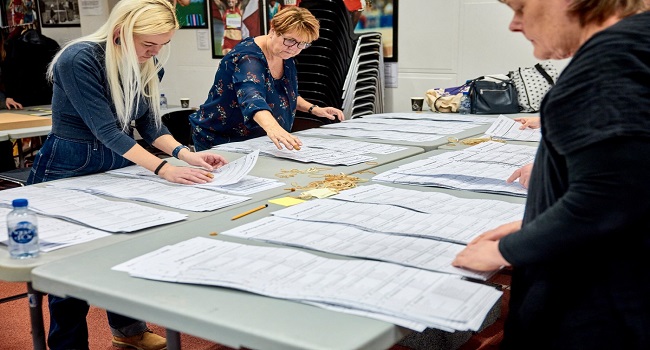
Election workers recount ballots in the Marselisborg Hallen in Aarhus, Denmark on March 25, 2026. (Photo by Mikkel Berg Pedersen / Ritzau Scanpix / AFP) /

Denmark’s political parties began the thorny process of forming a government Wednesday, with the centrist Moderates as kingmaker after the prime minister’s Social Democrats scraped through a general election without a majority.
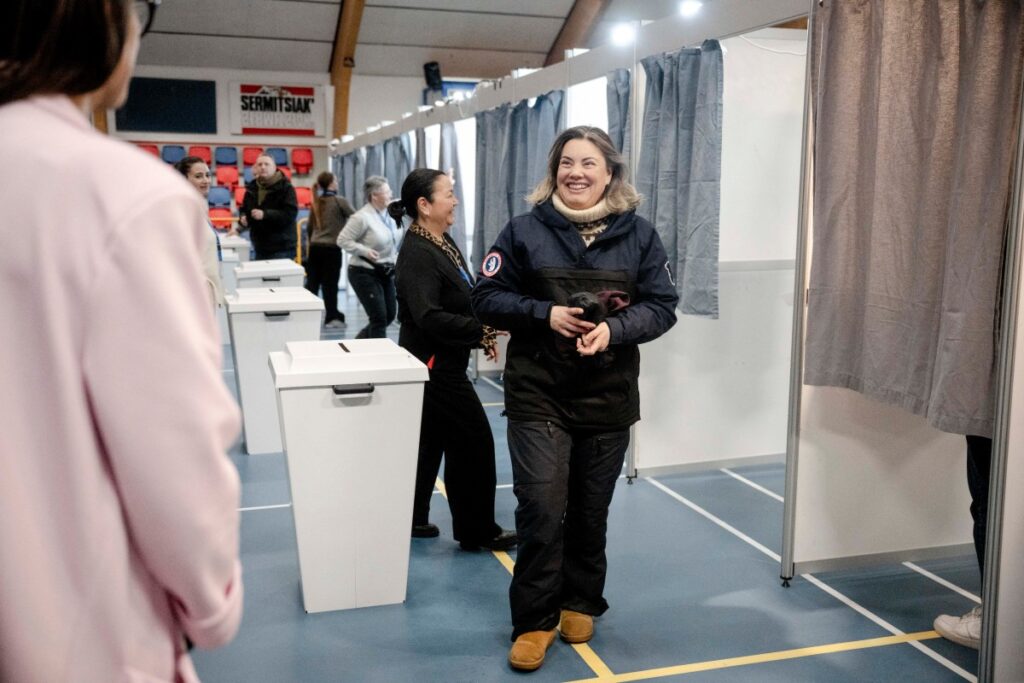
Greenland’s Inuit Ataqatigiit party member Naaja Nathanielsen (C) looks on in a polling station in Nuuk, on March 24, 2026, during the parliamentary election in Denmark (Photo by Oscar Scott Carl / Ritzau Scanpix / AFP) / Denmark OUT

Danes were braced for a weeks-long process as Prime Minister Mette Frederiksen seeks to consolidate power in the deeply splintered parliament after Tuesday’s snap vote.
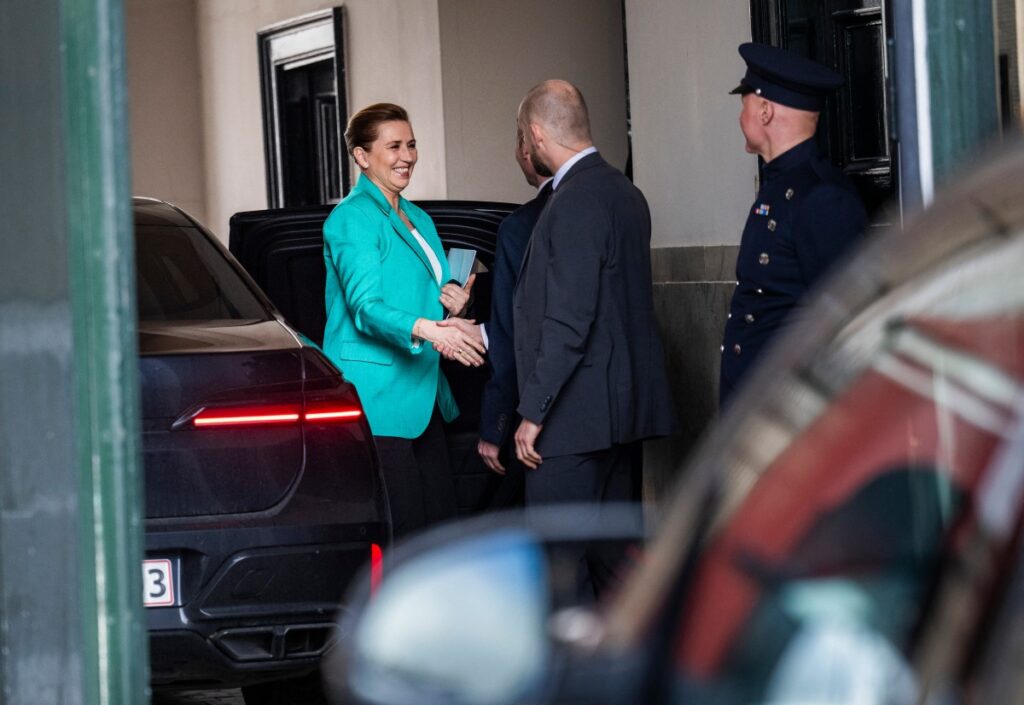
Denmark’s Prime Minister Mette Frederiksen arrives at Amalienborg Palace in Copenhagen to inform the king about the election result one day after the parliamentary election on March 25, 2026. (Photo by Martin Sylvest / Ritzau Scanpix / AFP) 

A left-wing bloc made up of five parties, including Frederiksen’s Social Democrats, won 84 seats; the right-wing and far-right claimed 77; and the Moderates won 14 in the election.

The Social Democrats posted their worst election score since 1903—though they remained Denmark’s largest single party, with 38 seats in the 179-seat parliament.
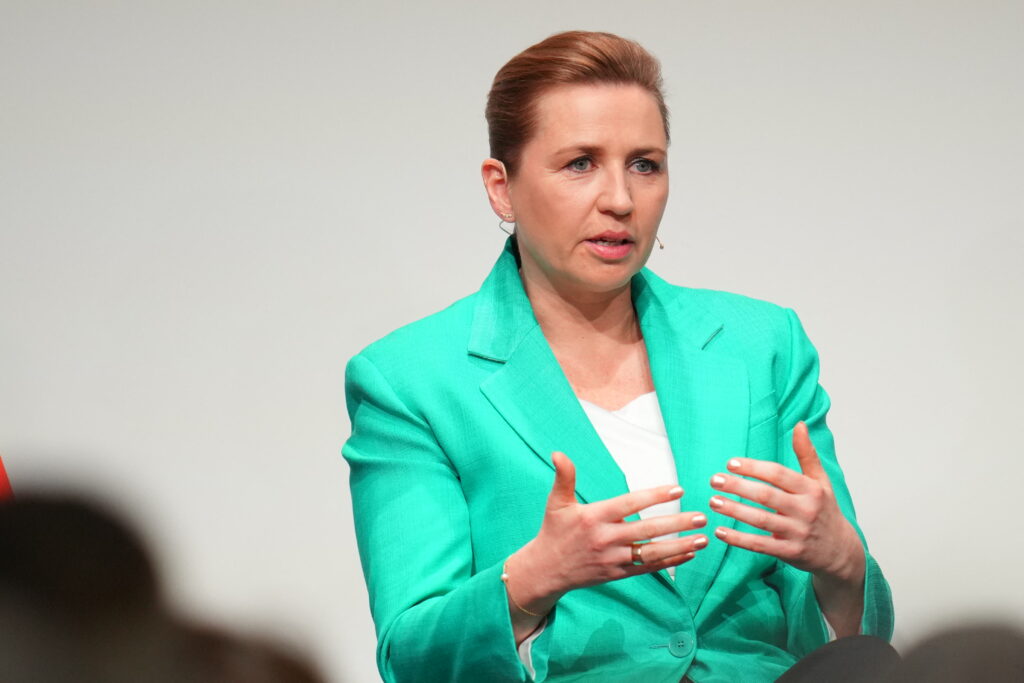
Chairwoman of the Social Democrats Mette Frederiksen attends a party leader debate hosted by Publicists’ Club one the day after the parliamentary election at the Confederation of Danish Industry’s building in Copenhagen on March 25, 2026. (Photo by Liselotte Sabroe / Ritzau Scanpix / AFP)


Frederiksen formally tendered her coalition government’s resignation to King Frederik on Wednesday, telling a televised party leader debate she wanted to try to form a centre-left government.

“The most realistic scenario” would be a coalition with the five parties on the left and the centre-right Moderates, she said.

But it is not certain the Moderates, led by Foreign Minister Lars Lokke Rasmussen, would agree to that.

“I don’t believe that Denmark needs policies aligned with” the leftist Red-Green Alliance, Lokke said.
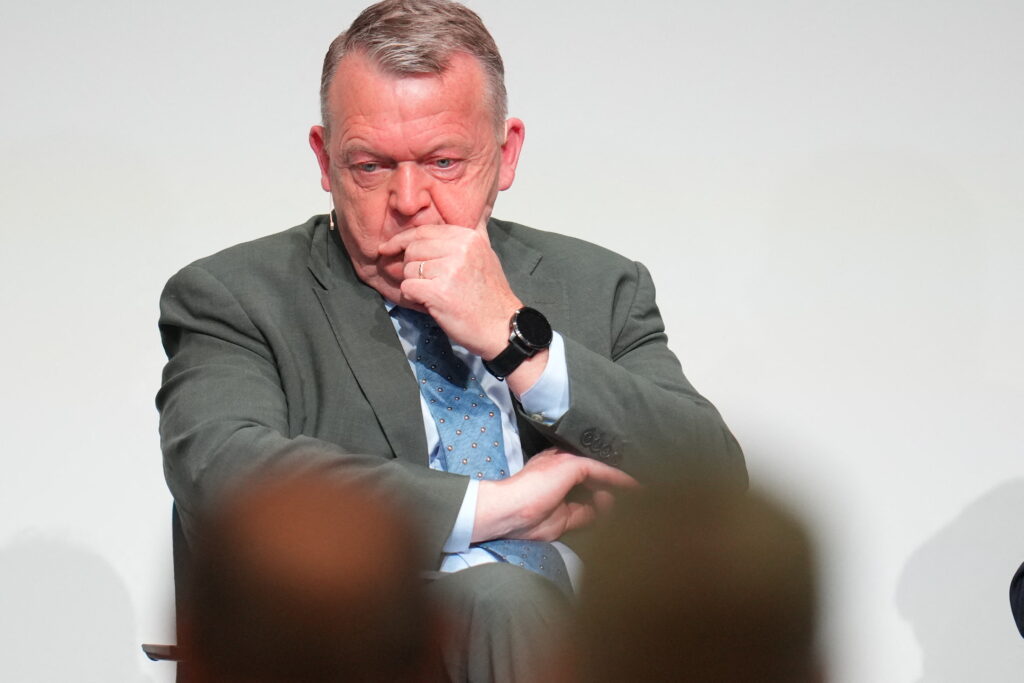
Chairman of the Moderates Lars Loekke Rasmussen attends a party leader debate at the Confederation of Danish Industry’s building in Copenhagen on March 25, 2026, the day after the parliamentary election. (Photo by Liselotte Sabroe / Ritzau Scanpix / AFP) / Denmark OUT

King Frederik was to meet party leaders individually later Wednesday to determine who should be asked to try to form the next government.

“My expectation is that Mette Frederiksen will become prime minister,” University of Copenhagen political science professor Rune Stubager told reporters.

“But I don’t know with the backing of which parties, like the left wing or the right wing,” he said.

He noted that Lokke, a two-time former prime minister, would likely vie for the position of prime minister, even though he has adamantly denied any interest in the job.

“Danes want me and not another prime minister. I still have the backing to be able to continue on behalf of the Danish people,” Frederiksen insisted during the debate.

Frederiksen has for the past four years headed an unprecedented left-right coalition made up of her Social Democrats, the Moderates and the Liberals.

The Liberals have refused to continue in a Social Democrat-led government.

‘Too Hard To Say’

Danes are now prepared for long negotiations. After the 2022 election, the talks lasted six weeks.

“It’s a long process, which means the government won’t be formed and it will be quite difficult to pass laws during this period,” lamented Jesper Dyrfjeld Christensen, a 54-year-old engineer.

“It’s really too hard to say who will be part of the coalition,” admitted Stubager.

With 12 parties in parliament, the political landscape is jagged — though Denmark is accustomed to minority governments.

“To some extent, this is the way Danish politics works. You have a minority government in the centre which forms a majority with the left on some issues and with the right on others,” he explained.

The negotiations are expected to focus on economic and pension issues, pollution and immigration, he said.

The traditional far-right party, the Danish People’s Party, which has heavily influenced policy since the late 1990s but slumped in the 2022 election, more than tripled its result to 9.1 per cent of votes.

The three anti-immigration groups together garnered 17 per cent, a stable figure for Denmark’s populist right over the past two decades.

“If negotiations take place in the left-wing bloc with the moderates, then there will be more focus on green issues than on immigration,” Stubager said.

“But if, instead, the Moderates negotiate with the parties on the right, then the central issue will be immigration.”

Four seats in Denmark’s parliament are held by its two autonomous territories — two for Greenland and two for the Faroe Islands.

While the Faroese renewed the mandates of the two outgoing lawmakers, with one for each bloc, Greenland overwhelmingly backed the left-wing party and Naleraq, which advocates rapid independence from Denmark.


AFP

International News

US Wants Justice In The killing Of Pastor Dachomo’s 9 Family Members 

Published

on

Spread the love


The United States has condemned the killing of members of the family of Plateau-based cleric, Rev. Ezekiel Dachomo, describing the attack as horrific and urging Nigerian authorities to ensure those responsible are brought to justice.


In a statement shared on X on Thursday, the US Department of State’s Bureau of African Affairs expressed condolences to the victims’ families and called for stronger measures to prevent further attacks on vulnerable communities across Nigeria’s Middle Belt.

“The United States strongly condemns the horrific killing of members of Rev. Ezekiel Dachomo’s family in Plateau State, Nigeria. The continued violence targeting Christian communities and other vulnerable populations in Nigeria’s Middle Belt is deeply alarming,” the bureau said

The US said it had already engaged Nigerian officials on the worsening security situation, stressing that urgent action was needed to curb recurring attacks and hold perpetrators accountable.

“As I discussed last week with Nigerian officials, we must do more to prevent violent acts. The perpetrators must be held accountable, and urgent action is needed to strengthen security and protect Christians and other vulnerable communities,” the statement added.

The bureau reaffirmed Washington’s commitment to working with the Nigerian government to combat terrorism and violent extremism, stressing that Christians and other Nigerians should be able to practise their faith without fear of violence.

The statement followed the July 12 attack on Kum community in Riyom Local Government Area of Plateau State, where nine members of Rev. Dachomo’s extended family, including a two-month-old baby, were killed.

According to the cleric, the attackers, believed to be armed Fulani militias, asked for him by name before opening fire on his relatives.

Dachomo, who serves as Regional Chairman of the Church of Christ in Nations (COCIN) in Barkin Ladi Local Government Area, said his family had repeatedly been targeted because of his outspoken criticism of the violence in Plateau State.

He recalled that his grandmother and an uncle were also killed in previous attacks, adding that days after burying his relatives, he received a written death threat from the same group, warning that he would be their next target.

Continue Reading

International News

Nigeria Missing As Saudi Arabia Names African Countries Eligible For eVisa

Published

on

Spread the love


Saudi Arabia has updated its tourist eVisa programme for 2026, limiting eligibility in Africa to only three countries as part of its list of 66 nations whose citizens can apply through the Kingdom’s online visa platform.


The move leaves most African countries, including Nigeria, outside the simplified entry scheme.

The electronic visa allows eligible travellers to visit Saudi Arabia for tourism, leisure activities, family visits and Umrah, excluding the annual Hajj pilgrimage. Applications are completed online, eliminating the need for embassy visits and lengthy visa processing.

Saudi authorities said the eVisa forms part of ongoing efforts to expand tourism, attract international visitors and simplify travel procedures through a fully digital application system. The visa is available only to citizens of approved countries and territories listed on the Kingdom’s official tourism portal.

Below is the list of African countries eligible for Saudi Arabia’s eVisa.

1. Mauritius

2. Seychelles

3. South Africa

Continue Reading

International News

South Africa Says Over 53,000 Deported In Migration Campaign

Published

on

Spread the love


The South African government says more than 53,000 foreign nationals have been deported or repatriated since launching a “migration management” campaign five weeks ago.

Most were from Malawi, Zimbabwe, and Mozambique, officials say, and the number is likely to rise as repatriations and deportations continue.

South Africa is carrying out one of its biggest crackdowns on undocumented migrants in years, following weeks of anti-immigration protests that have seen violence, intimidation and looting.

Protesters have been demanding tighter border controls and mass deportations, accusing migrants of contributing to high unemployment, rising crime rates and collapse of public services.

The UN has warned against using migrants as scapegoats for South Africa’s socioeconomic challenges.

Anti-migrant activists have threatened to stage weekly protests to pressure the government until their demands are met, and there are fears the protests could turn violent.

The demonstrators had set an “unofficial deadline” of 30 June for all undocumented migrants to leave the country, which has seen many foreigners leave to escape violence and intimidation.

Several countries, including Ghana, Nigeria, Uganda and Kenya, have flown their citizens home in recent weeks.

Justice and Constitutional Development Minister Mmamoloko Kubayi announced on Sunday that 53,499 foreign nationals have been processed for deportation and repatriation, “which is dominated by the Malawians, followed by Zimbabweans and Mozambicans”.

“We are striving to achieve an orderly and regular migration which is mindful and sensitive to the concerns raised by our people, while observing human rights and dignity of all people in our country, irrespective of their citizenship and immigration status,” Kubayi told a news conference in Pretoria.

She said the repatriation and deportation process has helped them catch people who were wanted by the police for alleged criminal activity.

Authorities will continue to enforce its immigration laws, she added, but warned that protesters should not conduct unauthorised searches of homes and businesses that are suspected of sheltering undocumented migrants.

South Africa’s President Cyril Ramaphosa has acknowledged public concerns about immigration but has condemned attacks against migrants, warning citizens against taking the law into their own hands.

South Africa is the continent’s wealthiest nation and has long attracted migrants searching for better economic opportunities, some of whom enter the country illegally.

Continue Reading

Trending

Copyright © 2026 TheColumn NG