
News
Disquiet In The Military Over Tinubu’s ADC’s Promotion

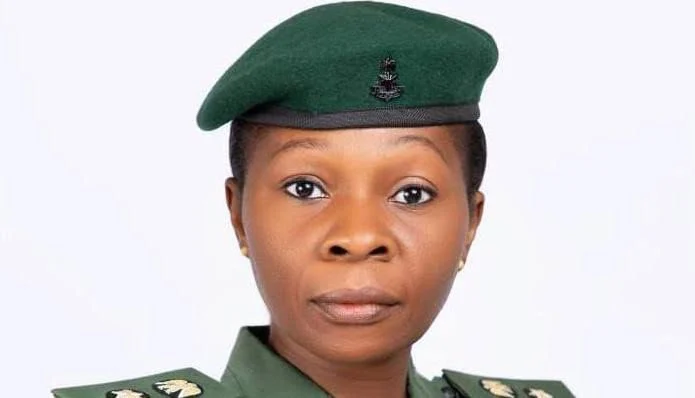
There are grumblings among military operatives following the recent promotion of Colonel Nurudeen Yusuf, the Aide-de-Camp (ADC) to President Bola Ahmed Tinubu, to the rank of Brigadier- General report says.
Unnamed sources in the report, were quoted as saying the promotion was an “unusual decision, especially under a democratic dispensation.”
One of the officers quoted said while young and middle cadre officers such as Lieutenants, Captains, Majors and Lieutenant Colonels could be promoted for exceptional performance, “promoting someone to the position of Brigadier General through executive fiat is not only abnormal but a terrible precedence.”
President Tinubu had, in a letter dated December 12, 2025, and addressed to the Chief of Army Staff, Lt.-Gen. Wahid Shaibu, approved the promotion of Colonel Yusuf to the rank of Brigadier-General.
The letter which is available on different platforms was signed by the National Security Adviser (NSA), Nuhu Ribadu, in which he conveyed the president’s approval for Col. Yusuf’s elevation.
Yusuf was appointed ADC to Tinubu on May 1, 2023, about four weeks before the president’s inauguration. He was a Lieutenant Colonel at the time but was promoted to the rank of Colonel.
The recent promotion has raised eyebrows within military circles because Yusuf was only decorated as a Colonel in January this year, making the latest advancement his second within a 12-month period.
Another source said, “This is an aberration…In the immediate past government, Brig.- Gen. ML Abubakar (N/10378), a member of 44 Regular Course of NDA, started with then President Muhammadu Buhari as Lt Col.
“When it was time for his promotion, he was promoted to Colonel along with his course mates. At the end of Buhari’s first term, he was released to attend the statutory course for promotion to Brigadier General. At the end of the course and passing through the normal process, he was posted out of the Villa to an appointment commensurate with his rank and replaced with then Lt Col YM Dodo (N/11624), a member of 50RC.”
The source added: “Similarly, during the President Olusegun Obasanjo era, Col Giwa Amu was replaced with Lt Col Chris Jemitola for the former to proceed to his Defence College and grow with his course mates
“The only time a Brig Gen was ADC, was during the time of General Abdussalami Abubakar, when Col Abide Aprezi, was promoted to Brigadier General and was retained for a few months to conclude the transition programme,” he said.
Meanwhile, a Premium Times report at the weekend said several officers, including some of Yusuf’s course mates, reportedly expressed frustration over what they described as an unprecedented fast-tracking of his career, with critics accusing the president of favouritism.
The Premium Times also quoted a Presidency source saying Tinubu approved the elevation to align Yusuf’s rank with those of other senior security officials attached to the Presidential Villa.
According to the source, the Nigeria Police Force in August promoted the president’s Chief Personal Security Officer, Usman Shugaba, from deputy commissioner of police to commissioner of police.
Similarly, the State Security Services (SSS) recently elevated the president’s Chief Security Officer, Adegboyega Fasasi, to the rank of director.
The source explained that the police and SSS ranks are considered equivalent to that of a brigadier-general in the Nigerian Army.
He added that without a corresponding promotion, Yusuf would have remained subordinate in rank to his counterparts within the Villa’s security architecture, a situation he said could undermine esprit de corps among the presidential security team.
But another anonymous source countered the claim saying, “The Nigerian Army is an institution sustained by tradition, memory, and an unwritten moral code that governs advancement, authority, and respect.”
According to him, “Promotion to the rank of Brigadier General has, over decades, been one of the clearest expressions of that code. It signifies that an officer has endured the full weight of professional scrutiny, satisfied exacting standards, and earned the confidence of both peers and subordinates through time, sacrifice, and intellectual preparation. This tradition is not ornamental. It is the backbone of discipline and the quiet assurance that the system is fair.
“Within this framework, the promotion of an officer who reportedly spent only one year in the rank of Colonel and who did not pass through the Army War College or the National Defence College represents a decision of extraordinary institutional risk. It is not merely a deviation from precedent, but a rupture with tradition. The immediate effect is not visible in public ceremonies but is felt deeply within messes, command offices, and informal professional spaces where officers measure decisions against the values they have lived by for decades.
“For generations, capable officers have been compulsorily retired or passed over at the Colonel level for failing to meet the stringent requirements for elevation to Brigadier General. Many accepted this outcome with dignity because they trusted the integrity of the system. To now elevate an officer who has not met those same benchmarks sends a devastating signal that sacrifice, patience, and professional education are no longer decisive. This is how quiet resentment begins. Not rebellion, but grumbling. Not protest, but erosion. Once officers begin to believe that the rules no longer apply equally, the moral fabric of the institution starts to fray.”
Another source also faulted the procedure of approving the promotion.
He said, “A letter from president conveying his request to the military was passed to the NSA. The NSA passed it directly to Chief of Army Staff, not to the CDS, not to the Minister of Defence…This is abnormal.”
Becoming a Brigadier-General
It was learnt that under long-standing Nigerian Army practice, and in line with the global best practice, an officer cannot legitimately move from Colonel to Brigadier General without meeting three key requirements:
Completion of War College / Senior Staff Course (approximately one year)
Completion of National Defence College or equivalent strategic course (approximately one year)
Minimum time-in-rank as Colonel: typically four to five years.

The Human Rights Writers Association of Nigeria (HURIWA) has alerted the public of what it described a coordinated campaign of calumny and deliberate misinformation being orchestrated by the handlers of the suspended Deputy Commissioner of Police, Abba Kyari currently facing trial for drug trafficking offences.
HURIWA made the claim in a statement issued on Wednesday.
The statement reads:
HURIWA wishes to alert the Nigerian public, and the international community to a coordinated campaign of calumny and deliberate misinformation being orchestrated by the handlers of the suspended Deputy Commissioner of Police, Abba Kyari currently facing trial for drug trafficking offences.
Following an in-depth investigation into recent sponsored reports circulating on social media, which claim that two convicted drug traffickers have indicted officers of the National Drug Law Enforcement Agency (NDLEA) of complicity in the case, HURIWA can authoritatively confirm that these reports are a total fabrication and a clumsy attempt to subvert the course of justice.
Our findings, backed by official court records and witness statements, reveal a starkly different reality from the narrative being pushed by Kyari’s camp. In their official witness statements, the convicted traffickers Chibunna Patrick Umeibe and Emeka Alphonsus Ezenwanne categorically denied any contact or collusion with NDLEA officers at the Enugu airport in January 2022.
The convicts confessed that their pictures and travel details were actually sent to Abba Kyari. Despite being on suspension at the time over another criminal case for which the United States government is still seeking his extradition to the US for trial, Kyari dispatched a team from Abuja to Enugu to intercept the traffickers for his own ends.
The convicts have stated on record that while in Kyari’s custody, they were forced under duress to indict the NDLEA. The “video confession” currently being circulated was scripted, with Kyari’s men actively dictating what the suspects should say while recording.
HURIWA reminds the public that no amount of digital spin can erase the overwhelming evidence already admitted as exhibits in court. The world has seen the video of Abba Kyari handing over $61,400 to an NDLEA undercover agent. This cash was established to be the proceeds from the sale of part of the cocaine Kyari’s team seized from the very same convicts they are now trying to use as pawns.
“It is pathetic that a high-ranking officer would resort to such low-level blackmail. This is a clear attempt to distract the public from the gravity of the drug trafficking charges. The U.S. government and the global community are watching this case closely. You cannot ‘spin’ your way out of a forensic sting operation.”
For the benefit of the public who they are struggling hard to confuse, the transcript of the conversation between Abba Kyari and an NDLEA undercover agent, already admitted as exhibit in court, clearly confirmed the transactional relationship and conspiracy between Kyari and members of the drug trafficking cartel. Here is a sampler from the conversation between Abba Kyari and NDLEA undercover agent:
ABBA KYARI: Yes, they (Cartel) will reveal to me those that are conveying it (the drugs), snap their pictures and send to us. So, we already know their goods, picture and the clothes they’re wearing, hope you understand, we know their names, they will give us everything. So, automatically the team will just be waiting, they will just see them and pick them up.
NDLEA UNDERCOVER AGENT: But are your boys inside the airport or outside?
ABBA KYARI: Yes, yes, some are outside while some are inside. They will just allow them to finish everything and arrest them the moment they come out.
This tallied with the witness statements by the two already convicted Kyari’s co-accused. In the words of one of them, Chibunna Patrick Umeibe: “I traveled to Ethiopia, Addis Ababa on 10th of January 2022, then I stayed in a lounge at the airport and somebody called me on phone whose name I can’t remember that Jekwu gave him my number that he supposed to give me some stuff which is cocaine. He met me at the lounge and gave me the stuff which is inside the nylon bag, then later snapped my picture. Then that was on the 18th of January 2022 (after staying 8 days in the airport) he asked me to dress the way I will travel back before he snapped the picture.
Then after snapping the picture he left. He knows the reason of snapping the picture, then on 19th of January I boarded to Nigeria. Immediately getting to the outside (Enugu international airport), a young man approached me and said that I should give him my international passport and I asked him what for? He bring out police ID card and showed me immediately and before I know, other police people some are on uniform while some are not on uniform, they surrounded me and pushed me and my brother inside a sienna car and zoomed off.”
There’s therefore no doubt from the court records that the pictures of the convicts were taken by the cartel members at the Addis Ababa airport and sent to Abba Kyari to enable him identify the couriers. This is the only reason his officers were able to pick only the two couriers out of the multitude of people at the airport’s car park.
HURIWA therefore calls on the Nigerian judiciary to remain undeterred by these subterranean moves to blackmail the prosecution. We urge the media to be professional and verify claims against official court transcripts before amplifying narratives that seek to shield alleged drug kingpins from accountability. The facts of the crime remain constant, no amount of sponsored falsehood will wish away the evidence of the $61,400 bribe or the documented betrayal of public trust.
Emmanuel Onwubiko
National Coordinator, Human Rights Writers Association of Nigeria (HURIWA)
March 25, 2026
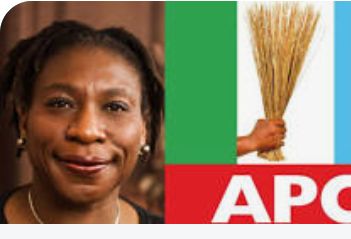
Senator Iyabo Obasanjo has expressed support for the use of consensus in the selection of candidates for political offices by parties ahead of the 2027 general election.
Speaking on Channels Television’s Sunrise Daily on Thursday monitored by the column.ng, the daughter of former President Olusegun Obasanjo, who is eyeing the governorship ticket of the All Progressives Congress (APC) in Ogun State, said consensus brings out the right candidates.
She dismissed fears that consensus would produce unpopular candidates, noting that it does not mean party leaders will ignore the wishes of the people.
“I do believe that consensus can bring the right candidates because consensus does not mean that leadership ignores the will of the people; consensus means that they look at what the people are saying. No party wants to lose, so the party will not choose people that open them for a loss; does that make sense?” Obasanjo said.
“So, the consensus is going to come towards people that can actually win on the ground, if that makes sense, because at the end of the day, the party wants to win. So, they do not want to put the least popular person as the consensus candidate in a way that is going to aggravate the other participants and in a way that is going to discourage people that are popular from participating. So, I have full belief that consensus is the way to go.”
She expressed strong belief that the consensus system would be an advantage to her in the race for the Ogun APC governorship ticket, citing her popularity and past performances as a commissioner and senator.
According to the former Ogun Central senator, the good salaries she received as a senator were put into working for her people, which she believes is an edge in the governorship race.
In another appearance on Channels Television’s The Morning Brief earlier this month, Senator Iyabo Obasanjo expressed confidence in her chances ahead of the 2027 governorship race in Ogun State, saying she is a candidate to beat.
The 59-year-old politician, who recently defected from the Peoples Democratic Party to the All Progressives Congress (APC) ahead of the 2027 elections, said she is confident of receiving the votes of her parents, including her father, former President Olusegun Obasanjo.
“I am almost 60; I think that at this age, my friends who still have both parents alive are very few, so I consider myself lucky to have both my mother and my father alive.
“I don’t think at this age I should be consulting them for everything in my career move. What I have said is that my father, I know, and my mother will vote for me; that’s all that I can ask of them. Even if I don’t ask, they will vote for me; that I can guarantee,” she said.
The new Electoral Act made changes to the modes of candidate selection for political parties. With the new Act, only direct primary and consensus are the options for political parties to choose their candidates, while the indirect primary option has been removed.
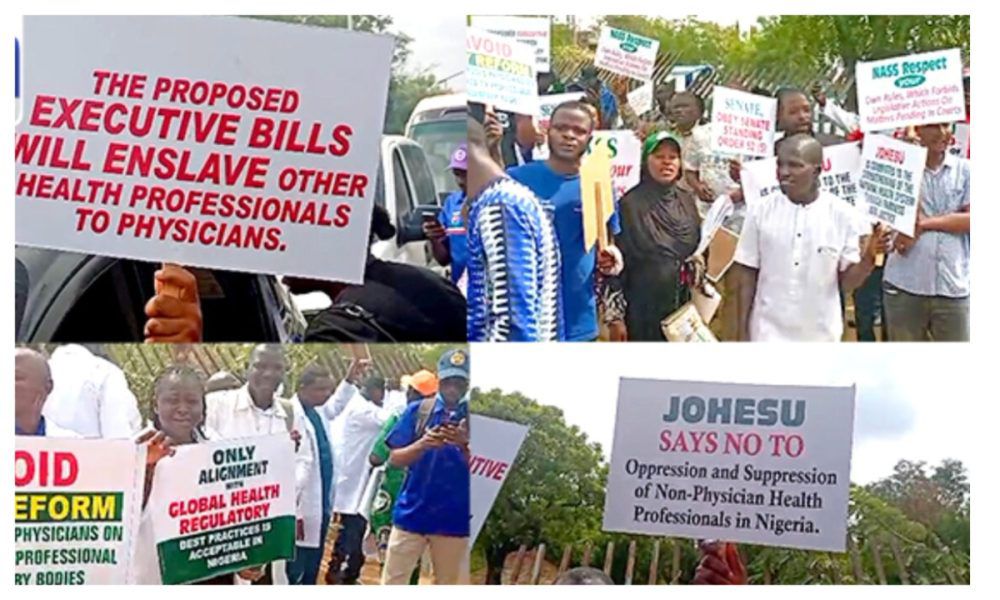
Health workers under the Joint Health Sector Unions and the Assembly of Healthcare Professional Associations are protesting at the Unity Fountain in Abuja.
The protest is against the proposed health sector regulatory bill, which is before the National Assembly.
The protesting health workers are against the bill, claiming that if allowed to pass, it would subject every medical profession to the regulation of the Medical and Dental Council of Nigeria.
They maintain that all health professions have their regulatory bodies, and that the new bill was seeking to make other health professionals second-class to medical doctors.
The protesters plan to also go to the National Assembly, where they hope to present their case to lawmakers.
-
 News3 years ago
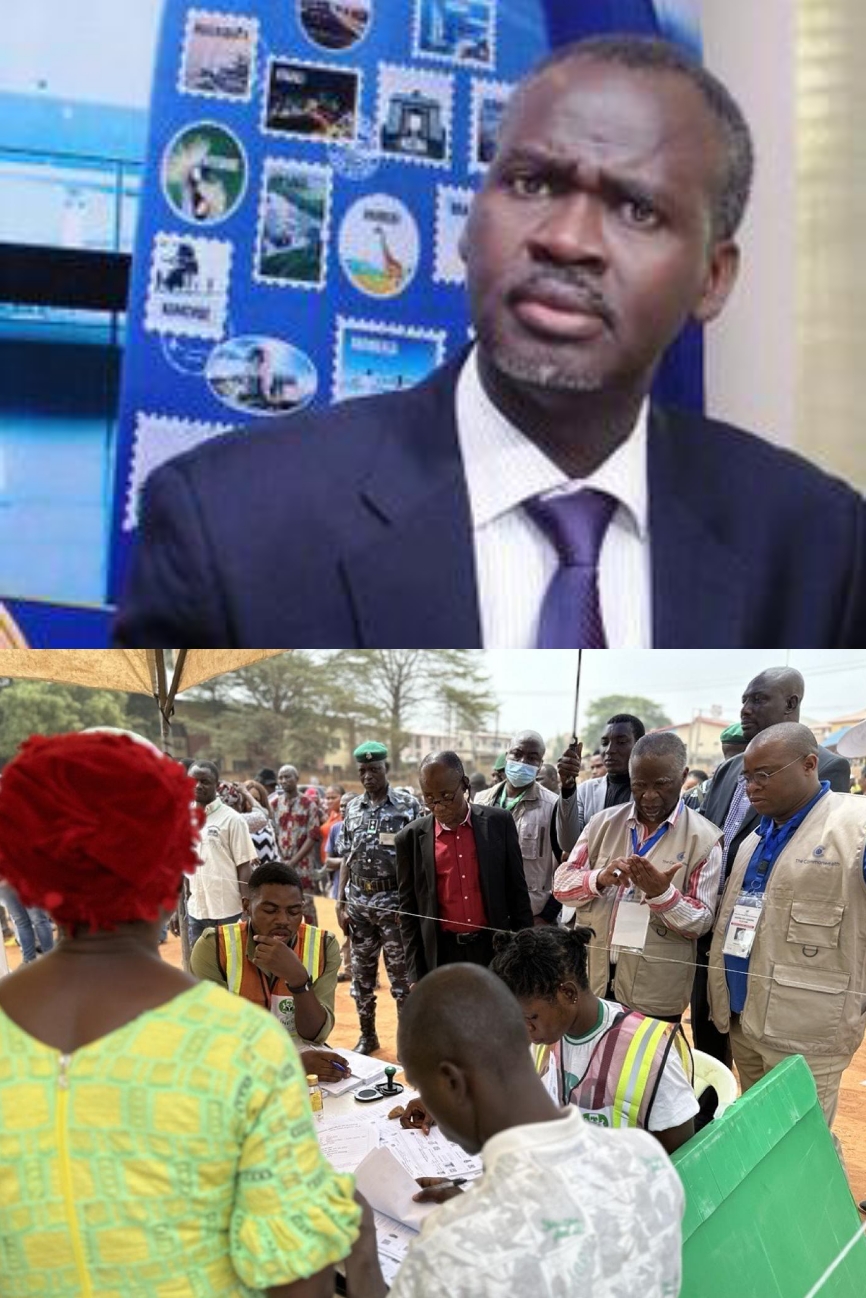
2023 Elections: Outgoing Rwandan High Commissioner say s Nigeria, ‘ handle their destiny’ in a peaceful way.
-
 News3 years ago
Just In: President Tinubu returns to Nigeria
-
 Entertainment3 years ago
Social media cloth Vendor Found Dead In Ibadan Hotel.
-
 News3 years ago
Ogun HoS Solicit Affordable Housing For Civil Servants
-
 Entertainment3 years ago
9mobile Ambassadors Begin “Meet And Greet” Session With Staffs, Customers.
-
 Trending News3 years ago
FG begins 40% pay rise for workers.
-
Sports3 years ago
CAF SALUTES RIVERS UNITED AFTER SEALING QUARTER-FINAL TICKET.
-
 Health & Wellness3 years ago
Breastfed babies have lower risks of diabetes – Nutritionist