
Uncategorized
I Felt The Bullet Rip Through My Skin,’ Says Trump On Assassination Attempt


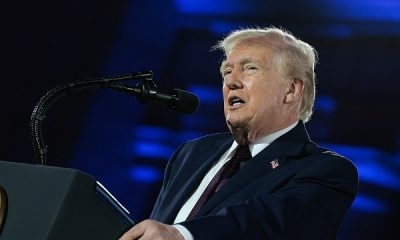
Former US president, Donald Trump, has spoken on his assassination attempt at his campaign rally in Pennsylvania.
He was hit by a gunman on Saturday in a chaotic and shocking incident set to supercharge political tensions ahead of the polarising US presidential election.
Hours after the incident, the Republican candidate said he felt the bullet rip through his skin.
“It is incredible that such an act can take place in our Country,” Trump said on his Truth Social network hours later, in remarks sure to stoke the political hostility already engulfing the United States.
“I knew immediately that something was wrong in that I heard a whizzing sound, shots, and immediately felt the bullet ripping through the skin. Much bleeding took place, so I realized then what was happening.”
He later could be seen walking unaided from his plane, though his wounded ear was not facing the camera in video footage posted by his deputy communications director. The New York Times reported that he was staying the night in New Jersey.
Police confirmed that a spectator was killed and two critically injured in the shooting, all of them male adults.
The 78-year-old former president was rushed off stage with blood streaked across his face after the shooting in Butler, Pennsylvania, while the shooter and a bystander were killed and two spectators critically injured.
Assassination Attempt
The FBI confirmed in a press conference that the shooting was being treated as “an assassination attempt against our former president, Donald Trump.”
The shooter, reportedly a registered Republican, was believed to be working alone.
His father Matthew Crooks told CNN that he was trying to establish “what the hell is going on”, and would not comment until he spoke to law enforcement.
looking confused. I heard the shots,” said John Yeykal from Franklin, Pennsylvania, who was attending his first Trump rally.
US political figures including former presidents Barack Obama and Bill Clinton lined up to condemn the attack and say there was no place for violence in politics.
Billionaire Elon Musk meanwhile reacted by quickly endorsing Trump.
The United States has a history of political violence, and presidents, former presidents and candidates have tight security.
President John F. Kennedy was assassinated in 1963 while riding in his motorcade, and his brother Bobby Kennedy was shot dead in 1968. President Ronald Reagan survived an assassination attempt in 1981.
AFP


The Borno State Police Command has arrested and arraigned five men in Maiduguri for allegedly printing and wearing T-shirts bearing the inscription “Tinubu Must Go.”
According to a First Information Report (FIR) issued by the State Criminal Investigation Department (SCID) and verified through court officials, the suspects are Baba Aji Gremami (44), Mustapha Abba Yemen (28), Abbacha Mohammed Ali (32), Adam Umar Gubio (21), and Abdulhamid Mohammed (21)
The document, dated September 29, 2026, stated that the incident occurred on September 25 at around 11:00 a.m. around the West End Roundabout community in the Borno State capital.
The police charged the defendants with criminal conspiracy, inciting disturbance, disturbance of public peace, and thuggery—offences the prosecution argues run contrary to Sections 60, 78, 79, and 392 of the Borno State Penal Code.
When the case was brought before the Chief Magistrate Court I in Maiduguri, all five defendants pleaded not guilty. Their legal counsel subsequently moved a bail application.
The presiding judge adjourned the matter to October 6, 2026, for a ruling on bail, while the substantive trial has been slated for October 26, 2026.
The arrest and prosecution of the five men for wearing politically themed T-shirts has sparked widespread outrage, drawing severe condemnation from social media commentators and human rights giant Amnesty International.
A report said the police action has fueled allegations from critics accusing a prominent state politician of orchestrating the detentions to stifle political opposition.
Meanwhile, in a strongly worded statement, Amnesty International has slammed the charges against the men as bizarre, labeling their detention as an act of arbitrary arrest.
The organization emphasized that expressing peaceful political dissent through clothing is a fundamental human right, not a criminal offense.
“Clearly, the intention of this reign of repression in Borno State appears to be selective injustice to curtail the opposition in the political space.
“It is sadly creating a toxic climate of fear that is contrary to the democratic principles of freedom and justice,” the statement read.
Amnesty International demanded the immediate and unconditional release of the detainees, a development it termed “sham trial based on bogus charges.”
The organization reiterated that the right to peacefully express political opinions must be protected rather than stifled in a democratic society.
The arrests have similarly ignited fierce debate online, with social media users condemning the police action as an abuse of power and a blow to free speech.

The Rule of Law and Accountability Advocacy Centre (RULAAC) has petitioned the Anambra State Commissioner of Police over the alleged unlawful arrest and four-day detention of a woman by operatives of the Rapid Response Squad (RRS), Awkuzu, formerly known as the Special Anti-Robbery Squad (SARS).
RULAAC, in a letter signed by its Executive Director, Okechukwu Nwanguma, dated September 5, alleged that Ms. Nwosu Chikamso Jennifer was arrested on August 31, 2026, not over an offence linked to her but in connection with the police search for her brother, who is reportedly wanted over an alleged murder case.
According to the organisation, Nwosu alleged that she was detained for four days and was expected to produce her brother despite not being accused of complicity in the alleged offence.
The organisation said Nwosu further alleged that she was released on September 3 after ₦600,000 was paid, with the payment allegedly described as being for “administrative bail.”
RULAAC said no receipt or acknowledgement was reportedly issued for the payment.
The complainant also alleged that her mobile phone was seized by the police and retained without a seizure form or property receipt.
The organisation identified the investigating officer in the matter as Mr Odoh Kingsley of RRS Awkuzu.
RULAAC said Nwosu had been directed to report again on Monday, September 7, 2026, but was apprehensive that she could face renewed detention or further demands for money.
The rights group therefore called on the Commissioner of Police to urgently intervene and verify the allegations before Nwosu’s scheduled appearance at the police facility.
RULAAC described the alleged arrest and detention of Nwosu over her brother’s alleged offence as a possible case of “arrest by proxy” or “arrest in lieu.”
The organisation argued that arresting a person merely to compel the surrender of a relative raises serious constitutional and human-rights concerns.
“If the claims are substantially correct, the actions complained of would raise grave legal and human-rights concerns,” the organisation said.
“Arresting and detaining a person merely to compel the surrender of a relative amounts to arrest by proxy or arrest in lieu, a practice expressly prohibited by Nigerian law.”
RULAAC also raised concerns about the alleged four-day detention, saying that holding a person beyond the constitutionally permissible period without taking the individual before a court could violate legal safeguards on arrest and detention.
It further described the alleged ₦600,000 payment as “particularly disturbing,” stressing that police bail is free.
The organisation said the allegations were particularly concerning because they involved the Awkuzu facility, which became notorious for alleged human rights abuses during the era of SARS.
RULAAC said the transition from SARS to RRS should have represented more than a change of name.
“These allegations, if established, inevitably evoke the ugly memories of the abuses historically associated with the former SARS facility at Awkuzu,” the organisation said.
“The transition from SARS to RRS ought to signify more than a change of name; it should represent a decisive institutional break from arbitrary detention, arrest by proxy, extortion and other practices that brought the former unit into disrepute.”
RULAAC said the alleged conduct, if established, would be inconsistent with safeguards contained in the Nigerian Constitution, the Police Act 2020 and applicable criminal justice legislation.
In its requests to the Commissioner of Police, RULAAC asked the police authorities to establish the circumstances and legal basis for Nwosu’s arrest and four-day detention.
It also demanded an investigation into the alleged ₦600,000 payment, including determining who allegedly demanded or received the money.
The organisation requested that the money be refunded if it was found to have been unlawfully collected.
RULAAC further asked the police to establish the legal basis for the seizure and continued retention of Nwosu’s phone and ensure that any property retained for investigative purposes is properly documented.
It also urged the police to ensure that Nwosu’s scheduled appearance on September 7 would not result in further arbitrary detention, intimidation or unlawful financial demands.
The organisation asked the police to ensure that Nwosu was not held responsible for producing her brother or punished for his alleged conduct without evidence establishing her own involvement in an offence.
It also called for disciplinary or other appropriate action against any police officer found to have acted unlawfully.
The rights organisation stressed that it recognised the responsibility of the police to investigate serious crimes, including murder allegations.
It said its intervention was not intended to obstruct the investigation into Nwosu’s brother.
“Nothing in this intervention is intended to obstruct any lawful investigation,” RULAAC said.
“Our concern is simply that the investigation must be conducted within the bounds of the law and that no citizen should be deprived of liberty or subjected to financial demands merely because the Police are seeking a relative.”
The organisation urged the police command to respond to the complaint and disclose the steps taken to address the allegations.
International News
Maguire: Tuchel Told Me By Video Call I Was Out And I Said I Was Very Disappointed
On “The Rest is Football” podcast, Manchester United center-back Maguire discussed how Tuchel informed him via video call that he had not been selected for the World Cup squad.
Maguire revealed: “He (Tuchel) video-called everyone. It was quite an awkward call. I first received a message asking if he could talk to me around 4 PM. It was quite a unique approach, and certainly difficult, because he could see everyone’s reactions.
“I said directly that I was really very disappointed. I felt I had done well enough to deserve to be in the squad, and I felt I could have helped the team, playing a role on and off the pitch. He said he couldn’t give me any excuses, but he chose the four players who had helped him through a difficult period last autumn.
“It was hard to accept. After being called up by him for the first time in the March training camp, I did think I would be in the squad. I performed well in both games and then returned to Manchester United, finishing the season with a very strong performance.”
Tuchel ultimately chose to take Stones, Guehi, Konsa, Quansah, and Dan Burn to the World Cup.
No Plans to Retire from England Duty
Furthermore, even with Tuchel’s contract extending to Euro 2028, Maguire is unwilling to close the door on playing for England.
He added: “I don’t think I’ll retire from England duty. I still feel I can shine. Sooner or later there will be a time and a point where I no longer deserve to be selected for England, but even then, I most likely won’t proactively step out and announce my retirement. If I can play for England one more time, it will all be worth it.”
Maguire will use the off-season to fully recover and prepare for Manchester United’s return to the Champions League in the 2026-27 season. While his England teammates face the immense pressure of a major international tournament, the experienced defender will strive to maintain his excellent club form. If he is to earn a recall to the England squad later this year, proving his endurance in the Premier League remains crucial.
-
 Health & Wellness1 year ago
President Tinubu Directs Cut in Dialysis Cost from ₦50,000 to ₦12,000
-
News2 years ago
CBN Debunks Fake Circular on New ₦5,000 and ₦10,000 Notes
-
 Business7 months ago
Dangote Refinery Reduces Petrol Gantry Price To ₦1,200 Per Litre
-
 International News7 months ago
Indian Police Arrest Nigerian Over ₦290m Drug Haul
-
 Business7 months ago
After Plea Bargain, Court Discharges Stella Oduah of ₦2.5bn Fraud
-
Business2 years ago
Dangote; We Did Not Fix ₦600/Litre Petrol Price
-
 Trending News1 year ago
NELFUND Disburses ₦86bn To 449,000 Beneficiaries
-
 Opinion2 years ago
Championing the People’s Voice: Obasa’s Dedication to Grassroots Representation By Dave Agboola⁰