Connect with us

International News

Morocco Set For Sheepless Eid As Drought Persists

Published

on

Spread the love
As the Islamic festival of Eid al-Adha approaches, Fatima Kharraz can’t seem to find the usual sense of celebration after drought-stricken Morocco urged people to forego the traditional sheep sacrifice this year.

The rare call was made as the kingdom grapples with a seventh consecutive year’s of a dry spell that has caused livestock numbers to decline.

“We don’t feel the usual excitement,” said Kharraz. “It’s as if the holiday doesn’t exist.”

But the 52-year-old said it would have been prohibitively expensive to observe the sacrifice this year: sheep “prices were already high last year… We couldn’t have afforded it.”

While sacrificing sheep during Eid al-Adha is not a religious obligation, it remains a widely observed ritual across the Muslim world.

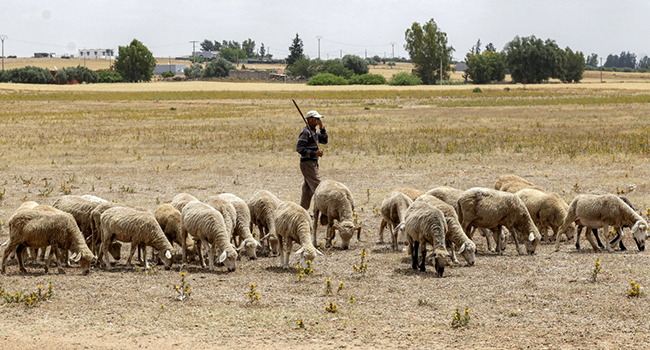
At the weekly livestock market in Khemisset, a small town near the capital Rabat, the usual holiday buzz was missing.

Cattle and horses stood in makeshift pens with no sheep in sight, an eerie scene for many just days before the festivity Moroccans are set to observe on Saturday.

Late February, King Mohammed VI — also the kingdom’s “Commander of the Faithful” — cited both “climate and economic challenges” when announcing the measure.

He said those challenges have caused a “substantial decline” in the country’s livestock.

‘Exorbitant’

His late father, Hassan II, made a similar appeal in 1996 when the kingdom also struggled with drought.

Recent rainfall deficits have chipped away at grazing pastures, also driving up the cost of livestock feed.

This has shrunk Morocco’s livestock numbers by more than a third compared to the figure counted in the last census in 2016, according to the agriculture ministry.

It has also caused red meat prices to skyrocket, making it unaffordable for many in a country where the minimum monthly wage is just over 3,000 dirhams ($325).

For livestock sellers, the economic toll has also proved heavy.

At the Khemisset market, 24-year-old Marouane Haizoun leaned against the rails of a nearly empty pen, waiting to sell two cows.

He said he had left his sheep on the family farm as it would have been difficult to sell any this year.

“Prices would have been exorbitant,” he said, while Mustapha Mastour, a 52-year-old horse and sheep breeder, said they would have climbed to “6,000 or 7,000 dirhams” ($650-$760).

Some families “would have to take out loans” to buy sheep, said Mona Hajjami, 28, buying vegetables at the market.

‘Void’

Many households opted instead to purchase small cuts of meat or lamb liver — key ingredients in Eid recipes.

“We’ve seen an increase in demand (for lamb meat), but it won’t have any impact” on endeavours to restore livestock numbers, said Mohamed Jebli, president of the Moroccan Federation of Livestock Industry Stakeholders.

The North African country of some 37 million people has typically seen up to six million sheep sacrificed each year for Eid al-Adha, Agriculture Minister Ahmed Bouari said in March.

Last month, the government unveiled a 6.2 billion dirham ($675 million) relief plan, including subsidies for animal feed and partial debt relief for herders.

Both breeders Mastour and Haizoun hoped for an equitable distribution of the aid, saying that big livestock owners were usually the primary beneficiaries.

This year’s unusual circumstances has caused a stir on social media, with false claims circulating about surveillance drones monitoring the festivities and steep fines for anyone defying the royal directive.

Yet within Morocco, the king’s appeal has largely been met with understanding.

“I support the decision,” said Hajjami. Still, she added, “it’s normal to feel a void without an atmosphere of grilled meat.”



AFP

International News

US Wants Justice In The killing Of Pastor Dachomo’s 9 Family Members 

Published

on

Spread the love


The United States has condemned the killing of members of the family of Plateau-based cleric, Rev. Ezekiel Dachomo, describing the attack as horrific and urging Nigerian authorities to ensure those responsible are brought to justice.


In a statement shared on X on Thursday, the US Department of State’s Bureau of African Affairs expressed condolences to the victims’ families and called for stronger measures to prevent further attacks on vulnerable communities across Nigeria’s Middle Belt.

“The United States strongly condemns the horrific killing of members of Rev. Ezekiel Dachomo’s family in Plateau State, Nigeria. The continued violence targeting Christian communities and other vulnerable populations in Nigeria’s Middle Belt is deeply alarming,” the bureau said

The US said it had already engaged Nigerian officials on the worsening security situation, stressing that urgent action was needed to curb recurring attacks and hold perpetrators accountable.

“As I discussed last week with Nigerian officials, we must do more to prevent violent acts. The perpetrators must be held accountable, and urgent action is needed to strengthen security and protect Christians and other vulnerable communities,” the statement added.

The bureau reaffirmed Washington’s commitment to working with the Nigerian government to combat terrorism and violent extremism, stressing that Christians and other Nigerians should be able to practise their faith without fear of violence.

The statement followed the July 12 attack on Kum community in Riyom Local Government Area of Plateau State, where nine members of Rev. Dachomo’s extended family, including a two-month-old baby, were killed.

According to the cleric, the attackers, believed to be armed Fulani militias, asked for him by name before opening fire on his relatives.

Dachomo, who serves as Regional Chairman of the Church of Christ in Nations (COCIN) in Barkin Ladi Local Government Area, said his family had repeatedly been targeted because of his outspoken criticism of the violence in Plateau State.

He recalled that his grandmother and an uncle were also killed in previous attacks, adding that days after burying his relatives, he received a written death threat from the same group, warning that he would be their next target.

Continue Reading

International News

Nigeria Missing As Saudi Arabia Names African Countries Eligible For eVisa

Published

on

Spread the love


Saudi Arabia has updated its tourist eVisa programme for 2026, limiting eligibility in Africa to only three countries as part of its list of 66 nations whose citizens can apply through the Kingdom’s online visa platform.


The move leaves most African countries, including Nigeria, outside the simplified entry scheme.

The electronic visa allows eligible travellers to visit Saudi Arabia for tourism, leisure activities, family visits and Umrah, excluding the annual Hajj pilgrimage. Applications are completed online, eliminating the need for embassy visits and lengthy visa processing.

Saudi authorities said the eVisa forms part of ongoing efforts to expand tourism, attract international visitors and simplify travel procedures through a fully digital application system. The visa is available only to citizens of approved countries and territories listed on the Kingdom’s official tourism portal.

Below is the list of African countries eligible for Saudi Arabia’s eVisa.

1. Mauritius

2. Seychelles

3. South Africa

Continue Reading

International News

South Africa Says Over 53,000 Deported In Migration Campaign

Published

on

Spread the love


The South African government says more than 53,000 foreign nationals have been deported or repatriated since launching a “migration management” campaign five weeks ago.

Most were from Malawi, Zimbabwe, and Mozambique, officials say, and the number is likely to rise as repatriations and deportations continue.

South Africa is carrying out one of its biggest crackdowns on undocumented migrants in years, following weeks of anti-immigration protests that have seen violence, intimidation and looting.

Protesters have been demanding tighter border controls and mass deportations, accusing migrants of contributing to high unemployment, rising crime rates and collapse of public services.

The UN has warned against using migrants as scapegoats for South Africa’s socioeconomic challenges.

Anti-migrant activists have threatened to stage weekly protests to pressure the government until their demands are met, and there are fears the protests could turn violent.

The demonstrators had set an “unofficial deadline” of 30 June for all undocumented migrants to leave the country, which has seen many foreigners leave to escape violence and intimidation.

Several countries, including Ghana, Nigeria, Uganda and Kenya, have flown their citizens home in recent weeks.

Justice and Constitutional Development Minister Mmamoloko Kubayi announced on Sunday that 53,499 foreign nationals have been processed for deportation and repatriation, “which is dominated by the Malawians, followed by Zimbabweans and Mozambicans”.

“We are striving to achieve an orderly and regular migration which is mindful and sensitive to the concerns raised by our people, while observing human rights and dignity of all people in our country, irrespective of their citizenship and immigration status,” Kubayi told a news conference in Pretoria.

She said the repatriation and deportation process has helped them catch people who were wanted by the police for alleged criminal activity.

Authorities will continue to enforce its immigration laws, she added, but warned that protesters should not conduct unauthorised searches of homes and businesses that are suspected of sheltering undocumented migrants.

South Africa’s President Cyril Ramaphosa has acknowledged public concerns about immigration but has condemned attacks against migrants, warning citizens against taking the law into their own hands.

South Africa is the continent’s wealthiest nation and has long attracted migrants searching for better economic opportunities, some of whom enter the country illegally.

Continue Reading

Trending

Copyright © 2026 TheColumn NG