Connect with us

International News

Rain, Snow Offer Hope In Japan’s Worst Wildfire In 50 Years

Published

on

Spread the love
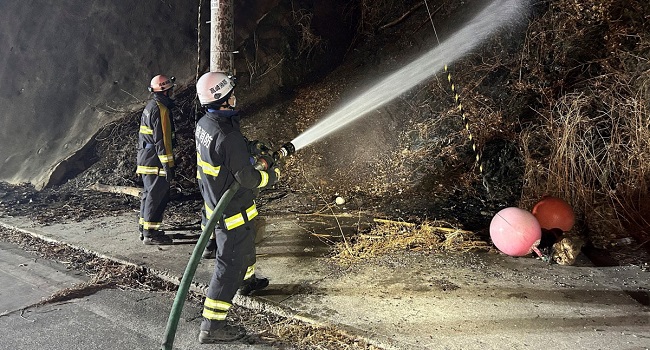
This photo taken on March 4, 2025 and received by AFP on March 5, 2025 from the Fire and Disaster Management Agency shows firefighters battling a wildfire near the city of Ofunato, Iwate prefecture. (Photo by HANDOUT / Fire and Disaster Management Agency / AFP)

Japan battled its worst wildfire in half a century on Wednesday in a region hit by record-low rainfall, as wet weather gave hope for some relief.

The blaze around the northern city of Ofunato has raged for more than a week, killing one person and forcing nearly 4,000 residents to evacuate their homes.

It has engulfed about 2,900 hectares (7,170 acres) — around half the size of Manhattan — making it the largest wildfire since at least 1975, when 2,700 hectares burnt in Hokkaido.

Columns of white smoke billowed from a mountain through the rain and snow on Wednesday, AFP reporters saw. More wet weather was forecast through Thursday.

“The fire was like nothing I’ve seen before. It was towering and spreading fast,” said Mitsuo Otsubo, 85, who fled his home to stay with a relative.

“It didn’t rain or snow at all this year… Thank goodness it rained today though. I can only hope it will help contain the situation,” the seaweed and scallop farmer said.
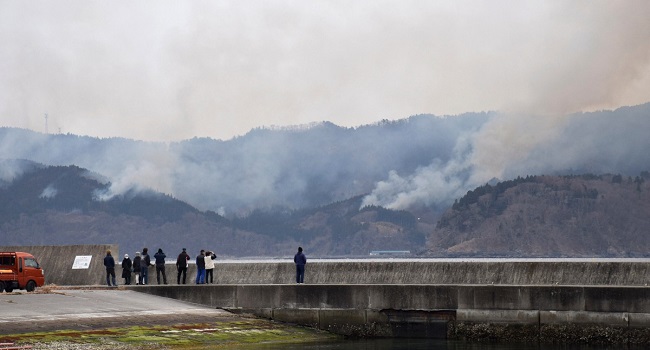
This picture taken on March 3, 2025 shows people watching a wildfire which approaches a village from the fishing port of Ofunato city in Iwate prefecture. (Photo by JIJI PRESS / AFP)

Japan endured its hottest summer on record last year as climate change pushes up temperatures worldwide.

Ofunato received just 2.5 millimetres (0.1 inches) of rainfall in February — breaking the previous record low for the month of 4.4 millimetres in 1967 and well below the average of 41 millimetres.

‘Don’t know where to run’

Makeshift tents were being set up at a city hall where around 270 people were taking shelter, with bottles of water and food supplies spread out on tables.

“Fires are the scariest disaster, because they spring from one place to another, so you don’t know where to run,” 69-year-old evacuee Fumiko Tanaka told AFP.

“I can only hope the fires won’t reach my house.”
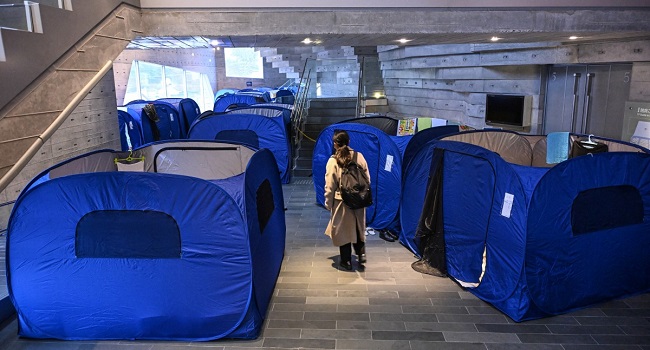
A woman walks past tents occupied by people who were evacuated from their homes due to a wildfire, at an evacuation centre in the city of Ofunato, Iwate prefecture on March 5, 2025. (Photo by Toshifumi KITAMURA / AFP)

Tanaka and her husband, a fisherman, “feel the effect of climate change every year” as rising ocean temperatures affect what they are able to catch, she said.

At least 84 buildings are believed to have been damaged, although details are still being assessed, according to the fire agency.

The owner of an “onsen” hot spring inn voluntarily opened his facility for free to evacuees.

“Not being able to bathe yourself on top of dealing with the chaos of life in a shelter definitely wears you down,” 60-year-old Toyoshige Shida, of Ofunato Onsen, told AFP.

He said he built the inn after seeing how people suffered in the wake of a huge earthquake and tsunami in 2011 that killed at least 340 people in Ofunato alone.

Dry weather

The number of wildfires in Japan has declined since its 1970s peak.

However, there were about 1,300 in 2023, concentrated in the period from February to April when the air dries out and winds pick up.

Greg Mullins, formerly fire and rescue commissioner for the Australian state of New South Wales, told AFP this fire and the recent Los Angeles wildfires were “highly unusual” because they were in winter.

“In both cases the fires were preceded by hot summers, which increased evaporation and drying of vegetation, followed by large rainfall deficits that parched the landscape,” he said.

“This is a common by-product of climate change,” said Mullins, a founder of the Emergency Leaders for Climate Action group.

“As the planet warms further we can expect to see fires in places where they have never before been a problem.”
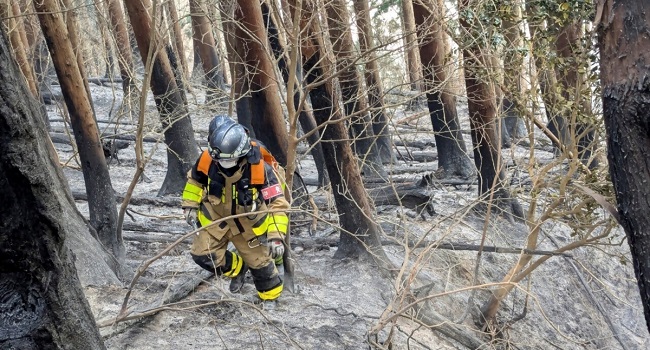
This photo taken on March 3, 2025 and received by AFP on March 5, 2025 from the Fire and Disaster Management Agency shows a firefighter walking amongst burnt trees as they battle a wildfire near the city of Ofunato, Iwate prefecture. (Photo by HANDOUT / Fire and Disaster Management Agency / AFP)

Around 2,000 firefighters, most deployed from other parts of Japan, including Tokyo, have been working from the air and on the ground.

“The fact that teams of firefighters are being reinforced every day, and that the fire has been going on for a week, shows the extent of the dry weather and the difficulties we are facing,” Ofunato Mayor Kiyoshi Fuchigami told reporters.

The topography of the mountainous coastal area, with steep slopes and narrow and winding roads, was hampering the fire-fighting operation.


AFP

Continue Reading
Click to comment

Leave a Reply

Your email address will not be published. Required fields are marked *

International News

UNHCR: Nigeria Hosts Over 142,000 Refugees, Seeks More Foreign Support

Published

on

Spread the love


The Federal Government has called for stronger international responsibility sharing and innovative arrangement to address the growing humanitarian needs of over 142,000 refugees and asylum seekers from 42 countries.


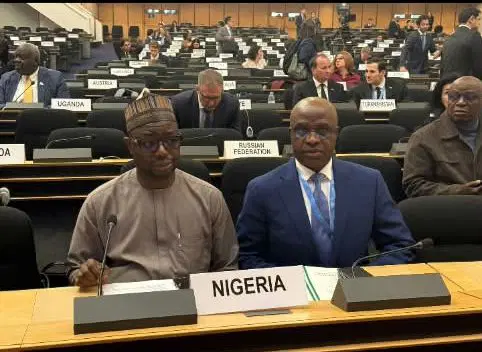
The Minister of Humanitarian Affairs and Poverty Reduction, Dr. Bernard Doro, made the call while delivering Nigeria’s national statement at the 77th Session of the Executive Committee of the United Nations High Commissioner for Refugees (UNHCR), currently holding at the Palais des Nations in Geneva.

In a statement by his Senior Technical Adviser on Information Systems and Data Analysis, Dr. Abimbola Fasanu, the Minister disclosed that as of September 2026, Nigeria had received over 24,000 returnees and was managing a population of more than 6.7 million internally displaced persons (IDPs).

Doro reaffirmed Nigeria’s commitment to international refugee protection obligations, noting that the country continues to maintain an asylum system under the National Commission for Refugees, Migrants and Internally Displaced Persons (NCFRMI) Act of 2022.

He stated that no case of refoulement had been recorded in Nigeria in 2026, reaffirming the country’s commitment to protecting people fleeing persecution from being returned to situations where their lives or freedom could be threatened.

Highlighting progress on durable solutions, the Minister disclosed that over 7,000 Nigerian refugees had voluntarily returned from neighbouring countries this year under Tripartite Agreements, while another 14,000 in Cameroon had registered their intention to return. An agreement covering the return of 2,000 Nigerians from Niger is also being finalised.

He acknowledged the continued hospitality of Cameroon, Chad and Niger in providing refuge to displaced Nigerians.

According to the Minister, improved security conditions in parts of the country are creating opportunities for voluntary return, while Resettlement Cities established in seven locations are supporting the phased closure of displacement camps in conditions of safety and dignity.

Beyond return and resettlement, Dr. Doro outlined measures aimed at promoting self-reliance and reducing prolonged dependence on humanitarian assistance.

He explained that refugees in five states are benefiting from access to land, agricultural inputs and skills training, while the newly established Public-Private Partnership Department of the NCFRMI is supporting efforts to expand livelihood opportunities.

The Minister also cited the successful local integration of former Liberian and Sierra Leonean refugees, some of whom have established businesses and become economically active members of their host communities.

On access to essential services, he disclosed that displaced persons and host communities are being enrolled in Nigeria’s national identity system to facilitate access to banking, education and social services.

He added that refugees are being incorporated into state action plans and social registers, while ten mobile documentation buses are expected to extend identity services to underserved and remote communities.

Doro further highlighted the development of a Digital Gateway in collaboration with UNHCR to provide refugees with secure online access to information.

Addressing the growing pressure on humanitarian financing, the Minister urged the international community to strengthen support for refugee-hosting countries through expanded resettlement opportunities, complementary pathways and greater responsibility-sharing.

He specifically called on UNHCR to explore partnerships with regional and subregional financial institutions, including the African Development Bank and the ECOWAS Bank for Investment and Development, as a means of mobilising additional resources for refugee protection and durable solutions.

The Minister emphasised that the responsibility for addressing displacement could not rest on host countries alone, particularly at a time of increasing humanitarian needs and declining international resources.

Continue Reading

International News

Child Soldiers: US List Nigeria Among Erring Countries, Threaten Sanctions

Published

on

Spread the love


The United States has listed Nigeria among 14 countries identified for recruiting or using child soldiers, warning that the designation could trigger restrictions on certain forms of military assistance.

The listing is contained in the 2026 Trafficking in Persons (TIP) Report, which covers the period from April 1, 2025, to March 31, 2026.

According to the report, restrictions under the Child Soldiers Prevention Act (CSPA) could affect international military education and training, foreign military financing, excess defence articles, peacekeeping operations and licences for direct commercial sales of military equipment, unless a presidential waiver is granted.

Nigeria was listed alongside Afghanistan, Burma, the Central African Republic, the Democratic Republic of the Congo, Ethiopia, Iran, Russia, Rwanda, Somalia, South Sudan, Sudan, Venezuela and Yemen.

The report also retained Nigeria on Tier 2 for human trafficking, a category for countries whose governments do not fully meet the minimum standards for eliminating trafficking but are making significant efforts to comply.

However, the US raised concerns about corruption and alleged official complicity in human trafficking crimes.

“The government did not report any investigations, prosecutions, or convictions of government employees allegedly complicit in trafficking crimes or provide details or other actions taken against complicit officials from previous years,” the report stated.

The report also faulted Nigeria’s efforts to protect trafficking victims, stating that 675 victims received assistance in 2025, compared with 2,058 in the previous year.

It said support services, particularly for male victims, remained limited, with only one dedicated non-governmental organisation shelter for adult male victims operating during the reporting period.

The report further stated that shelters operated by the National Agency for the Prohibition of Trafficking in Persons (NAPTIP) restricted residents’ freedom of movement, while access to certain protection services depended on victims cooperating with law enforcement proceedings.

Despite these concerns, the report acknowledged increased government efforts in investigating, prosecuting and securing convictions in human trafficking cases compared with the previous reporting period.

Continue Reading

International News

Child Soldiers: US List Nigeria Among Erring Counties, Threaten Sanctions

Published

on

Spread the love


The United States has listed Nigeria among 14 countries identified for recruiting or using child soldiers, warning that the designation could trigger restrictions on certain forms of military assistance.

The listing is contained in the 2026 Trafficking in Persons (TIP) Report, which covers the period from April 1, 2025, to March 31, 2026.

According to the report, restrictions under the Child Soldiers Prevention Act (CSPA) could affect international military education and training, foreign military financing, excess defence articles, peacekeeping operations and licences for direct commercial sales of military equipment, unless a presidential waiver is granted.

Nigeria was listed alongside Afghanistan, Burma, the Central African Republic, the Democratic Republic of the Congo, Ethiopia, Iran, Russia, Rwanda, Somalia, South Sudan, Sudan, Venezuela and Yemen.

The report also retained Nigeria on Tier 2 for human trafficking, a category for countries whose governments do not fully meet the minimum standards for eliminating trafficking but are making significant efforts to comply.

However, the US raised concerns about corruption and alleged official complicity in human trafficking crimes.

“The government did not report any investigations, prosecutions, or convictions of government employees allegedly complicit in trafficking crimes or provide details or other actions taken against complicit officials from previous years,” the report stated.

The report also faulted Nigeria’s efforts to protect trafficking victims, stating that 675 victims received assistance in 2025, compared with 2,058 in the previous year.

It said support services, particularly for male victims, remained limited, with only one dedicated non-governmental organisation shelter for adult male victims operating during the reporting period.

The report further stated that shelters operated by the National Agency for the Prohibition of Trafficking in Persons (NAPTIP) restricted residents’ freedom of movement, while access to certain protection services depended on victims cooperating with law enforcement proceedings.

Despite these concerns, the report acknowledged increased government efforts in investigating, prosecuting and securing convictions in human trafficking cases compared with the previous reporting period.

Continue Reading

Trending

Copyright © 2026 TheColumn NG