
Seven persons have lost their lives in a multiple accident that occurred Saturday morning along the Lagos/ Ibadan expressway.
Four others were injured in the accident.
The incident was confirmed by the Ogun State Sector’s Route Commander and Chief Public Education Officer of the Federal Roads Safety Corps, Florence Okupe, in a statement in Abeokuta, the state capital.
A total of 15 people were involved, comprising 13 male adults and two females.
Of the 15 passengers, four persons were injured ( three male adults and one female adult), while seven people were recorded dead from the multiple crashes (six male adults and one female adult), she said.
According to her, the suspected cause of the multiple crash was excessive speed on the part of the Mack truck, which led to loss of control and ramming into the other two vehicles.
“The injured victims were taken to Divine Touch Hospital and Glory Center Hospital Ibafo while the dead bodies were taken to Idera morgue Sagamu.
“The crash vehicles were towed off the road for free flow of traffic.
“The Sector Commander, Fasakin Akinwumi, visited the crash scene for further investigation as he sympathised with the families of the crash victims and enjoined them to contact FRSC IBAFO for more information”
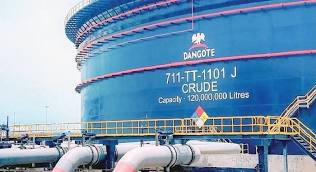
Africa’s richest man, Aliko Dangote, has announced plans to build a 650,000 barrels-per-day refinery in East Africa, mirroring the scale of his flagship facility in Nigeria, as part of a broader push to deepen industrial capacity across the continent.
Dangote made the disclosure at a high-level summit in Nairobi on Thursday, where African leaders, financiers, and industry stakeholders gathered to discuss the continent’s growing energy and infrastructure needs.
Addressing Presidents William Ruto and Yoweri Museveni, Dangote said the refinery project would depend on strong government backing and policy consistency.
“That’s why, as a group, we have now launched an initiative where, between now and 2030, we’re investing $40 billion in various fields,” he said
“Even now, I can give a commitment to the two presidents who are here that if they support the refinery, we will build an identical one to what we have in Nigeria—650,000 barrels.”
He emphasised that the proposal is still at an early stage but expressed confidence in its feasibility.
When asked about the feasibility of the project, the industrialist said it will “definitely” work, adding that “There’s nothing that can stop it.”
Push for Self-Sufficiency
Dangote is Africa’s richest man.
Dangote used the platform to argue that Africa must move away from its long-standing dependence on imports and instead build domestic industrial capacity.
“We export raw materials, which means when you export raw materials, you are exporting jobs, and when you import, you are importing poverty because you are creating jobs out there, not here on the continent,” he said.
He stressed that industrialisation—particularly in refining, fertiliser production and petrochemicals—is critical to reversing that trend and creating jobs on the continent.
The proposed East African refinery forms part of a wider $40 billion investment plan by his group between now and 2030, targeting key sectors that underpin economic transformation.
Backdrop of Growing Fuel Deficit
Dangote’s announcement comes as the Africa Finance Corporation (AFC) warned that the continent could face an 86 million tonne fuel shortfall by 2040.
According to the AFC report presented at the summit, Africa currently imports over 70 percent of its refined fuel and spends about $230 billion annually on essential imports, including fuel, food, and industrial goods.
The report projects that fuel import demand will rise from 74 million tonnes in 2023 to 86 million tonnes by 2040—equivalent to nearly three refineries the size of Dangote’s Lagos facility.
Leaders Call for Shift in Strategy
President William Ruto echoed Dangote’s position, warning that Africa must rethink its economic model.
“Our ambitions will remain unrealised if we continue to depend on external capital whose primary interest is securing raw materials,” Ruto said, adding: “We cannot continue to export raw materials and import finished products made from them.”
The summit also highlighted vulnerabilities in Africa’s energy systems, particularly exposure to global supply shocks and infrastructure gaps across the continent.
A Broader Industrial Vision
Beyond refining, Dangote pointed to ongoing efforts to scale fertiliser production and petrochemical capacity across Africa, including plans to expand urea output and establish blending plants in underserved regions.
“With the support of the government, there’s nothing that is impossible,” he said, expressing confidence that Africa can achieve self-sufficiency in key industrial inputs.
For Dangote, the refinery proposal represents a continuation of a larger vision—to reposition Africa from a net importer to a global industrial player.
“Let us not be scared… It is possible. Africans can do it,” he said.
As discussions continue, the proposed East Africa refinery could mark a significant step toward addressing the continent’s looming fuel deficit while advancing its long-term goal of economic independence.
The Federal Government of Nigeria has approved a sweeping increase in peculiar allowances and other welfare benefits for civil servants, in a move aimed at improving take-home pay and boosting morale across the public service.
The announcement was made on Friday by the Head of the Civil Service of the Federation, Didi Walson-Jack, during a press briefing in Abuja, where she outlined key reforms endorsed by the Federal Executive Council.
According to Walson-Jack, the review affects workers under both the Consolidated Public Service Salary Structure (CONPSS) and the Consolidated Research and Allied Institutions Salary Structure (CONRAISS), ensuring a broad-based impact across all cadres.
She said the revised peculiar allowances have been structured to reflect across all grade levels, resulting in a meaningful increase in earnings for both junior and senior officers.
In addition, the government approved an upward review of several key allowances, including duty tour allowance (DTA), estacode, and book allowance. Walson-Jack noted that virtually all allowances listed under the Public Service Rules have now been revised.
A major highlight of the reform is the approval of 100 percent Duty Tour Allowance for civil servants attending approved training programmes, regardless of whether travel is involved.
“Even if you are based in Abuja and attend training within Abuja, you are entitled to full DTA,” she said.
Beyond salary-related adjustments, the government also introduced a new exit benefit scheme for retiring civil servants under the Contributory Pension Scheme. The scheme provides 100 percent of a retiree’s total annual emoluments as an exit package, in addition to their pension, effective January 1, 2026.
Walson-Jack described the move as a step toward ensuring dignity in retirement, stressing that no public servant should leave service without adequate financial support.
The government also confirmed the operationalisation of the Employee Compensation Scheme, designed to provide financial protection for workers who suffer job-related injuries or death.
The reforms come amid growing calls from labour unions for improved welfare, as rising living costs continue to put pressure on workers. Analysts say the combined measures could significantly enhance financial stability for civil servants and improve overall productivity in the public sector.
Norway said Friday it will present a bill this year making it the latest country seeking to ban social networks for under 16s, adding that technology companies will be responsible for verifying the age of its users.
“We are introducing this legislation because we want a childhood where children get to be children. Play, friendships, and everyday life must not be taken over by algorithms and screens,” Prime Minister Jonas Gahr Store said in a statement.
“This is an important measure to safeguard children’s digital lives,” he added.
Several European countries, such as France, Spain, and Denmark have already said they will introduce a digital age of majority for social networks and others like Australia and Türkey have already done so.
The European Commission has also made clear its determination to take action to protect children and adolescents, notably by unveiling in mid-April an age-verification app that will soon be made available to European citizens.
“I expect technology companies to ensure that the age limit is respected. Children cannot be left with the responsibility for staying away from platforms they are not allowed to use,” added Norwegian Minister of Digitalisation and Public Governance Karianne Tung.
“That responsibility rests with the companies providing these services. They must implement effective age verification and comply with the law from day one”.
The government said the number of children with phones or using social media had declined due to a host of measures it had already taken, including “national screen-time guidelines and recommendations for mobile-free schools.”