
Health & Wellness
Tropical Storm Hits Philippine, 40 Dead, Towns Submerged


Philippine rescue workers battled floodwaters Friday to reach residents still trapped on the roofs of their homes as Tropical Storm Trami moved out to sea after killing at least 40 people.
Tens of thousands remained displaced after fleeing floods driven by a torrential downpour that dumped two months’ worth of rainfall in just two days in some areas.
“Many are still trapped on the roofs of their homes and asking for help,” Andre Dizon, police director for the hard-hit Bicol region. “We are hoping that the floods will subside today, since the rain has stopped.”

Accessibility remained a major issue for rescuers Friday, particularly in Bicol, President Ferdinand Marcos said at a press briefing.
“There were landslides in areas that didn’t have landslides before … so I guess the soil is completely saturated, the water has nowhere to go,” he said.
The cities of Naga and Legazpi were reporting “many casualties but we haven’t been able to get in yet,” Marcos added.
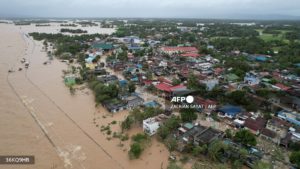
As Trami departed the Philippines in the early hours, traveling west over the South China Sea, the storm’s death toll swelled as fresh reports of victims emerged.
In Batangas province south of the capital Manila, police staff sergeant Nelson Cabuso told AFP six unidentified bodies had been found in Sampaloc village.
“The area was hit by a flash flood yesterday. Our people are still in the area to check if there are other casualties,” he said.

Another five people were killed in a flash flood in the coastal village of Subic Ilaya, police corporal Alvin de Leon said, pushing the toll to at least 40, according to an AFP tally from police and disaster officials.
While Manila was seemingly spared the heavy flooding that accompanied Typhoon Gaemi in July, AFP reporters saw a subdivision south of the capital largely submerged on Friday.

– ‘Two months’ worth of rain –
Government offices and schools across the main island of Luzon remained shuttered Friday, and storm surge warnings were still in place along the west coast, with potential waves as high as two metres.
State weather agency specialist Jofren Habaluyas told AFP that Batangas province had seen “two months’ worth of rain”, or 391.3 millimetres, fall over October 24 and 25.
An official tally late Thursday reported 193,000 people evacuated in the face of flooding that turned streets into rivers and half-buried some towns in sludge-like volcanic sediment set loose by the storm.
Many of those were in the Bicol region, where more than 30,000 fled Wednesday alone in the face of “unexpectedly high” flooding.

Rescuers in the region’s Naga city and Nabua municipality used boats to reach residents stranded on rooftops, many of whom sought assistance via Facebook posts.
In the Batangas town of Lemery, about 97 kilometres (60 miles) south of Manila, a hospital was forced to turn away patients as its wards and emergency rooms were flooded.
And the search for a missing fisherman whose boat sunk in the waters off Bulacan province west of Manila remained suspended on Friday due to strong currents, the local disaster office said.
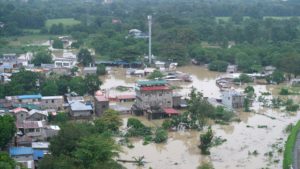
About 20 big storms and typhoons hit the Philippines or its surrounding waters each year, damaging homes and infrastructure and killing dozens of people.
But a recent study showed that storms in the Asia-Pacific region are increasingly forming closer to coastlines, intensifying more rapidly and lasting longer over land due to climate change.
AFP
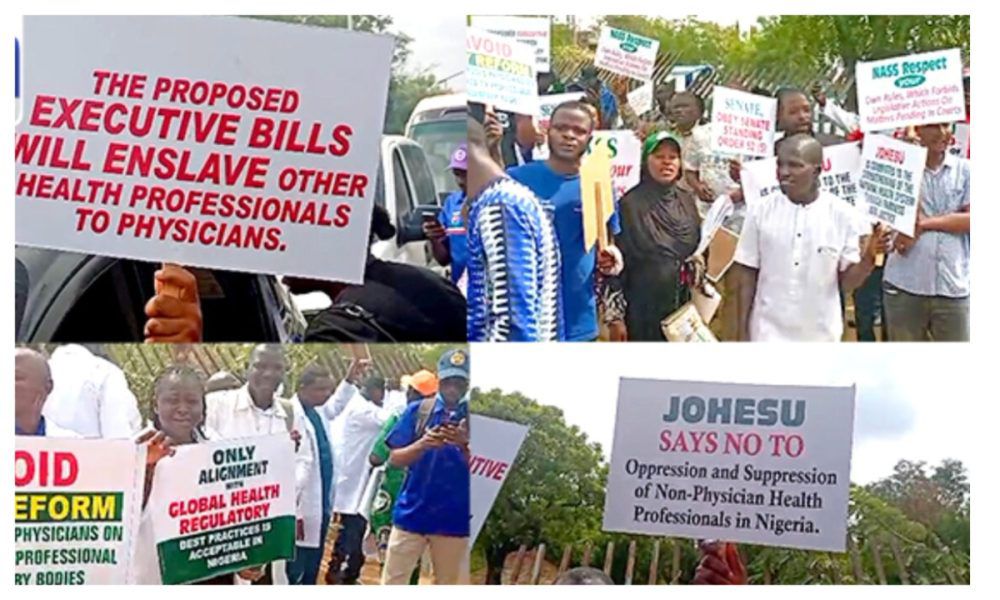
Health workers under the Joint Health Sector Unions and the Assembly of Healthcare Professional Associations are protesting at the Unity Fountain in Abuja.
The protest is against the proposed health sector regulatory bill, which is before the National Assembly.
The protesting health workers are against the bill, claiming that if allowed to pass, it would subject every medical profession to the regulation of the Medical and Dental Council of Nigeria.
They maintain that all health professions have their regulatory bodies, and that the new bill was seeking to make other health professionals second-class to medical doctors.
The protesters plan to also go to the National Assembly, where they hope to present their case to lawmakers.

Nigerian Association of Resident Doctors have issued a 10-day ultimatum to all relevant government agencies on Monday, warning that its members would embark on a nationwide strike if the demands were not met.
NARD disclosed this in a communiqué signed by its President, Dr. Tope Osundara; the General Secretary, Dr. Oluwasola Odunbaku; and Publicity and the Social Secretary, Omoha Amobi, issued after its Extraordinary National Executive Council meeting, which was held virtually on Sunday.
In July, NARD had issued a three-week ultimatum, but in the interest of industrial harmony, the NEC granted the National Officers’ Committee an additional three weeks to engage with all relevant stakeholders, after which it would reconvene to reassess the extent of implementation of its demands.
In Sunday’s meeting, the E-NEC condemned the failure of the Federal Government to fulfil its promises, noting with dismay that a substantial number of resident doctors remain unpaid for their 2025 Medical Residency Training Fund, and the refusal to pay the outstanding five months’ arrears arising from the 25 per cent/35 per cent Consolidated Medical Salary Structure review, as well as other longstanding salary arrears.
It also condemned the government’s failure to pay the arrears of the 2024 Accoutrement Allowance.
“The E-NEC expressed displeasure over the unjust downgrading of the membership certificates of the West African Colleges of Physicians and Surgeons by the Medical and Dental Council of Nigeria, as well as the persistent non-issuance of membership certificates by the National Postgraduate Medical College of Nigeria.
“The E-NEC condemned in strong terms the failure of the Kaduna State Government to honour its commitments to members under ARD Kaduna and Barau Dikko Teaching Hospital, despite earlier agreements and signed Memoranda of Understanding. The E-NEC condemned the failure of the Oyo State Government to address the challenges faced by members of ARD LAUTECH Teaching Hospital, Ogbomosho, despite an ongoing indefinite strike action in the hospital,” it noted.
It, however, commended state governors who have demonstrated commitment to the welfare of doctors by paying the 2025 MRTF.
Meanwhile, the doctors said that if their demands are not met by September 10, 2025, they would embark on a nationwide strike.
E-NEC, however, demands the immediate payment of the outstanding 2025 MRTF to all eligible resident doctors by the Federal Government, as well as the settlement of the outstanding five months’ arrears of CONMESS, alongside other longstanding salary arrears.
The Council also demands, “The immediate payment of the arrears of the 2024 Accoutrement Allowance. The E-NEC demands the commencement of payment of specialist allowances to all doctors without further delay, given their indispensable role in delivering specialist medical care across the nation. The E-NEC demands that the MDCN immediately restore the recognition of the West African postgraduate membership certificates to their rightful status and calls on the NPMCN to commence without delay the issuance of membership certificates to all deserving candidates, in line with international best practices.
“The E-NEC demands the immediate implementation of the 2024 CONMESS and resolution of all outstanding welfare concerns in Kaduna State, noting that the indefinite strike by our members has already resumed and will continue until these demands are met. The E-NEC demands that the Governor of Oyo State, His Excellency Governor Seyi Makinde, immediately resolve the welfare concerns of resident doctors under the employment of the state government, particularly those at LAUTECH Teaching Hospital, Ogbomosho.
“The E-NEC urges all State Governors to prioritise the welfare of doctors in their state-owned hospitals and training institutions, ensure the timely payment of MRTF to their resident doctors, and take proactive steps to curb emigration while maintaining industrial harmony.
“The E-NEC extends the ultimatum by a final 10 days to all relevant government agencies to meet these demands. Failure to do so within this period (expiring on Wednesday, 10th September 2025) will leave the NEC with no other option than to embark on a nationwide strike action.”

President Bola Tinubu has authorized a reduction in the cost of kidney dialysis at federal hospitals nationwide, lowering the fee from ₦50,000 to ₦12,000.
The Special Adviser to the President on Policy Information, Daniel Bwala, disclosed this on his X handle on Monday.
He noted that “with this intervention, the price of each dialysis session has been reduced from N50,000 to just N12,000, bringing relief to thousands of citizens battling kidney-related diseases.”
According to Bwala, the subsidy is already being implemented in major federal hospitals across the six geopolitical zones.
The hospitals include the Federal Medical Centre (FMC), Ebute-Metta, Lagos; Federal Medical Centre (FMC), Jabi, Abuja; University College Hospital (UCH), Ibadan; and the Federal Medical Centre (FMC), Owerri.
Others are the University of Maiduguri Teaching Hospital (UMTH), Maiduguri; the Federal Medical Centre (FMC), Abeokuta; Lagos University Teaching Hospital (LUTH), Lagos; Federal Medical Centre (FMC), Azare; University of Benin Teaching Hospital (UBTH), Benin; and the University of Calabar Teaching Hospital (UCTH), Calabar.
He disclosed that more federal medical centres and teaching hospitals will be added before the end of the year to widen access nationwide.
Bwala recalled how Tinubu also approved free caesarean sections (C-sections) for pregnant women in federal hospitals, a bold step aimed at boosting maternal healthcare and reducing preventable maternal deaths.
“Together, these measures demonstrate the President’s Renewed Hope Agenda in action—ensuring that no Nigerian is denied healthcare because of cost,” he said.
-
 News3 years ago
2023 Elections: Outgoing Rwandan High Commissioner say s Nigeria, ‘ handle their destiny’ in a peaceful way.
-
 News3 years ago
Just In: President Tinubu returns to Nigeria
-
 Entertainment3 years ago
Social media cloth Vendor Found Dead In Ibadan Hotel.
-
 News3 years ago
Ogun HoS Solicit Affordable Housing For Civil Servants
-
 Entertainment3 years ago
9mobile Ambassadors Begin “Meet And Greet” Session With Staffs, Customers.
-
 Trending News3 years ago
FG begins 40% pay rise for workers.
-
Sports3 years ago
CAF SALUTES RIVERS UNITED AFTER SEALING QUARTER-FINAL TICKET.
-
 Health & Wellness3 years ago
Breastfed babies have lower risks of diabetes – Nutritionist