Connect with us

Business

China Slaps 125% Tariffs On US Goods

Published

on

Spread the love
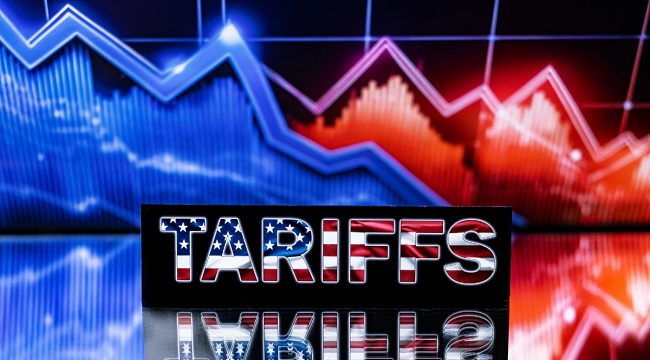
This illustration photograph shows a screen displaying a stock market index graphs and the word “Tariffs” written in the colours of the US flag, in Paris on April 4, 2025. Markets extended a global selloff on April 4, 2025 as countries around the world reeled from US President’s trade war, but the White House insisted the American economy will emerge victorious. (Photo by JOEL SAGET / AFP)

China said Friday it would raise tariffs on US goods to 125 percent but would ignore further levies by President Donald Trump because it no longer makes economic sense for importers to buy from America.

After a week of market mayhem as the world’s two largest economies took turns to put up trade barriers, Beijing dismissed Trump’s mounting brinkmanship as a “joke” and a “numbers game”.

China accused Trump of unleashing turbulence in the market with the sweeping tariffs that has hit the world, and said the United States “should bear full responsibility” for the chaos.

Trump has deployed sweeping tariffs, including painfully higher levies for dozens of major economies, as a stick to force manufacturers to base themselves in the United States and for countries to lower barriers to US goods.

But following market turmoil this week, he blinked first in his push to remodel the post-war system of global commerce and froze many tariffs for 90 days, although he raised them for China to a staggering total of 145 percent.

Beijing’s latest round of retaliation brings its levies to 125 percent, effective Saturday.

But the Chinese finance ministry said further action by the US will be ignored because “at the current tariff level, there is no possibility of market acceptance for US goods exported to China”.

“The United States’ imposition of round upon round of abnormally high tariffs on China has become a numbers game with no practical significance in economics,” Beijing’s commerce ministry said.

“If the US continues to play the tariff numbers game, China will ignore it,” a spokesperson said.

Beijing also said it would file a lawsuit with the World Trade Organization over the latest round of levies.

‘Beautiful Thing’
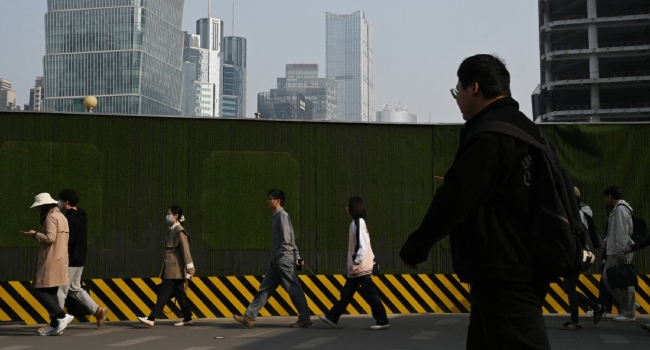
Trump has acknowledged “a transition cost and transition problems” arising from his tariff strategy, but he has dismissed global market turmoil.

“In the end it’s going to be a beautiful thing,” he said.

He described the European Union as “very smart” to refrain from retaliatory levies.

“(The EU) were ready to announce retaliation. And then they heard about what we did with respect to China’,” Trump said.

But the 27-nation bloc’s chief Ursula von der Leyen told the Financial Times that it remained armed with a “wide range of countermeasures” if negotiations with Trump hit the skids.

“An example is you could put a levy on the advertising revenues of digital services” applying across the bloc, she said.

French President Emmanuel Macron also urged the EU to keep preparing action to counter the tariffs, which are only paused but not scrapped.

“With the European Commission, we must show ourselves as strong: Europe must continue to work on all the necessary counter-measures,” he said on X.

At talks with Spain’s Prime Minister Pedro Sanchez on Friday, state media quoted Xi as saying that China and the EU should simply team up on the issue.

“China and Europe should fulfil their international responsibilities… and jointly resist unilateral bullying practices,” Xi said.

This, he stressed, would not only “safeguard their own legitimate rights and interests, but also… safeguard international fairness and justice.”

 ‘No winners’
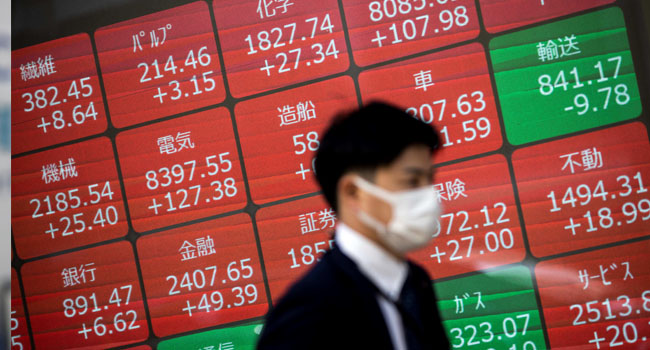
A pedestrian walks past an electronic board displaying share prices on the Tokyo Stock Exchange in Tokyo on November 4, 2020, as Asian markets react to early predictions following the US presidential election. Behrouz MEHRI / AFP

After new falls on Wall Street, Asian markets were under pressure again on Friday.

Tokyo sank more than four percent — a day after surging more than nine percent — while Sydney, Seoul, Singapore and others also sagged.

European markets also retreated on China’s latest salvo.

Oil and the dollar slid on fears of a global slowdown while gold hit a new record above $3,200, as investors spooked by Trump’s erratic policies dumped normally rock-solid US Treasuries.

“The sugar high from Trump’s tariff pause is fading fast,” said Stephen Innes at SPI Asset Management.

“Bottom line: the world’s two largest economies are in a full-blown trade war — and there are no winners.”


 ‘Golden Age’
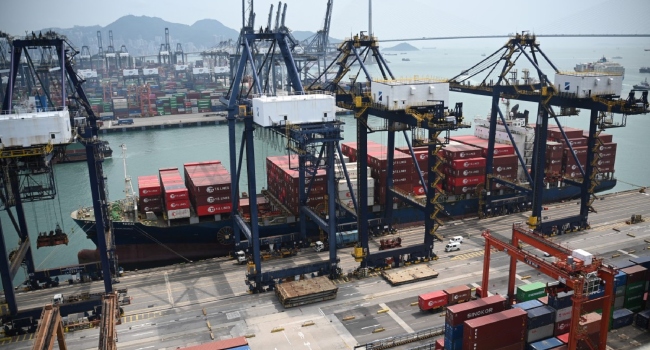
Critics of Trump’s policies say they are causing chaos for companies that rely on complex supply chains, alienating close allies and making goods more expensive for US consumers.

But Howard Lutnick, his commerce secretary, posted on social media Thursday that “the Golden Age is coming. We are committed to protecting our interests, engaging in global negotiations and exploding our economy.”

Trump has meanwhile warned that the tariffs could come back after the 90 days.

“If we can’t make the deal we want to make… then we’d go back to where we were,” he said.

Canadian Prime Minister Mark Carney called Trump’s reversal a “welcome reprieve” and said Ottawa would begin negotiations with Washington on a new economic deal after elections on April 28.

Vietnam said it had agreed with the United States to start trade talks, while Pakistan is sending a delegation to Washington.

As China battles to find allies against Trump’s trade war, Xi will travel next week to Vietnam, Malaysia and Cambodia, where the tariff drama is expected to feature high on the agenda.



AFP

Business

Food Prices May Drop By Next Harvest – Farmers

Published

on

Spread the love


The All Farmers Association of Nigeria (AFAN) says food prices may decline by the next harvest season if governments improve security and reduce production costs for farmers.


The Deputy Chairman of AFAN, Lagos State Chapter, Mr Shakin Agbayewa, said this in an interview with the News Agency of Nigeria (NAN) on Tuesday in Lagos

Agbayewa said staple foods such as rice, yam, cassava and Garri would become more affordable if farmers could cultivate safely and access farm inputs at lower costs.

According to him, insecurity, high fertiliser prices, rising fuel costs and expensive farm operations are the major drivers of current food inflation.

“The government must be intentional and deliberate.

“Input costs are high. Fertiliser is expensive, while tractor operations cost more because of rising fuel prices. All these affect production,” he said.

Agbayewa said the high cost of cultivation, transportation and security was ultimately passed on to consumers.

He urged governments at all levels to support farmers with subsidised inputs, improved rural roads, irrigation facilities and affordable credit.

He also called for stronger collaboration with farmers’ associations to identify practical solutions tailored to the needs of each state.

According to him, increased agricultural production in the coming farming season will naturally ease pressure on market prices.

Agbayewa said Nigeria has sufficient land and manpower to feed itself if the right policies are implemented.

He added that supporting farmers remains the most sustainable path to lower food prices and economic stability.

Continue Reading

Business

Breweries Revenue Growing Despite Economic Hardship

Published

on

Spread the love


Against the backdrop of rising costs of living and declining purchasing power, brewing companies have recorded sharp rise in revenues.


Filings by the companies to Nigeria Exchange Limited, NGX, indicate that leading brewers, Nigerian Breweries Plc, Guinness Nigeria Plc, International Breweries Plc, and Champion Breweries Plc recorded combined revenue of over N2.8 trillion from the sale of mainly beer and spirits, in addition to their non-alcoholic beverages in the year ended December 31, 2025, up from N1.89 trillion recorded in the corresponding period of 2024, representing an increase of 48.1%.

Analysts noted that the figure underscores the scale of beer and other alcoholic beverage consumption in Nigeria despite prevailing economic pressures.

According to the financial statements of the four major brewers profit was even more impressive with Profit Before Tax (PBT) rising 117.2 percent to N317.213 billion, up from N146.050 billion in 2024.

Meanwhile, the growth rate in revenue and profit were far higher than their cost of doing business despite the inflationary pressures in the economy.

The companies’ cost of sales rose 36.5% to N1.8 trillion from N1.3trillion, while administrative expenses rose by 17.6%, to N639.8billion from N544.04 billion.

Revenue generated

Nigerian Breweries Plc, the largest brewer, recorded revenue of N1.467 trillion for the period, up from N1.084 trillion in the corresponding period of 2024, indicating a 35.3% increase.

Guinness Nigeria followed as the second-largest revenue generator in absolute terms, posting N730.808 billion, up by 144.0% from N299.489 billion in 2024. International Breweries ranked third, posting N620.149 billion, up by 26.8% from N488.955 billion in 2024, while Champion Breweries recorded the least revenue of N29.797 billion, up by 42.6% from N20.890 billion in 2024.

Profit Before Tax

A breakdown of industry profit shows that Nigerian Breweries also topped the chart in absolute terms, posting N161.062 billion, though down by 11.9% from N182.917 billion in 2024.

Trailing Nigerian Breweries is International Breweries, which recorded N85.108 billion, improving from a loss of N111.820 billion in 2024.

Guinness Nigeria ranked third with N68.392 billion, declining by 7.2% from N73.679 billion in 2024, while Champion Breweries recorded N2.651 billion, up from N1.274 billion, representing a 108.1% increase.

Cost of sales/Operating expenses

Breakdown of cost of sales shows that Nigerian Breweries recorded the highest in absolute terms at N902.239 billion, compared to N764.520 billion in 2024.

Guinness Nigeria followed with N500.326 billion against N208.031 billion in 2024; International Breweries recorded N415.707 billion from N357.605 billion, while Champion Breweries posted N14.427 billion from N12.172 billion.

Similarly, operating and administrative expenses showed that Nigerian Breweries rose by 44.7% to N361.782 billion from N249.993 billion. Guinness increased by 104.2% to N141.496 billion from N69.288 billion. International Breweries recorded N131.649 billion, down from N222.428 billion in 2024, representing a 40.8% decline, while Champion Breweries rose to N4.829 billion from N2.328 billion, up by 107.4%.

Continue Reading

Business

Poor Service: FG Goes Tough On MTN, Airtel, Glo

Published

on

Spread the love


The Federal Government has warned telecom operators to improve service quality or face regulatory sanctions, saying recent reforms have stabilised the sector and removed excuses for poor network performance.

Minister of Communications, Innovation and Digital Economy, Dr Bosun Tijani, issued the warning in a statement on Sunday, emphasising that Nigeria’s connectivity gaps were largely structural, driven by years of underinvestment and constraints on operators.

Tijani said the government had tackled the problem through long-term infrastructure planning and immediate sector-stabilisation measures aimed at restoring sustainability and investor confidence.

He said the long-term reforms are focused on expanding infrastructure through new fibre deployment and tower rollout initiatives designed to close critical gaps in Nigeria’s digital backbone.

The minister noted that funding has been secured with support from the World Bank for Project BRIDGE, alongside additional investments in satellite capacity to boost nationwide coverage.

He added that these interventions are expected to transform connectivity over the next two to five years, enabling businesses and households to access reliable high-speed internet beyond unstable mobile connections.

“When we assumed office, it was clear that Nigeria’s connectivity challenges were structural, driven by years of underinvestment in infrastructure and constraints that limited the ability of operators to deliver quality service.

“We have addressed this on two fronts. First, the long-term structural solution. We have secured funding, led by the World Bank, and established the framework for a special purpose vehicle with Project BRIDGE, to deliver nationwide open access fibre infrastructure. Deployment of fibre will commence, alongside new tower rollouts through NUCAP, before the end of the year even as we also expand our satellite capability.

“These investments will address the foundational gaps in our digital infrastructure over the next two to five years and permanently transform connectivity across Nigeria,” he said.

Speaking on immediate interventions, Tijani said that government has stabilised the sector through tariff adjustments, the designation of telecom infrastructure as critical national infrastructure, tax harmonisation efforts, and broader macroeconomic reforms.

According to him, the reforms have restored operator profitability and created a more transparent and market-driven environment, giving telcos the capacity to invest in network improvements.

“It is now the responsibility of telecom operators such as MTN Nigeria, Airtel Nigeria, Globacom, and T2 to take all necessary steps to resolve network challenges and deliver the level of service Nigerians expect,” the minister insisted.

Tijani stressed that the Nigerian Communications Commission (NCC) has been fully empowered to monitor performance, enforce standards, and ensure compliance, with sanctions expected for defaulting operators.

He said Nigerians should begin to see measurable improvements in call quality, data speed and network coverage, adding that the government will continue to rely on regulatory reports and user feedback to hold operators accountable and ensure consumers receive value for money.

Continue Reading

Trending

Copyright © 2026 TheColumn NG