Connect with us

International News

Russia, US Swap Prisoners In Push For Closer Ties

Published

on

Spread the love
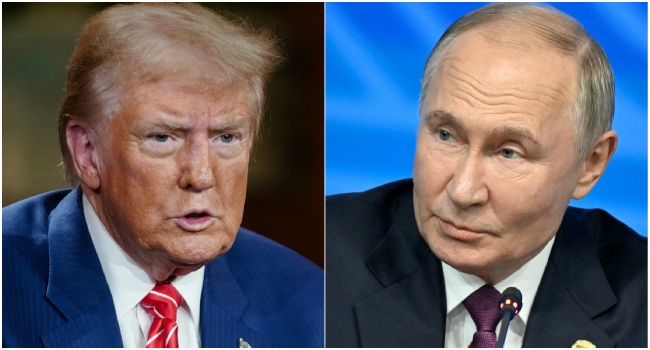
FILE: US President Donald Trump and his Russian counterpart, Vladimir Putin. AFP


A Los Angeles-based ballet dancer released by Russia as part of a prisoner swap landed safely in the United States Thursday night, the second swap under President Donald Trump as Moscow and Washington push to rebuild ties.

Ksenia Karelina, a US-Russian dual national convicted in Russia of “treason” over a one-time donation worth around $50 to a pro-Ukraine charity, landed at Joint Base Andrews just before 11:00 pm local time Thursday (0300 GMT).

Karelina descended the stairs of the jet plane where she was greeted by several loved ones — including her boyfriend, South African boxer Chris van Heerden — who applauded and shouted “welcome home!” before embracing her.
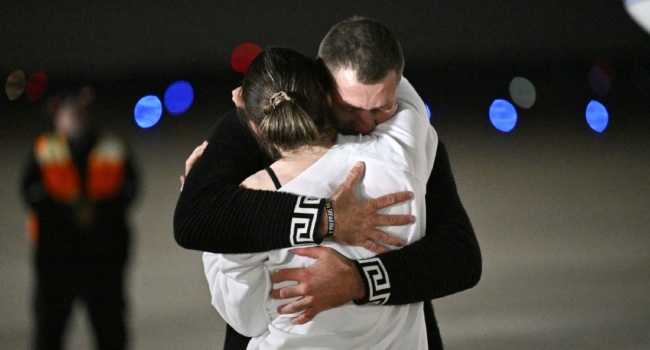
 

TOPSHOT – US-Russian ballerina Ksenia Karelina and her boyfriend South African boxer Chris van Heerden embrace as she arrives at Joint Base Andrews in Maryland, following her release from Russia on April 10, 2025. (Photo by ROBERTO SCHMIDT / AFP)

In return, Washington freed Arthur Petrov, a Russian-German national accused of illegally exporting US-made electronics to manufacturers supplying the Russian military.

The exchange took place at an airport in Abu Dhabi, where a dozen people wearing suits were present, video posted by Russia’s FSB security service showed.

Trump has sought to reset ties with Moscow since taking office, after Russia’s invasion of Ukraine three years ago plunged bilateral relations to their lowest point since the Cold War.

Trump said Karelina’s case was brought to his attention by the president of the UFC mixed martial arts league and that the United States then asked Russian President Vladimir Putin to free her.

“She is now out, and that was good. So we appreciate that,” Trump told reporters at a cabinet meeting.

“We hope that we’re going to be able to make a deal relatively soon with Russia and Ukraine to stop the fighting. It’s so senseless,” Trump said.

The FSB video showed Petrov seated on a plane after he was freed, telling an unseen interviewer that he had not slept for two days but otherwise had no complaints.

Petrov, arrested in Cyprus in 2023 and extradited to the United States, was facing 20 years in a US jail.
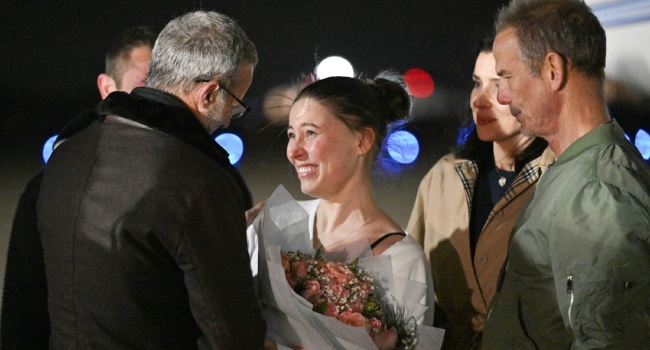
US director Peter Berg (R) watches US-Russian ballerina Ksenia Karelina greet friends as she arrives at Joint Base Andrews in Maryland, following her release from Russia on April 10, 2025. (Photo by ROBERTO SCHMIDT / AFP)

‘Positive’ step

CIA Director John Ratcliffe was the key negotiator with Russian intelligence and foreign partners, the CIA said.

Ratcliffe in a statement thanked the UAE “for enabling this exchange.”

“Other Americans remain wrongfully detained in Russia,” a CIA spokesperson said.

“We see this exchange as a positive step and will continue to work for their release.”

The State Department said that the United States has raised the particular case of Stephen Hubbard, an English teacher living in eastern Ukraine who was taken away by Russian troops during the invasion and accused of being a mercenary.

“We continue to work to free Mr. Hubbard and all other Americans unjustly detained,” State Department spokeswoman Tammy Bruce told reporters.

As the prisoner swap took place, US and Russian delegations were meeting in Istanbul on restoring embassy staffing levels after years of diplomat expulsions.

The State Department said after the meeting that Washington renewed concern about Moscow’s prohibition of its citizens working at US missions in Russia.

The two sides also moved to formalize an agreement on banking access for their diplomats, despite the US sanctions on Russia, the State Department said.
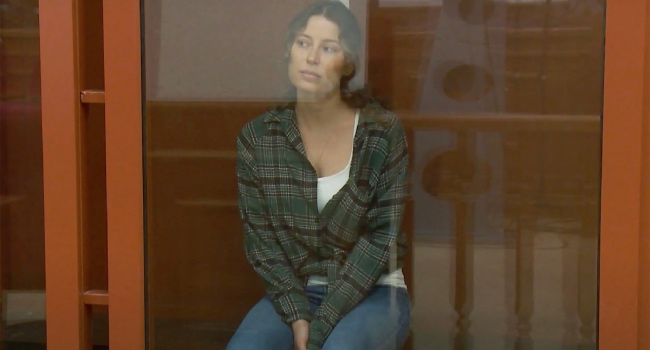
(FILES) This grab from a handout footage taken and released by Sverdlovsk regional Court press service on June 20, 2024, shows US-Russian citizen Ksenia Karelina sitting in a cage at The Sverdlovsk Regional Court in Yekaterinburg. (Photo by HANDOUT / Sverdlovsk regional Court press / AFP)


Prisoner swaps

Karelina, 33, was serving a 12-year prison sentence for having donated around $50 to a pro-Ukraine charity.

She was arrested in the Russian city of Yekaterinburg in January 2024 while on a trip to visit her family and charged with “treason.”

Russia’s Federal Security Service accused her of contributing to “equipment, weapons and ammunition” for Ukraine’s army — charges she denied. Her supporters say she donated to a US-based organization that delivers humanitarian aid to Ukraine.

Petrov was accused by US authorities of illegally exporting electronic components to Russia for military use, in violation of Washington’s sanctions against Moscow over the Ukraine war.
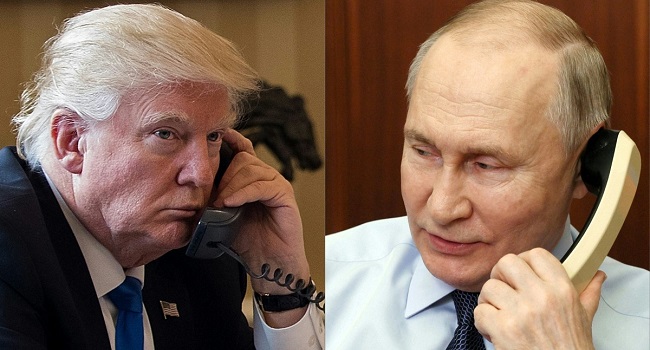
(COMBO) This combination of pictures created on March 18, 2025 shows President Donald Trump (L) on the phone on January 28, 2017 in Washington, and Russia’s President Vladimir Putin (R) on the phone Moscow on December 27, 2023. (Photo by Drew ANGERER and Gavriil GRIGOROV / various sources / AFP)


In mid-February, following a call between Putin and Trump, Russia released Kalob Wayne Byers, a 28-year-old US citizen arrested at a Moscow airport for transporting cannabis gummy sweets.

Washington and Moscow also exchanged US teacher Marc Fogel for Russian computer expert Alexander Vinnik in early February.

The largest US-Russia prisoner exchange since the end of the Cold War took place on August 1, 2024. It involved the release of journalists, including WSJ reporter Evan Gershkovich, and dissidents held in Russia in exchange for alleged Russian spies held in the West.


AFP

International News

Students On Rampage In France Set Fire To Schools, Hundreds Arrested

Published

on

Spread the love


French students have set fire to school entrances and blocked education facilities across the country as protests over teacher shortages, overcrowded classrooms and deteriorating school buildings escalated into violent clashes on Thursday, October 1.

The fires broke out at two high schools in Nantes, western France, while another blaze was recorded at a school in Rouen.

The demonstrations, which began last week, have spread to hundreds of secondary schools and at least 30 universities, with students demanding more teachers, better facilities and improved learning conditions.

In Nantes, a fire at Nelson Mandela High School spread from a burning rubbish bin to the front of the building, damaging the entrance hall.

Another school in the city was also affected by a fire, while footage showed flames at the entrance of a school in Rouen.

The unrest was also reported in Marseille, where staff at Victor Hugo High School were splashed with petrol as protesters reportedly carried containers.

At Saint-Exupery High School, protesters set fire to a fire truck, according to Reuters.

A headteacher at Degrugillier High School in Auchel was also injured in the ear by a firework during the unrest, while authorities reported clashes and arrests in several locations.

French Prime Minister Sébastien Lecornu held a crisis meeting on Thursday following the escalation.

The government later described parts of the demonstrations as having descended into what it called “urban violence.”

French authorities said hundreds of people had been arrested as the protests spread. Interior Minister Laurent Nuñez said 625 people had been detained, while 83 police officers and gendarmes were injured. Education Minister Édouard Geffray said 119 people, including students and school staff, had been injured.

The protests have centred on complaints about shortages of teachers and supervisors, overcrowded classrooms and poorly maintained school buildings. Students have also raised concerns about inadequate facilities, including classrooms, toilets and canteens.

Seventeen-year-old Raphael, who joined a protest in Strasbourg, said that some rooms at his school had leaks and that the institution lacked enough toilets. He also complained about a small cafeteria, limited resources and insufficient supervisors.

The demonstrations have now extended beyond secondary schools, with university students joining the action.

At least 30 universities have reportedly been blocked, including campuses in Paris and Rennes.

Public transport has also been disrupted in parts of the country. Services in Marseille and Strasbourg were halted on Thursday following incidents involving vandalism, threats of violence and attempts to prevent protesters from moving between locations.

The protests have also become a political issue, with government figures and politicians on the right blaming groups associated with the French left for encouraging the unrest

Leaders on the left have rejected responsibility for the violence while arguing that the concerns raised by students over education and public services should be addressed.

National Rally leader Marine Le Pen accused members of La France Insoumise of overseeing the unrest and called for a new anti-rioting law.

La France Insoumise leader Jean-Luc Mélenchon, meanwhile, said he supported non-violent demonstrations and argued that blaming the political left would not resolve the problems behind the protests.

Marseille Mayor Benoît Payan condemned the violence in the city but said young people had legitimate concerns about their future and public services. Nice Mayor Eric Ciotti separately called for parents of young people found responsible for damaging school property to pay for repairs.

The protests began last week and expanded rapidly amid wider public-sector demonstrations over government spending plans. More than 350 high schools had been affected as of Wednesday, with the unrest occurring alongside a broader strike by public-sector workers.

French authorities are now facing pressure to restore order while responding to students’ complaints about staffing and school conditions.

Education Minister, Édouard Geffray, is expected to meet student and union representatives as the government considers measures to prevent further disruption to schools.

Continue Reading

International News

Plane Makes Emergency Landing As Pilots Fight In Cockpit

Published

on

Spread the love


A Flydubai passenger plane travelling from Dubai to Tel Aviv made an emergency landing in Saudi Arabia after its two pilots reportedly got into a physical fight in the cockpit.


The Boeing 737, operating as Flight FZ1073, was diverted to Tabuk in northwestern Saudi Arabia after transmitting emergency signals.

The aircraft first sent a general emergency signal before transmitting another indicating possible unlawful interference.

The signal triggered a security alert in Israel, with fighter jets reportedly scrambled over fears that the plane had been hijacked.

However, an Israeli official told Reuters that the signals were sent after the pilots became involved in a physical altercation.

The aircraft later landed safely at Tabuk airport.

Flydubai confirmed that an incident occurred and said all passengers were safe and accounted for.

Flight-tracking data showed the plane made a sharp descent before diverting to Saudi Arabia.

Passengers reportedly heard shouting from the cockpit, while Israeli media reported that one of the pilots may have been injured.

The circumstances surrounding the confrontation remain under investigation.

The aircraft was carrying about 150 passengers and was operating a regular Flydubai service between Dubai and Tel Aviv.

Israeli authorities said the situation was under control and arrangements were being made to return the passengers to Israel.

Continue Reading

International News

Fatima El Mansouri Becomes Morocco’s First Female Prime Minister

Published

on

Spread the love


Member of the collective leadership of Morocco’s Authenticity and Modernity Party (PAM), Fatima Ezzahra El Mansouri, who is also Morocco’s Minister of National Planning, Urban Planning, Housing and Urban Policy and Mayor of Marrakesh has been named the country’s Prime Minister. She becomes the first female to be so named.


El Mansouri was elected as Morocco’s prime minister after her party won the most seats in the parliamentary elections held in the North African country.

King Mohammed VI named El Mansouri as the country’s prime minister on Tuesday and tasked her with forming a new government, the Royal Palace said in a statement.

Morocco is a constitutional monarchy, but the king retains significant powers. Under the constitution, the king appoints the head of government from the political party that wins the most seats in the house of representatives.

The 50-year-old attorney was previously the mayor of Marrakech before her appointment as prime minister. She is the second woman to serve as prime minister in the Arab world, after Tunisia’s Najla Bouden.

Fouzi Lekjaa, president of the Royal Moroccan Football Federation and a key figure in the king’s aligned Authenticity and Modernity Party (AMP), was El Mansouri’s strongest contender.

El Mansouri’s government will oversee the final stages of a $20-billion push to prepare Morocco for the 2030 World Cup, which the country will co-host with Portugal and ‌Spain.

She will also be tasked with implementing economic policies aimed at addressing widespread youth discontent, an issue highlighted by a mass border rush on the Spanish enclave of Ceuta in July and deadly Gen-Z-led protests last year.

Continue Reading

Trending

Copyright © 2026 TheColumn NG