
News
APC in Rivers is ready to work with Fubara, says APC Chairman


The APC said collaborating with the governor will not stop the main opposition in the state from holding Fubara accountable on issues of governance.
The state APC Chairman, Chief Tony Okocha, made the declaration during a news briefing in Port Harcourt, Rivers State capital, on Tuesday.
Okocha assured all that the APC would continue to consolidate on its membership base while also offering constructive criticism of the Fubara administration after his return.
He said, “The governor who was suspended will return to office on September 18. The APC will work with him when he returns.
“There are states where the governor and assembly members are in different parties, so we are going to work with him.
“However, that will not take away our right to criticise him when he does wrong. But for us, the LG chairmen will work with him, except that we will not agree to vicious policies.”
Okocha described the just-concluded local government elections in the state as an introduction to the 2027 general elections, noting that the APC deliberately chose not to field candidates in strongholds of the Peoples Democratic Party but concentrated on areas where it had a comparative advantage.
“The Rivers State LG election is a prelude to what will happen in 2027.
“Whilst we were campaigning, I told our people that there is a need for us to believe in the centre and leave the periphery.
“We did not field candidates in Obio/Akpor, Port Harcourt City, and Ogba/Egbema/Ndoni LGAs because we do not have the strength in those areas.
“It was our own calculated strategy not to field candidates in those LGAs and concentrate only where we have a comparative advantage. Remember that Rivers State was a PDP state,” Okocha explained.
He expressed optimism about the party’s growing influence, contrasting its position in the 2023 elections with its current status.
“In 2023, APC in Rivers State had no shoes. Now we are wearing psychedelic shoes.
“We are going to double and redouble our membership for the President. As far as my party is concerned, we will be fielding him for a second term in 2027,” he said.
Okocha took a swipe at the PDP, saying the party was collapsing and its members were defecting in droves to the APC, which he said now calls the shots.
He stressed, “PDP is in tatters and people are leaving them in droves for other parties, and we’re privileged to have them.
“We’ll continue our pleas for the PDP members, particularly the FCT Minister, to come over to the APC and have peace. The PDP is in tatters.”
Recall that Fubara was suspended from office by President Bola Tinubu on March 18, after he declared a state of emergency in Rivers State following rising political tensions in the state.
Tinubu had based his action on the attack on oil facilities in the state by militants who were allegedly sympathetic to the governor, accusing Fubara of not doing anything to stop the threats to cause mayhem.
The President then appointed former Chief of Naval Staff, Vice Admiral Ibok-Ete Ibas (retd.) as Administrator of the state for an initial six-month period.
Last Saturday, while speaking to newsmen after casting his vote in the just concluded local government elections, the Minister of the Federal Capital Territory, Nyesom Wike, said that with the poll, the ‘coast’ was now clear for Fubara to be reinstated.
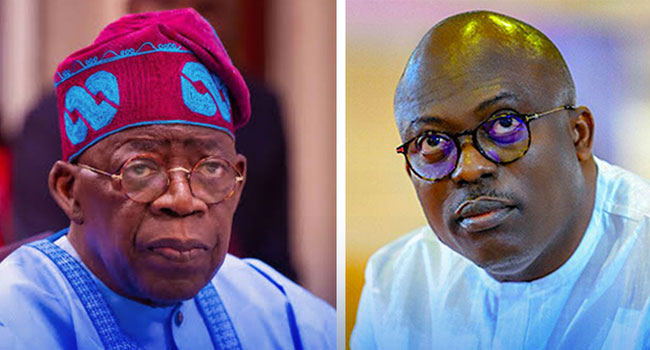

The Human Rights Writers Association of Nigeria (HURIWA) has alerted the public of what it described a coordinated campaign of calumny and deliberate misinformation being orchestrated by the handlers of the suspended Deputy Commissioner of Police, Abba Kyari currently facing trial for drug trafficking offences.
HURIWA made the claim in a statement issued on Wednesday.
The statement reads:
HURIWA wishes to alert the Nigerian public, and the international community to a coordinated campaign of calumny and deliberate misinformation being orchestrated by the handlers of the suspended Deputy Commissioner of Police, Abba Kyari currently facing trial for drug trafficking offences.
Following an in-depth investigation into recent sponsored reports circulating on social media, which claim that two convicted drug traffickers have indicted officers of the National Drug Law Enforcement Agency (NDLEA) of complicity in the case, HURIWA can authoritatively confirm that these reports are a total fabrication and a clumsy attempt to subvert the course of justice.
Our findings, backed by official court records and witness statements, reveal a starkly different reality from the narrative being pushed by Kyari’s camp. In their official witness statements, the convicted traffickers Chibunna Patrick Umeibe and Emeka Alphonsus Ezenwanne categorically denied any contact or collusion with NDLEA officers at the Enugu airport in January 2022.
The convicts confessed that their pictures and travel details were actually sent to Abba Kyari. Despite being on suspension at the time over another criminal case for which the United States government is still seeking his extradition to the US for trial, Kyari dispatched a team from Abuja to Enugu to intercept the traffickers for his own ends.
The convicts have stated on record that while in Kyari’s custody, they were forced under duress to indict the NDLEA. The “video confession” currently being circulated was scripted, with Kyari’s men actively dictating what the suspects should say while recording.
HURIWA reminds the public that no amount of digital spin can erase the overwhelming evidence already admitted as exhibits in court. The world has seen the video of Abba Kyari handing over $61,400 to an NDLEA undercover agent. This cash was established to be the proceeds from the sale of part of the cocaine Kyari’s team seized from the very same convicts they are now trying to use as pawns.
“It is pathetic that a high-ranking officer would resort to such low-level blackmail. This is a clear attempt to distract the public from the gravity of the drug trafficking charges. The U.S. government and the global community are watching this case closely. You cannot ‘spin’ your way out of a forensic sting operation.”
For the benefit of the public who they are struggling hard to confuse, the transcript of the conversation between Abba Kyari and an NDLEA undercover agent, already admitted as exhibit in court, clearly confirmed the transactional relationship and conspiracy between Kyari and members of the drug trafficking cartel. Here is a sampler from the conversation between Abba Kyari and NDLEA undercover agent:
ABBA KYARI: Yes, they (Cartel) will reveal to me those that are conveying it (the drugs), snap their pictures and send to us. So, we already know their goods, picture and the clothes they’re wearing, hope you understand, we know their names, they will give us everything. So, automatically the team will just be waiting, they will just see them and pick them up.
NDLEA UNDERCOVER AGENT: But are your boys inside the airport or outside?
ABBA KYARI: Yes, yes, some are outside while some are inside. They will just allow them to finish everything and arrest them the moment they come out.
This tallied with the witness statements by the two already convicted Kyari’s co-accused. In the words of one of them, Chibunna Patrick Umeibe: “I traveled to Ethiopia, Addis Ababa on 10th of January 2022, then I stayed in a lounge at the airport and somebody called me on phone whose name I can’t remember that Jekwu gave him my number that he supposed to give me some stuff which is cocaine. He met me at the lounge and gave me the stuff which is inside the nylon bag, then later snapped my picture. Then that was on the 18th of January 2022 (after staying 8 days in the airport) he asked me to dress the way I will travel back before he snapped the picture.
Then after snapping the picture he left. He knows the reason of snapping the picture, then on 19th of January I boarded to Nigeria. Immediately getting to the outside (Enugu international airport), a young man approached me and said that I should give him my international passport and I asked him what for? He bring out police ID card and showed me immediately and before I know, other police people some are on uniform while some are not on uniform, they surrounded me and pushed me and my brother inside a sienna car and zoomed off.”
There’s therefore no doubt from the court records that the pictures of the convicts were taken by the cartel members at the Addis Ababa airport and sent to Abba Kyari to enable him identify the couriers. This is the only reason his officers were able to pick only the two couriers out of the multitude of people at the airport’s car park.
HURIWA therefore calls on the Nigerian judiciary to remain undeterred by these subterranean moves to blackmail the prosecution. We urge the media to be professional and verify claims against official court transcripts before amplifying narratives that seek to shield alleged drug kingpins from accountability. The facts of the crime remain constant, no amount of sponsored falsehood will wish away the evidence of the $61,400 bribe or the documented betrayal of public trust.
Emmanuel Onwubiko
National Coordinator, Human Rights Writers Association of Nigeria (HURIWA)
March 25, 2026
Senator Iyabo Obasanjo has expressed support for the use of consensus in the selection of candidates for political offices by parties ahead of the 2027 general election.
Speaking on Channels Television’s Sunrise Daily on Thursday monitored by the column.ng, the daughter of former President Olusegun Obasanjo, who is eyeing the governorship ticket of the All Progressives Congress (APC) in Ogun State, said consensus brings out the right candidates.
She dismissed fears that consensus would produce unpopular candidates, noting that it does not mean party leaders will ignore the wishes of the people.
“I do believe that consensus can bring the right candidates because consensus does not mean that leadership ignores the will of the people; consensus means that they look at what the people are saying. No party wants to lose, so the party will not choose people that open them for a loss; does that make sense?” Obasanjo said.
“So, the consensus is going to come towards people that can actually win on the ground, if that makes sense, because at the end of the day, the party wants to win. So, they do not want to put the least popular person as the consensus candidate in a way that is going to aggravate the other participants and in a way that is going to discourage people that are popular from participating. So, I have full belief that consensus is the way to go.”
She expressed strong belief that the consensus system would be an advantage to her in the race for the Ogun APC governorship ticket, citing her popularity and past performances as a commissioner and senator.
According to the former Ogun Central senator, the good salaries she received as a senator were put into working for her people, which she believes is an edge in the governorship race.
In another appearance on Channels Television’s The Morning Brief earlier this month, Senator Iyabo Obasanjo expressed confidence in her chances ahead of the 2027 governorship race in Ogun State, saying she is a candidate to beat.
The 59-year-old politician, who recently defected from the Peoples Democratic Party to the All Progressives Congress (APC) ahead of the 2027 elections, said she is confident of receiving the votes of her parents, including her father, former President Olusegun Obasanjo.
“I am almost 60; I think that at this age, my friends who still have both parents alive are very few, so I consider myself lucky to have both my mother and my father alive.
“I don’t think at this age I should be consulting them for everything in my career move. What I have said is that my father, I know, and my mother will vote for me; that’s all that I can ask of them. Even if I don’t ask, they will vote for me; that I can guarantee,” she said.
The new Electoral Act made changes to the modes of candidate selection for political parties. With the new Act, only direct primary and consensus are the options for political parties to choose their candidates, while the indirect primary option has been removed.
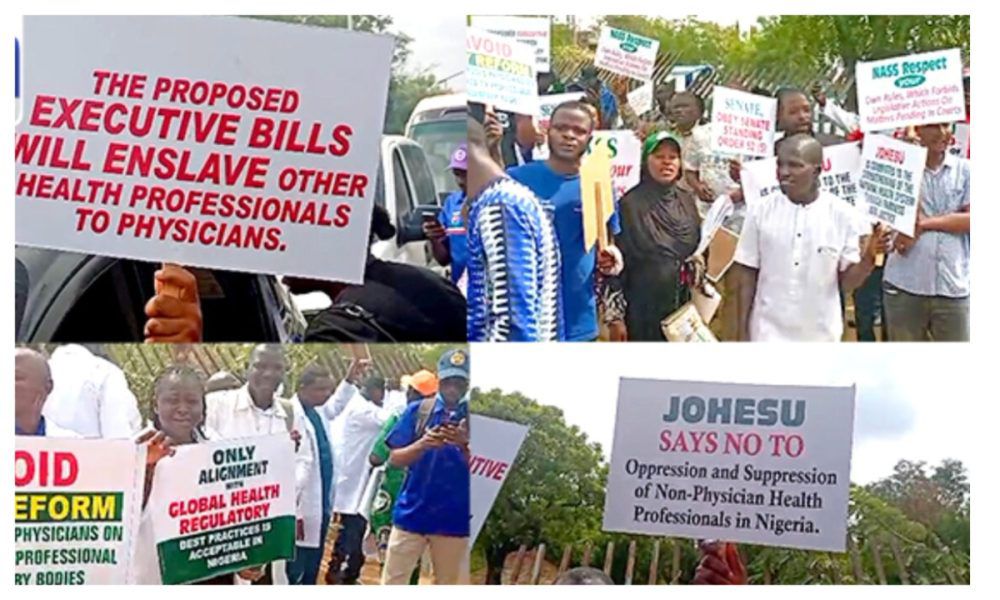
Health workers under the Joint Health Sector Unions and the Assembly of Healthcare Professional Associations are protesting at the Unity Fountain in Abuja.
The protest is against the proposed health sector regulatory bill, which is before the National Assembly.
The protesting health workers are against the bill, claiming that if allowed to pass, it would subject every medical profession to the regulation of the Medical and Dental Council of Nigeria.
They maintain that all health professions have their regulatory bodies, and that the new bill was seeking to make other health professionals second-class to medical doctors.
The protesters plan to also go to the National Assembly, where they hope to present their case to lawmakers.
-
 News3 years ago
2023 Elections: Outgoing Rwandan High Commissioner say s Nigeria, ‘ handle their destiny’ in a peaceful way.
-
 News3 years ago
Just In: President Tinubu returns to Nigeria
-
 Entertainment3 years ago
Social media cloth Vendor Found Dead In Ibadan Hotel.
-
 News3 years ago
Ogun HoS Solicit Affordable Housing For Civil Servants
-
 Entertainment3 years ago
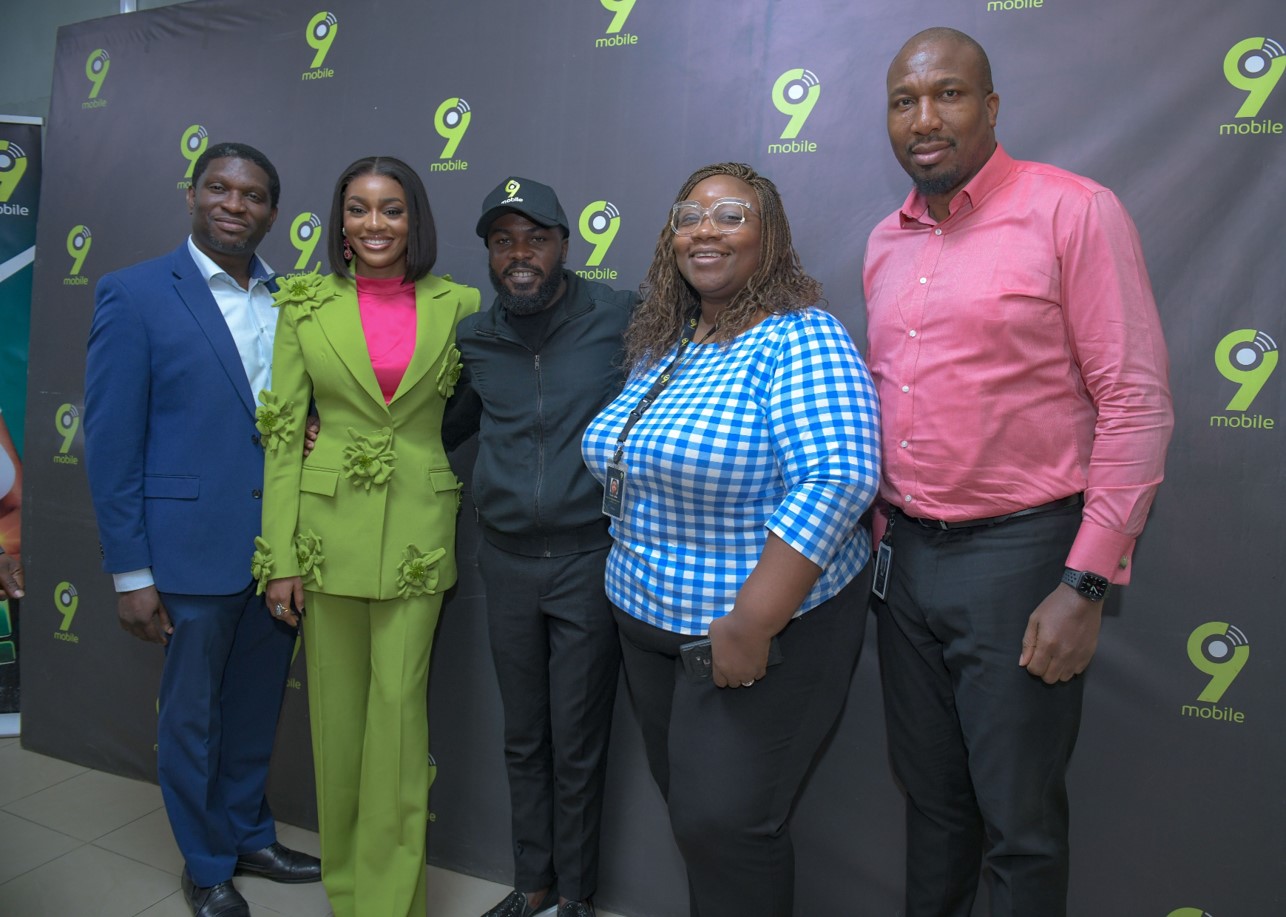
9mobile Ambassadors Begin “Meet And Greet” Session With Staffs, Customers.
-
 Trending News3 years ago
FG begins 40% pay rise for workers.
-
Sports3 years ago
CAF SALUTES RIVERS UNITED AFTER SEALING QUARTER-FINAL TICKET.
-
 Health & Wellness3 years ago
Breastfed babies have lower risks of diabetes – Nutritionist