Connect with us

International News

Israel Vows To Put ‘National Interest’ First In Response To Iran Attack

Published

on

Spread the love
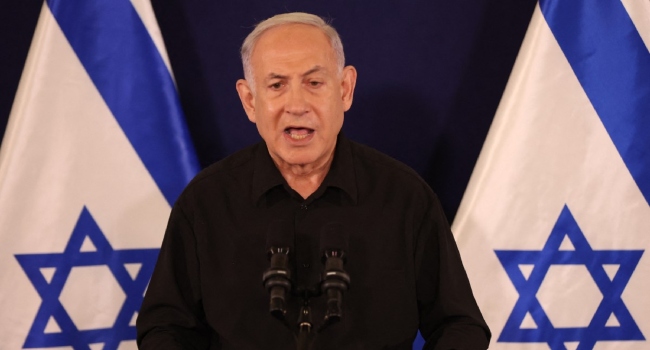
Benjamin Netanyahu
(FILES) Israeli Prime Minister Benjamin Netanyahu (Photo by Abir SULTAN / POOL / AFP)

Prime Minister Benjamin Netanyahu’s office said Tuesday that Israel — and not the United States — will decide how it will strike back after Iran fired around 200 missiles at his country earlier this month.


The comments came as a top Iranian commander, whose absence sparked rumours that he could have been killed in an Israeli strike, appeared in public for the first time in weeks.


Israel and the Iran-backed group Hezbollah also exchanged fire as fighting raged in Lebanon, while humanitarian groups sounded the alarm about a dire humanitarian crisis in the Gaza Strip.


On October 1, Iran launched a volley of about 200 missiles at Israel in response to an Israeli strike in Lebanon’s capital Beirut that killed Hezbollah leader Hassan Nasrallah and Iranian general Abbas Nilforoushan.


Israel has vowed to respond to the attack. Biden — whose government is Israel’s top arms supplier — has warned against striking Iran’s nuclear or oil facilities in order to avoid broader war.
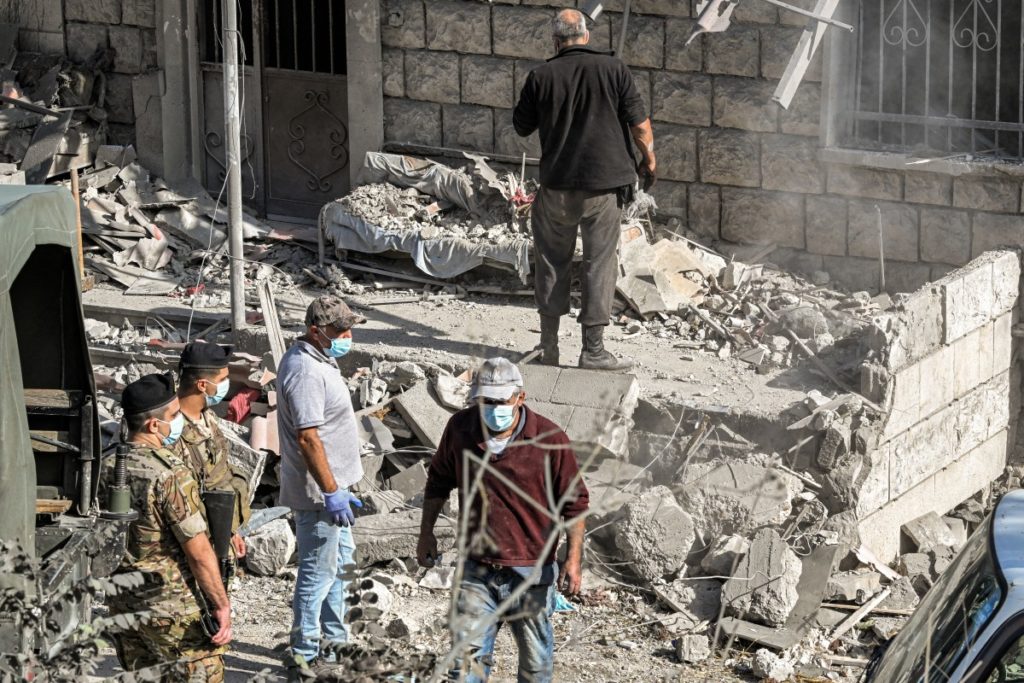
Lebanese army soldiers stand by as people clear debris and rubble from the site of a previous Israeli air strike on the village of Aito in northern Lebanon on October 15, 2024. (Photo by JOSEPH EID / AFP)

According to a Washington Post report on Monday citing unnamed US officials, Netanyahu reassured the White House that Israel was only contemplating targeting military sites.


A statement from Netanyahu’s office on Tuesday took a different tone.

“We listen to the opinions of the United States, but we will make our final decisions based on our national interest,” the statement said.


Also on Tuesday, Esmail Qaani, the head of Iran’s powerful Quds Force, attended the funeral for Nilforoushan, dispelling rumours he had been killed.


Israel and Hezbollah exchange fire

Israel’s military launched several strikes on eastern Lebanon on Tuesday, a day after Netanyahu vowed to “mercilessly strike Hezbollah in all parts of Lebanon –- including Beirut”.


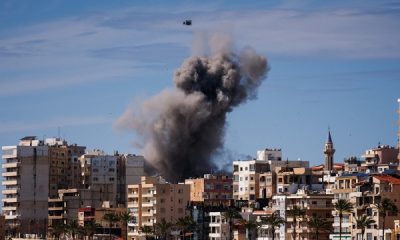
Multiple Israeli air strikes hit the eastern Bekaa Valley, putting a hospital in Baalbek city out of service, Lebanon’s official National News Agency (NNA) reported.


“It was a violent night in Baalbek, we have not witnessed a similar one since” the 2006 war between Israel and Lebanon, 50-year-old resident Nidal al-Solh told AFP.


Israeli strikes have targeted Hezbollah strongholds as well as other parts of Lebanon, including a northern Christian-majority village where at least 21 people were killed on Monday, according to the health ministry.

Excavators clear debris and rubble of a destroyed building at the site of a previous Israeli air strike on the village of Aito in northern Lebanon on October 15, 2024. (Photo by JOSEPH EID / AFP)

Anis Abla, civil defence chief in the southern border town of Marjayoun, said that “our rescue missions are becoming more and more difficult, because the strikes are never-ending and target us”.

At least 1,315 people have been killed in Lebanon since Israel last month escalated its bombing there, according to an AFP tally of Lebanese health ministry figures, though the real toll is likely higher.

The war in Lebanon has displaced at least 690,000 people, according to verified figures last week from the International Organization for Migration.

UNICEF and the World Food Programme on Tuesday called for more funding to address “increasing” needs in Lebanon.

‘Entirely unjustified’

Israel says it wants to push back Hezbollah in order to secure its northern boundary and allow tens of thousands of people displaced by rocket fire since last year to return home safely.

Hezbollah claimed several attacks early Tuesday, including targeting Israeli troops in northern Israel with a salvo of rockets.

It also said it downed an Israeli Hermes 450 drone overnight, without specifying where.

Fighters from Hezbollah also clashed with Israeli troops in a Lebanese border village, and sent rockets towards the northern Israeli town of Kiryat Shmona, the group said.

Hezbollah says its strikes are also in support of Palestinian militants Hamas who attacked Israel on October 7 last year, triggering the ongoing war with Israel in the Gaza Strip.

Israel has faced new criticism over injuries and damage sustained by UNIFIL, the United Nations peacekeeping force which has been deployed in Lebanon since 1978, after a previous Israeli invasion.

Italian Prime Minister Giorgia Meloni, whose country is the second-biggest contributor of UNIFIL peacekeepers, lashed out at the Israeli attacks. The attitude of the Israeli forces was “entirely unjustified,” she told the Italian Senate.

Men stand by an excavator near a destroyed vehicle at the site of a previous Israeli air strike on the village of Aito in northern Lebanon on October 15, 2024. (Photo by JOSEPH EID / AFP)

The UN Security Council for the first time on Monday expressed “strong concerns” over peacekeepers being wounded in Lebanon.

UNIFIL has refused Netanyahu’s request for peacekeepers to “get out of harm’s way”, with UN peacekeeping chief Jean-Pierre Lacroix saying the blue helmets will stay in their positions.

‘Unimaginable fear’ in Gaza

While deploying troops into Lebanon, Israel has kept up its bombardment of Gaza where it has been at war since the Hamas attack on southern Israel.

That attack resulted in the deaths of 1,206 people, mostly civilians, according to an AFP tally of official Israeli figures, including hostages killed in captivity.

Israel’s retaliatory military campaign in Gaza has killed 42,344 people, the majority civilians, according to the health ministry in the Hamas-run territory. The UN has described the figures as reliable.

At a school-turned-shelter hit by an Israeli strike in the central Nuseirat camp, Fatima al-Azab said “there is no safety anywhere” in Gaza.

“They are all children, sleeping in the covers, all burned and cut up,” she said.

In northern Gaza, the Israeli military announced it had effectively laid siege to the Jabalia area as it seeks to rout out Hamas fighters.

The International Committee for the Red Cross warned that “northern Gaza families are facing unimaginable fear, loss of loved ones, confusion, and exhaustion”.

“People must be able to flee safely,” the ICRC’s Adrian Zimmerman said.



AFP

International News

Trump: I Am Not A Big Fan Of Pope Leo, He Is Weak On Crime

Published

on

Spread the love

US President Donald Trump says he is “not a big fan” of Pope Leo XIV, after the global leader of Catholics made a plea for peace amid the war in the Middle East.


The 70-year-old American pope publicly implored leaders on Saturday to end the violence, telling worshippers at St Peter’s Basilica: “Enough of the idolatry of self and money! Enough of the display of power! Enough of war!”

“I’m not a big fan of Pope Leo. He’s a very liberal person, and he’s a man that doesn’t believe in stopping crime,” Trump told reporters at Joint Base Andrews in Maryland.

He accused the pontiff of “toying with a country that wants a nuclear weapon.”

Trump later doubled down on his comments to reporters with a post on Truth Social, saying: “I don’t want a Pope who thinks it’s OK for Iran to have a Nuclear Weapon.”

“Pope Leo is WEAK on Crime, and terrible for Foreign Policy,” he said.

The president added that Leo had only been elected “because he was an American, and they thought that would be the best way to deal with President Donald J. Trump.”

“If I wasn’t in the White House, Leo wouldn’t be in the Vatican.”

Trump later posted an AI-generated image seemingly depicting himself as Jesus Christ.

In the image, the president appears dressed in red and white robes as he cures a man with his healing hand. The American flag is shown over his shoulder.

Trump and the White House have previously shared AI-generated images, including one that showed the president dressed as the pope.

On Friday, a Vatican official denied reports that a top Pentagon official gave the church’s envoy to the United States a “bitter lecture” over Pope Leo’s criticisms of the Trump administration.

The story in the Free Press — which the Pentagon had already dismissed as “distorted” — reported that Cardinal Christophe Pierre was summoned in January to the Pentagon, where he was given a dressing-down by US Under Secretary of Defense for Policy Elbridge Colby.

The military official reportedly told the cardinal that the United States “has the military power to do whatever it wants — and that the Church had better take its side.”

Vatican spokesman Matteo Bruni said in a statement “the account presented by certain media outlets regarding this meeting does not correspond to the truth in any way.”

While both parties insist the meeting was cordial, the Holy See and the White House have openly been at odds over the Trump administration’s hardline mass deportation campaign — which the pope called “inhuman” — and the use of military force in the Middle East and Venezuela.

When Trump made genocidal threats against Iran Tuesday — saying “A whole civilization will die tonight, never to be brought back again” — the pontiff slammed the “truly unacceptable” statement and urged parties to “come back to the table” for negotiations.

Earlier this month, Pope Leo hailed the news of a ceasefire between the United States and Iran as a “sign of real hope.”

But peace talks between the United States and Iran, held in the Pakistani capital Islamabad, ended abruptly and without a resolution on Saturday, with US Vice President JD Vance telling reporters after a marathon-session of talks that Washington has delivered its “final and best offer.”

Continue Reading

International News

Guardiola Explains Reason Behind Man City’s Resurgence

Published

on

Spread the love

Pep Guardiola has explained the reason for Manchester City’s resurgence as they push for the Premier League title.


The win lifts City to 64 points from 31 games, cutting the deficit to leaders Arsenal—who have 70 points from 32 matches—to just six points, ramping up the title race in the closing stages of the campaign.

Asked why Manchester City have been in such fine form in the final stages of the season, Pep Guardiola joked: “The sun! If it had been shining in November, we’d have been league champions by January… No, I’m joking, of course. In Manchester, the sun doesn’t shine very often.”

Looking ahead to next Sunday’s 32nd-round clash with Arsenal in the Premier League, he added: “That game will feel like a final for both teams, but there is a tactical detail we need to review, so we may make some adjustments.

“Everyone is talking about the Arsenal game, but matches against Brentford, Bournemouth and the other sides are just as important. The season is still long.”

Guardiola added “We’re in better shape, and in training everyone knows exactly what they have to do. We’ve faced three strong opponents, three Champions League teams. We didn’t put in a complete performance for the full 90 minutes, but we were organised enough, didn’t concede many chances, and our attacking threat was always there.”

Pep Guardiola

He added:One of our secrets as a club and a system is that, after one success after another, we have remained humble and have always asked ourselves: what must we do to stay at the top? Winning once or twice is normal, but to remain at the top for nine years—with the exception of last season—reflects the strength of the entire system.”

Continue Reading

International News

Artemis II Nears Pacific Splashdown Finale

Published

on

Spread the love

Their dramatic grand finale fast approaching, Artemis II’s astronauts aimed for a splashdown in the Pacific on Friday to close out humanity’s first voyage to the moon in more than half a century.

The tension in Mission Control mounted as the miles melted away between the four returning astronauts and Earth.

All eyes were on the capsule’s life-protecting heat shield that has to withstand thousands of degrees during reentry. On the only other test flight of the spacecraft — in 2022, with no one on board — the shield’s charred exterior came back looking as pockmarked as the moon.

Commander Reid Wiseman, pilot Victor Glover, Christina Koch, and Canada’s Jeremy Hansen were on track to hit the atmosphere traveling Mach 32 — or 32 times the speed of sound — a blistering blur not seen since NASA’s Apollo moonshots of the 1960s and 1970s.

This screen grab from NASA’s feed released on April 3, 2026, shows the four Artemis II crew members (L-R) Canadian Space Agency (CSA) astronaut Jeremy Hansen, Artemis II mission specialist, NASA astronauts Reid Wiseman, Artemis II commander, Christina Koch, Artemis II mission specialist and Victor Glover, Artemis II pilot as they head to orbit the Moon for the first time in more than half a century. Photo by HANDOUT / NASA TV / AFP

They didn’t plan on taking manual control except in an emergency. Their Orion capsule, dubbed Integrity, is completely self-flying.

Like so many others, lead flight director Jeff Radigan anticipated feeling some of that “irrational fear that is human nature,” especially during the six minutes of communication blackout preceding the opening of the parachutes. The recovery ship USS John P. Murtha awaited the crew’s arrival, along with a squadron of military planes and helicopters.

The last time NASA and the Defense Department teamed up for a lunar crew’s reentry was Apollo 17 in 1972. Artemis II was projected to come screaming back at 34,965 feet (10,657 meters) per second — or 23,840 mph (38,367 kph) — not a record but still mind-bogglingly fast before slowing to a 19 mph (30 kph) splashdown.


Artemis II’s record flyby and lunar views

\

This handout picture provided by NASA shows Earth as seen through the Orion spacecraft’s window, photographed by NASA astronaut Reid Wiseman, commander of Artemis II, on April 2, 2026, after completing the translunar injection burn. (Photo by Reid Wiseman/NASA / NASA / AFP)

Launched from Florida on April 1, the astronauts racked up one win after another as they deftly navigated NASA’s long-awaited lunar comeback, the first major step in establishing a sustainable moon base.

Artemis II didn’t land on the moon or even orbit it. But it broke Apollo 13’s distance record, making Wiseman and his crew the farthest that humans have ever journeyed from Earth when they reached 252,756 miles (406,771 kilometers). Then, in the mission’s most heart-tugging scene, the teary astronauts asked permission to name a pair of craters after their moonship and Wiseman’s late wife, Carroll.

During the record-breaking flyby, they documented scenes of the lunar far side never seen before by the naked eye and savored a total solar eclipse courtesy of the cosmos thanks to their launch date. The eclipse, in particular, “just blew all of us away,” Glover said.

This handout picture by an Artemis II crew member provided by NASA shows Artemis II mission specialist Christina Koch looking back at earth through the window of the Orion spacecraft on April 2, 2026. (Photo by Handout / NASA / AFP)

Their sense of wonder and love awed everyone, as did their breathtaking pictures of the moon and Earth. The Artemis II crew channeled Apollo 8’s first lunar explorers with Earthset, showing our blue marble setting behind the gray moon. It was reminiscent of Apollo 8’s famous Earthrise shot from 1968.

“It just makes you want to continue to go back,” Radigan said on the eve of splashdown. “It’s the first of many trips, and we just need to continue on because there’s so much” more to learn about the moon.

Their moonshot drew global attention as well as star power, earning props from President Donald Trump; Canadian Prime Minister Mark Carney; Britain’s King Charles III; Ryan Gosling, star of the latest space flick “Project Hail Mary;” Scarlett Johansson of the Marvel Cinematic Universe; and even Captain Kirk himself, William Shatner of TV’s original “Star Trek.”

Artemis II was a test flight for future moon missions

A view through a window of the Orion spacecraft mockup on April 7, 2026 at Johnson Space Center in Houston, Texas.  (Photo by RONALDO SCHEMIDT / AFP)


Despite its rich scientific yield, the nearly 10-day flight was not without technical issues. Both the capsule’s drinking water and propellant systems were hit with valve problems. In perhaps the most high-profile predicament, toilet trouble prevented the crew from using it for No. 1 most of the trip, forcing them to resort to old-time bags and funnels.

The astronauts shrugged it all off.

“We can’t explore deeper unless we are doing a few things that are inconvenient,” Koch said, “unless we’re making a few sacrifices, unless we’re taking a few risks, and those things are all worth it.”

Added Hansen: “You do a lot of testing on the ground, but your final test is when you get this hardware to space, and it’s a doozy.”

A journalist looks at the Orion spacecraft mockup on April 7, 2026 at Johnson Space Center in Houston, Texas. Photo by RONALDO SCHEMIDT / AFP


Under the revamped Artemis program, next year’s Artemis III will see astronauts practice docking their capsule with a lunar lander or two in orbit around Earth. Artemis IV will attempt to land a crew of two near the moon’s south pole in 2028.

The Artemis II crew’s allegiance was to those next Artemis crews, Wiseman said.

“But we really hoped in our soul is that we could for just for a moment have the world pause and remember that this is a beautiful planet and a very special place in our universe, and we should all cherish what we have been gifted,” he said.

Continue Reading

Trending

Copyright © 2026 TheColumn NG