Connect with us

International News

South Korea Court Ousts Impeached President Yoon

Published

on

Spread the love
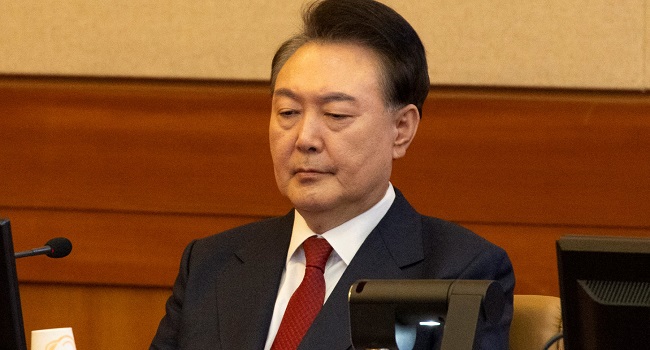
(FILES) South Korea’s impeached President Yoon Suk Yeol attends a hearing of his impeachment trial at the Constitutional Court in Seoul on February 13, 2025. (Photo by JEON HEON-KYUN / POOL / AFP)


South Korea’s top court on Friday unanimously ruled to remove impeached president Yoon Suk Yeol from office over his disastrous martial law declaration, triggering fresh elections after months of political turmoil.

Yoon, 64, was suspended by lawmakers over his December 3 attempt to subvert civilian rule, which saw armed soldiers deployed to parliament. He was also arrested on insurrection charges as part of a separate criminal case.

Millions of Koreans watched the Constitutional Court hand down its verdict live on television, with the country’s main messaging app KakaoTalk telling AFP that some users were experiencing delays due to a sudden surge in traffic.
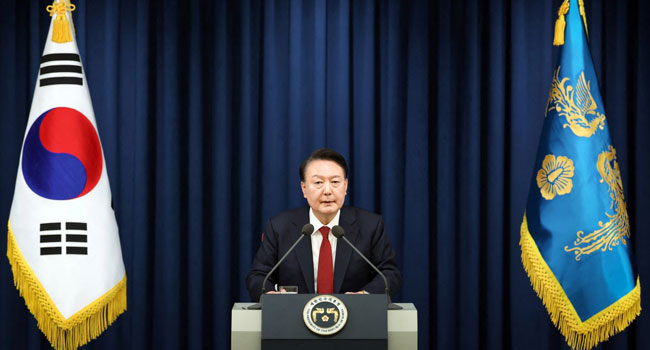
FILE: South Korean President Yoon Suk Yeol delivers a speech to declare martial law in Seoul. (Photo by Handout / South Korean Presidential Office / AFP)

“Given the serious negative impact and far-reaching consequences of the respondent’s constitutional violations… (We) dismiss respondent President Yoon Suk Yeol,” acting court President Moon Hyung-bae said while delivering the ruling.

Yoon’s removal, which is effective immediately, triggers fresh presidential elections, which must be held within 60 days. Authorities will announce a date in the coming days.

Outside the court, AFP reporters heard Yoon supporters shouting threats that they wanted to kill the judges, who decided unanimously to uphold Yoon’s impeachment, and have been given additional security protection by police.

Yoon’s actions “violate the core principles of the rule of law and democratic governance”, the judges said in their ruling.

Yoon sending armed soldiers to parliament in a bid to prevent lawmakers from voting down his decree “violated the political neutrality of the armed forces”.

He deployed troops for “political purposes”, the judges added.

“In the end, the respondent’s unconstitutional and illegal acts are a betrayal of the people’s trust and constitute a serious violation of the law that cannot be tolerated,” they ruled.

Opposition party lawmakers clapped their hands as the verdict was announced, calling it “historic”, while lawmakers from Yoon’s party filed out of the courtroom.

Yoon apologised for failing to meet the people’s “expections” in a brief statement released after the verdict.
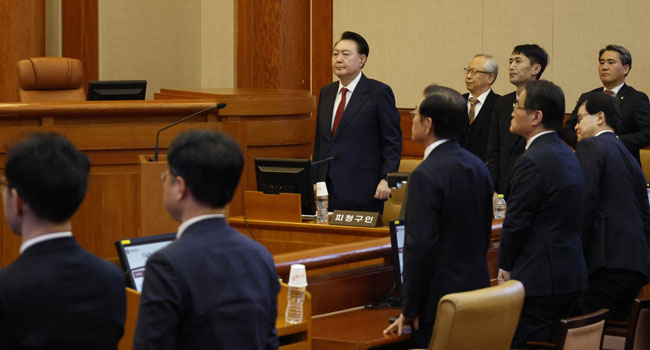
(FILES) South Korea’s impeached president Yoon Suk Yeol (C) stands as he attends the fourth hearing of his impeachment trial over his short-lived imposition of martial law at the Constitutional Court in Seoul on January 23, 2025. (Photo by JEON HEON-KYUN / POOL / AFP)

Impeached

Yoon is the second South Korean leader to be impeached by the court after Park Geun-hye in 2017.

After weeks of tense hearings, judges spent more than a month deliberating the case, while public unrest swelled.

Police raised the security alert to the highest possible level on Friday. Officers encircled the courthouse with a ring of vehicles and stationed special operations teams in the vicinity.

Anti-Yoon protesters gathered outdoors to watch a live broadcast of the verdict, cheering and holding hands. When Yoon’s removal was announced, they erupted into wild cheers, with some bursting into tears.

“When the dismissal was finally declared, the cheers were so loud it felt like the rally was being swept away,” Kim Min-ji, a 25-year-old anti-Yoon protester, told AFP.

“We cried tears and shouted that we, the citizens, had won!”

Yoon, who defended his attempt to subvert civilian rule as necessary to root out “anti-state forces”, still commands the backing of extreme supporters.
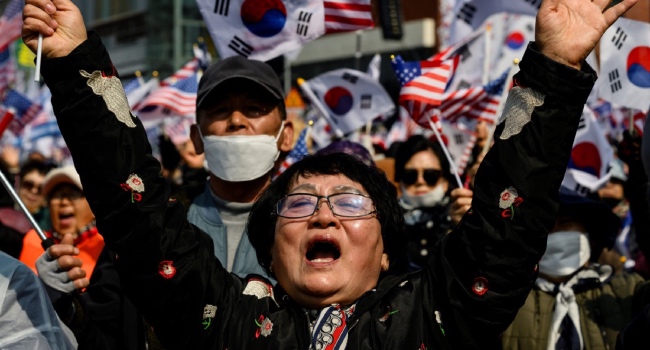
TOPSHOT – Supporters of South Korea president Yoon Suk Yeol react prior to the announcement of the Constitutional Court’s verdict on Yoon’s impeachment outside the presidential residence in Seoul on April 4, 2025. (Photo by ANTHONY WALLACE / AFP)


Outside his residence, his supporters shouted and swore, with some bursting into tears as the verdict was announced.

This year, at least two staunch Yoon supporters have died after self-immolating in protest of the leader’s impeachment.

The decision shows “first and foremost the resilience of South Korean democracy”, Byunghwan Son, professor at George Mason University, told AFP.

“The very fact that the system did not collapse suggests that the Korean democracy can survive even the worst challenge against it — a coup attempt.”

Portraits of Yoon will be taken down from military offices Friday, Yonhap reported. According to defence ministry regulations, a photo of the country’s commander-in-chief must be displayed at their offices.
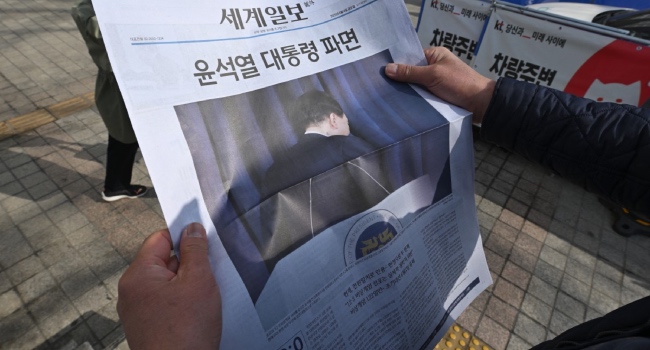
A man looks at an extra edition newspaper in downtown Seoul on April 4, 2025, after the Constitutional Court upheld the impeachment of South Korean President Yoon Suk Yeol. (Photo by Jung Yeon-je / AFP)

Trade winds

The Korean won jumped sharply against the US dollar immediately after the court announced Yoon’s dismissal, with Seoul’s benchmark KOSPI up 8.62 points, or 0.35 percent.

South Korea has spent the four months since the martial law declaration without an effective head of state, as the opposition impeached Yoon’s stand-in — only for him to be later reinstated by a court ruling.

The leadership vacuum came during a series of crises and headwinds, including an aviation disaster and the deadliest wildfires in the country’s history.

This week, South Korea was slammed with 25 percent tariffs on exports to key ally the United States after President Donald Trump unveiled global, so-called reciprocal levies.

After the court decision on Friday, National Assembly speaker Woo Won-shik said “we have reaffirmed that no one in the Republic of Korea can be above the law”.

“We have made clear the principle that any power that commits unconstitutional or illegal acts must be held accountable,” Woo said.

Yoon also faces a separate criminal trial on charges of insurrection over the martial law bid.

Acting president Han Duck-soo will remain at the helm until the new elections are held.


AFP

International News

Nigeria Missing As Saudi Arabia Names African Countries Eligible For eVisa

Published

on

Spread the love


Saudi Arabia has updated its tourist eVisa programme for 2026, limiting eligibility in Africa to only three countries as part of its list of 66 nations whose citizens can apply through the Kingdom’s online visa platform.


The move leaves most African countries, including Nigeria, outside the simplified entry scheme.

The electronic visa allows eligible travellers to visit Saudi Arabia for tourism, leisure activities, family visits and Umrah, excluding the annual Hajj pilgrimage. Applications are completed online, eliminating the need for embassy visits and lengthy visa processing.

Saudi authorities said the eVisa forms part of ongoing efforts to expand tourism, attract international visitors and simplify travel procedures through a fully digital application system. The visa is available only to citizens of approved countries and territories listed on the Kingdom’s official tourism portal.

Below is the list of African countries eligible for Saudi Arabia’s eVisa.

1. Mauritius

2. Seychelles

3. South Africa

Continue Reading

International News

South Africa Says Over 53,000 Deported In Migration Campaign

Published

on

Spread the love


The South African government says more than 53,000 foreign nationals have been deported or repatriated since launching a “migration management” campaign five weeks ago.

Most were from Malawi, Zimbabwe, and Mozambique, officials say, and the number is likely to rise as repatriations and deportations continue.

South Africa is carrying out one of its biggest crackdowns on undocumented migrants in years, following weeks of anti-immigration protests that have seen violence, intimidation and looting.

Protesters have been demanding tighter border controls and mass deportations, accusing migrants of contributing to high unemployment, rising crime rates and collapse of public services.

The UN has warned against using migrants as scapegoats for South Africa’s socioeconomic challenges.

Anti-migrant activists have threatened to stage weekly protests to pressure the government until their demands are met, and there are fears the protests could turn violent.

The demonstrators had set an “unofficial deadline” of 30 June for all undocumented migrants to leave the country, which has seen many foreigners leave to escape violence and intimidation.

Several countries, including Ghana, Nigeria, Uganda and Kenya, have flown their citizens home in recent weeks.

Justice and Constitutional Development Minister Mmamoloko Kubayi announced on Sunday that 53,499 foreign nationals have been processed for deportation and repatriation, “which is dominated by the Malawians, followed by Zimbabweans and Mozambicans”.

“We are striving to achieve an orderly and regular migration which is mindful and sensitive to the concerns raised by our people, while observing human rights and dignity of all people in our country, irrespective of their citizenship and immigration status,” Kubayi told a news conference in Pretoria.

She said the repatriation and deportation process has helped them catch people who were wanted by the police for alleged criminal activity.

Authorities will continue to enforce its immigration laws, she added, but warned that protesters should not conduct unauthorised searches of homes and businesses that are suspected of sheltering undocumented migrants.

South Africa’s President Cyril Ramaphosa has acknowledged public concerns about immigration but has condemned attacks against migrants, warning citizens against taking the law into their own hands.

South Africa is the continent’s wealthiest nation and has long attracted migrants searching for better economic opportunities, some of whom enter the country illegally.

Continue Reading

International News

FIFA Boss,Infantino Plans 64-Team World Cup

Published

on

Spread the love


Plans for a 64-team men’s World Cup are set to be assessed after the 2026 tournament, with Fifa boss Gianni Infantino saying the event needs to be “for the whole world”.


The proposal for an expanded tournament was put forward last year, and Infantino says the success of the expanded 48-team tournament means Fifa should look at how a 64-team World Cup could work.

“These are all issues that we will be examining after the World Cup,” Infantino told Swiss broadcaster Blue Sport, external when asked if the tournament could grow to 64 teams.

“When organising a World Cup, it’s important to organise it for the whole world – not just Europe and South America, but effectively the entire world. Every nation should be allowed to dream of participating in the World Cup.

“You can see that the quality of the teams is extremely high, and it’s getting higher and higher, all over the world. If you don’t give smaller countries a chance to participate in the World Cup, they’ll lack the incentive to keep improving.”

Infantino said that the first 48-team World Cup has been “a huge success”, citing the progression of nine out of 10 African teams to the knockout stages.

“At the last World Cup, there were only five teams from Africa,” he said. “That just goes to show how important it is to include all teams – to give them this opportunity to participate.”

The Fifa council approved the expansion of the World Cup from 32 to 48 teams in 2017.

An official proposal to boost the 2030 World Cup to 64 teams was put forward by South American governing body Conmebol in April 2025, but no decision has been reached.

The 2030 edition will be mainly co-hosted by Spain, Portugal and Morocco, with the three opening matches to be hosted by Argentina, Uruguay and Paraguay to celebrate the centenary of the competition. Uruguay hosted the first World Cup, in 1930.

Uefa president Aleksander Ceferin is among those to have dismissed the 64-team proposal, with the Slovenian saying it is a “bad idea” for both the tournament itself and the qualifying process.

Asian Football Confederation (AFC) president Sheikh Salman bin Ibrahim Al Khalifa agreed, saying further expansion would bring “chaos”.

Victor Montagliani, president of the governing body for football in North and Central America and the Caribbean (Concacaf), said the suggestion “doesn’t feel right” and he believes the expansion would damage “the broader football ecosystem”.

However, Andrew Giuliani, executive director of the White House’s World Cup task force, said the United States could consider making a bid to host the 2038 World Cup and would be able to “handle it” if expanded to 64 teams.

Fifa’s official position has always been it will discuss expansion ideas with stakeholders and it is duty bound to consider any proposals from council members.

The Fifa council would make the ultimate decision, but there are no signs it is something expected to happen imminently.

Continue Reading

Trending

Copyright © 2026 TheColumn NG