Connect with us

International News

Trade Wars intensify As US Tariffs On Canada, Mexico, China Take Force

Published

on

Spread the love
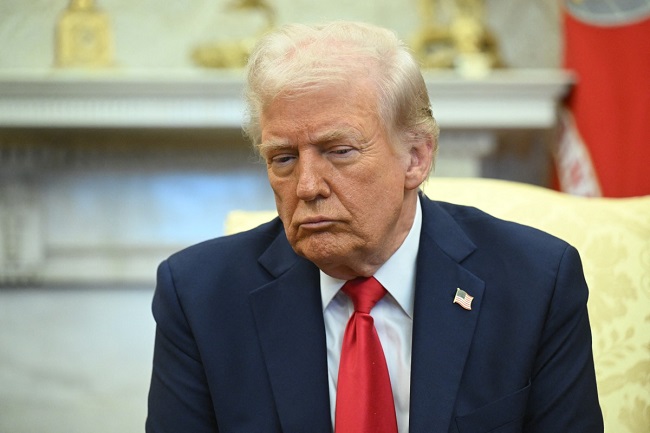
US President Donald Trump listens as he meets with Ukraine’s President Volodymyr Zelensky in the Oval Office of the White House in Washington, DC, February 28, 2025. Zelensky and Trump openly clashed in the White House on February 28 at a meeting where they were due to sign a deal on sharing Ukraine’s mineral riches and discuss a peace deal with Russia. “You’re not acting at all thankful. It’s not a nice thing,” Trump said. “It’s going to be very hard to do business like this,” he added. (Photo by SAUL LOEB / AFP)


Mounting trade wars between the United States and its largest economic partners deepened on Tuesday as US tariffs on Canada, Mexico and China kicked in, sparking swift retaliation from Beijing and Ottawa.

Stinging US tariffs on Canadian and Mexican goods came into effect as a deadline to avert President Donald Trump’s levies passed without the nations striking a deal — a move set to snarl supply chains.

Trade war fears sent markets falling in Asia and Europe on Tuesday in response to what analysts said were its steepest tariffs on imports since the 1940s.

Trump had announced — and then paused — the blanket 25 per cent tariffs on imports from major trading partners Canada and Mexico in February, accusing them of failing to stop illegal immigration and drug trafficking.

In pushing ahead with the duties, Trump cited a lack of progress in tackling the flow of drugs like fentanyl into the United States.

The duties stand to impact over $918 billion worth of US imports from both countries.

The sweeping duties on Canada and Mexico are set to snarl supply chains for key sectors like automobiles and construction materials, risking cost increases to households.

Mexico supplied 63 per cent of US vegetable imports and nearly half of US fruit and nut imports in 2023, according to the US Department of Agriculture.

More than 80 per cent of US avocados come from Mexico — meaning higher import costs could push up prices for American shoppers.

And the United States imports construction materials from Canada, too, meaning tariffs could drive up housing costs.

More than 70 per cent of imports of two key materials homebuilders need — softwood lumber and gypsum — come from Canada and Mexico, said National Association of Home Builders chairman Carl Harris.

– ‘Bitter end’ –

Trump also inked an order Monday to increase a previously imposed 10 per cent tariff on China to 20 per cent — piling atop existing levies on various Chinese goods.

Beijing condemned the “unilateral imposition of tariffs by the US” and swiftly retaliated, saying it would impose 10 and 15 per cent levies on a range of agricultural imports from the United States.

China’s tariffs will come into effect next week and will impact tens of billions of dollars in imports, from US soybeans to chickens.

Beijing’s foreign ministry vowed to fight a US trade war to the “bitter end.”

“The Chinese people will not be intimidated,” spokesman Lin Jian said.

And after Trump earlier announced tariffs on EU products would be 25 per cent, France’s Economy Minister Eric Lombard called for the European Union to reach a “balanced deal” with Washington.

Economists caution that tariffs could raise consumer prices while weighing on growth and employment.

The Tax Foundation estimates that before accounting for foreign retaliation, tariffs on Canada, Mexico and China this time would each cut US economic output by 0.1 per cent.

This could complicate Trump’s efforts to fulfil his campaign promises of lowering prices for Americans.

Former US officials see Trump’s tariffs over drugs like fentanyl as a means to tackle socio-economic problems — while providing legal justifications to move quickly.

Washington is also seeking leverage and to rebalance trade ties, analysts say.

But using emergency economic powers to impose tariffs on Canada, Mexico and China is a novel move, and could trigger lawsuits.

– US tariffs won’t ‘go unanswered’ –

Canadian Prime Minister Justin Trudeau on Monday pledged to impose retaliatory 25 percent tariffs on Washington, saying in a statement: “Canada will not let this unjustified decision go unanswered.”

Mexican President Claudia Sheinbaum said her country has contingency plans.

If Trump continues with his tariff plans, KPMG chief economist Diane Swonk warned ahead of them going into effect: “We could easily reach the highest effective tariff rate since 1936 by the beginning of 2026.”

Both consumers and manufacturers stand to bear the costs of additional tariffs, which could diminish demand and trigger layoffs as businesses try to keep costs under control, she told AFP.

Robert Dietz, chief economist at the National Association of Home Builders, told AFP the group expects a possible “combined duty tariff rate of above 50 per cent on Canadian lumber” as proposed duties add up.

Even as the United States also plans to expand forestry, Dietz said, prices will likely rise in the short run.



AFP

International News

US Wants Justice In The killing Of Pastor Dachomo’s 9 Family Members 

Published

on

Spread the love


The United States has condemned the killing of members of the family of Plateau-based cleric, Rev. Ezekiel Dachomo, describing the attack as horrific and urging Nigerian authorities to ensure those responsible are brought to justice.


In a statement shared on X on Thursday, the US Department of State’s Bureau of African Affairs expressed condolences to the victims’ families and called for stronger measures to prevent further attacks on vulnerable communities across Nigeria’s Middle Belt.

“The United States strongly condemns the horrific killing of members of Rev. Ezekiel Dachomo’s family in Plateau State, Nigeria. The continued violence targeting Christian communities and other vulnerable populations in Nigeria’s Middle Belt is deeply alarming,” the bureau said

The US said it had already engaged Nigerian officials on the worsening security situation, stressing that urgent action was needed to curb recurring attacks and hold perpetrators accountable.

“As I discussed last week with Nigerian officials, we must do more to prevent violent acts. The perpetrators must be held accountable, and urgent action is needed to strengthen security and protect Christians and other vulnerable communities,” the statement added.

The bureau reaffirmed Washington’s commitment to working with the Nigerian government to combat terrorism and violent extremism, stressing that Christians and other Nigerians should be able to practise their faith without fear of violence.

The statement followed the July 12 attack on Kum community in Riyom Local Government Area of Plateau State, where nine members of Rev. Dachomo’s extended family, including a two-month-old baby, were killed.

According to the cleric, the attackers, believed to be armed Fulani militias, asked for him by name before opening fire on his relatives.

Dachomo, who serves as Regional Chairman of the Church of Christ in Nations (COCIN) in Barkin Ladi Local Government Area, said his family had repeatedly been targeted because of his outspoken criticism of the violence in Plateau State.

He recalled that his grandmother and an uncle were also killed in previous attacks, adding that days after burying his relatives, he received a written death threat from the same group, warning that he would be their next target.

Continue Reading

International News

Nigeria Missing As Saudi Arabia Names African Countries Eligible For eVisa

Published

on

Spread the love


Saudi Arabia has updated its tourist eVisa programme for 2026, limiting eligibility in Africa to only three countries as part of its list of 66 nations whose citizens can apply through the Kingdom’s online visa platform.


The move leaves most African countries, including Nigeria, outside the simplified entry scheme.

The electronic visa allows eligible travellers to visit Saudi Arabia for tourism, leisure activities, family visits and Umrah, excluding the annual Hajj pilgrimage. Applications are completed online, eliminating the need for embassy visits and lengthy visa processing.

Saudi authorities said the eVisa forms part of ongoing efforts to expand tourism, attract international visitors and simplify travel procedures through a fully digital application system. The visa is available only to citizens of approved countries and territories listed on the Kingdom’s official tourism portal.

Below is the list of African countries eligible for Saudi Arabia’s eVisa.

1. Mauritius

2. Seychelles

3. South Africa

Continue Reading

International News

South Africa Says Over 53,000 Deported In Migration Campaign

Published

on

Spread the love


The South African government says more than 53,000 foreign nationals have been deported or repatriated since launching a “migration management” campaign five weeks ago.

Most were from Malawi, Zimbabwe, and Mozambique, officials say, and the number is likely to rise as repatriations and deportations continue.

South Africa is carrying out one of its biggest crackdowns on undocumented migrants in years, following weeks of anti-immigration protests that have seen violence, intimidation and looting.

Protesters have been demanding tighter border controls and mass deportations, accusing migrants of contributing to high unemployment, rising crime rates and collapse of public services.

The UN has warned against using migrants as scapegoats for South Africa’s socioeconomic challenges.

Anti-migrant activists have threatened to stage weekly protests to pressure the government until their demands are met, and there are fears the protests could turn violent.

The demonstrators had set an “unofficial deadline” of 30 June for all undocumented migrants to leave the country, which has seen many foreigners leave to escape violence and intimidation.

Several countries, including Ghana, Nigeria, Uganda and Kenya, have flown their citizens home in recent weeks.

Justice and Constitutional Development Minister Mmamoloko Kubayi announced on Sunday that 53,499 foreign nationals have been processed for deportation and repatriation, “which is dominated by the Malawians, followed by Zimbabweans and Mozambicans”.

“We are striving to achieve an orderly and regular migration which is mindful and sensitive to the concerns raised by our people, while observing human rights and dignity of all people in our country, irrespective of their citizenship and immigration status,” Kubayi told a news conference in Pretoria.

She said the repatriation and deportation process has helped them catch people who were wanted by the police for alleged criminal activity.

Authorities will continue to enforce its immigration laws, she added, but warned that protesters should not conduct unauthorised searches of homes and businesses that are suspected of sheltering undocumented migrants.

South Africa’s President Cyril Ramaphosa has acknowledged public concerns about immigration but has condemned attacks against migrants, warning citizens against taking the law into their own hands.

South Africa is the continent’s wealthiest nation and has long attracted migrants searching for better economic opportunities, some of whom enter the country illegally.

Continue Reading

Trending

Copyright © 2026 TheColumn NG