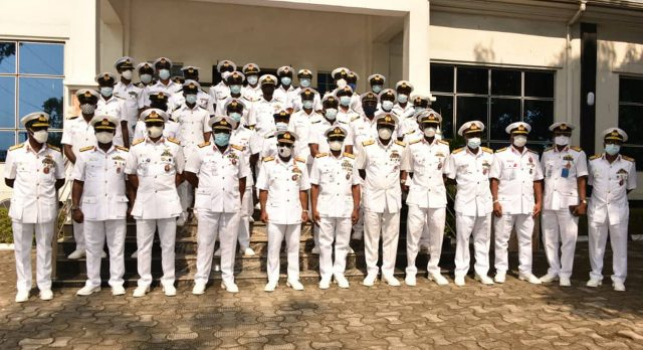
The Nigerian Navy has warned those involved in crude oil theft, sea piracy, unregulated fishing, and other crimes within the maritime environment to stay clear or face the law.
The Fleet Commander of Eastern Fleet and the officer in tactical command (OIC) for the exercise Sea Guard 2024, Rear Admiral Mohamed Moye said this shortly after the end of the exercise sea guard at the territorial borders on high sea at the military wing of the Onne Port in Rivers state on Monday.
Moye said the aim of exercise Sea Guard 2024 has been achieved and has given the Navy the opportunity to correct some lapses ahead of the upcoming Chief of Naval staff’s annual sea inspection.
It is the flag-off for Operation Sea Guard, an operation of the Nigerian Navy, and in his briefing, the Flag Officer Commanding Eastern Naval Command, Rear Admiral Saheed Akinwande explained the intentions behind the exercise.
According to him, the exercise is a collaboration between the Central and Eastern Naval Commands.
The Officer in Tactical Command, Rear Admiral Mohamed Muye told journalists during the event that sea piracy, unregulated fishing, oil theft, and other maritime offences within Nigeria’s territorial waters will be dealt with.
Admiral Muye further assured that all lapses observed during the exercise have been corrected pending the Navy’s next operation.
The exercise involved a total of about 10 warships, helicopters, Maritime Domain Awareness Assets and elements of the Nigerian Navy Special Boat Service exercising together in the Atlantic Ocean.
An Uber driver has been traced to his home after allegedly absconding with an iPhone 16 entrusted to him for delivery, following the cancellation of a trip midway in Lagos.
An X user, Ashake, who tweets as #Molayoo_, raised the alarm on Saturday, tagging Uber in her post with screenshots of the booking.
“Uber, one of your riders in Lagos, Nigeria, picked up a package(an iPhone 16) from Egbeda to be delivered to Ikeja, and he cancelled the ride midway, and he’s been unreachable ever since!
“His name is Augustine Adimabua. This is someone’s business, fgs! We need the package,” she wrote.
The situation escalated after the driver was reportedly tracked to his location.
Providing an update on Thursday, Ashake noted that the driver has been caught. She claimed that the driver sold the phone for N400,000.
“He has been caught and handed over to the right authorities. Thank you to every single one of you who made this possible.
“He sold iPhone 16 of over 1m, he sold it for 400k,” she wrote.
In the accompanying videos, the driver agreed that he collected the phone.
“I agree he gave me an iPhone 16, 256 GB, worth 1.2million naira”, he said
He, however, claimed that the phone had been stolen after being questioned about it.
“Where is the phone? Where is the iPhone 16?” one of the men queried.
“The phone was stolen”, he responded.
The confrontation quickly turned heated, with the driver being accused of dishonesty while appearing visibly uneasy, and a woman said to be his wife shocked by the situation.
The video has since gone viral, with individuals recalling personal experiences of stolen package deliveries and others condemning the act.
PUNCH reported in 2025 that delivery delays and thefts cost Nigeria’s logistics sector billions annually due to poor visibility and a lack of journey control systems.
Earlier in 2026, an investigation into Nigeria’s food delivery industry revealed a rise in food delivery theft, missing items and tampered packaging by dispatch riders, eroding customer trust in the fast-growing sector.
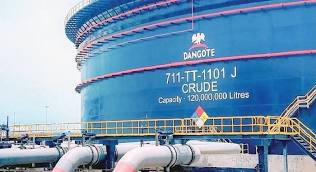
Africa’s richest man, Aliko Dangote, has announced plans to build a 650,000 barrels-per-day refinery in East Africa, mirroring the scale of his flagship facility in Nigeria, as part of a broader push to deepen industrial capacity across the continent.
Dangote made the disclosure at a high-level summit in Nairobi on Thursday, where African leaders, financiers, and industry stakeholders gathered to discuss the continent’s growing energy and infrastructure needs.
Addressing Presidents William Ruto and Yoweri Museveni, Dangote said the refinery project would depend on strong government backing and policy consistency.
“That’s why, as a group, we have now launched an initiative where, between now and 2030, we’re investing $40 billion in various fields,” he said
“Even now, I can give a commitment to the two presidents who are here that if they support the refinery, we will build an identical one to what we have in Nigeria—650,000 barrels.”
He emphasised that the proposal is still at an early stage but expressed confidence in its feasibility.
When asked about the feasibility of the project, the industrialist said it will “definitely” work, adding that “There’s nothing that can stop it.”
Push for Self-Sufficiency
Dangote is Africa’s richest man.
Dangote used the platform to argue that Africa must move away from its long-standing dependence on imports and instead build domestic industrial capacity.
“We export raw materials, which means when you export raw materials, you are exporting jobs, and when you import, you are importing poverty because you are creating jobs out there, not here on the continent,” he said.
He stressed that industrialisation—particularly in refining, fertiliser production and petrochemicals—is critical to reversing that trend and creating jobs on the continent.
The proposed East African refinery forms part of a wider $40 billion investment plan by his group between now and 2030, targeting key sectors that underpin economic transformation.
Backdrop of Growing Fuel Deficit
Dangote’s announcement comes as the Africa Finance Corporation (AFC) warned that the continent could face an 86 million tonne fuel shortfall by 2040.
According to the AFC report presented at the summit, Africa currently imports over 70 percent of its refined fuel and spends about $230 billion annually on essential imports, including fuel, food, and industrial goods.
The report projects that fuel import demand will rise from 74 million tonnes in 2023 to 86 million tonnes by 2040—equivalent to nearly three refineries the size of Dangote’s Lagos facility.
Leaders Call for Shift in Strategy
President William Ruto echoed Dangote’s position, warning that Africa must rethink its economic model.
“Our ambitions will remain unrealised if we continue to depend on external capital whose primary interest is securing raw materials,” Ruto said, adding: “We cannot continue to export raw materials and import finished products made from them.”
The summit also highlighted vulnerabilities in Africa’s energy systems, particularly exposure to global supply shocks and infrastructure gaps across the continent.
A Broader Industrial Vision
Beyond refining, Dangote pointed to ongoing efforts to scale fertiliser production and petrochemical capacity across Africa, including plans to expand urea output and establish blending plants in underserved regions.
“With the support of the government, there’s nothing that is impossible,” he said, expressing confidence that Africa can achieve self-sufficiency in key industrial inputs.
For Dangote, the refinery proposal represents a continuation of a larger vision—to reposition Africa from a net importer to a global industrial player.
“Let us not be scared… It is possible. Africans can do it,” he said.
As discussions continue, the proposed East Africa refinery could mark a significant step toward addressing the continent’s looming fuel deficit while advancing its long-term goal of economic independence.
The Federal Government of Nigeria has approved a sweeping increase in peculiar allowances and other welfare benefits for civil servants, in a move aimed at improving take-home pay and boosting morale across the public service.
The announcement was made on Friday by the Head of the Civil Service of the Federation, Didi Walson-Jack, during a press briefing in Abuja, where she outlined key reforms endorsed by the Federal Executive Council.
According to Walson-Jack, the review affects workers under both the Consolidated Public Service Salary Structure (CONPSS) and the Consolidated Research and Allied Institutions Salary Structure (CONRAISS), ensuring a broad-based impact across all cadres.
She said the revised peculiar allowances have been structured to reflect across all grade levels, resulting in a meaningful increase in earnings for both junior and senior officers.
In addition, the government approved an upward review of several key allowances, including duty tour allowance (DTA), estacode, and book allowance. Walson-Jack noted that virtually all allowances listed under the Public Service Rules have now been revised.
A major highlight of the reform is the approval of 100 percent Duty Tour Allowance for civil servants attending approved training programmes, regardless of whether travel is involved.
“Even if you are based in Abuja and attend training within Abuja, you are entitled to full DTA,” she said.
Beyond salary-related adjustments, the government also introduced a new exit benefit scheme for retiring civil servants under the Contributory Pension Scheme. The scheme provides 100 percent of a retiree’s total annual emoluments as an exit package, in addition to their pension, effective January 1, 2026.
Walson-Jack described the move as a step toward ensuring dignity in retirement, stressing that no public servant should leave service without adequate financial support.
The government also confirmed the operationalisation of the Employee Compensation Scheme, designed to provide financial protection for workers who suffer job-related injuries or death.
The reforms come amid growing calls from labour unions for improved welfare, as rising living costs continue to put pressure on workers. Analysts say the combined measures could significantly enhance financial stability for civil servants and improve overall productivity in the public sector.